Pagdandi Bookstore: Reclaiming the Joy of Physical Books
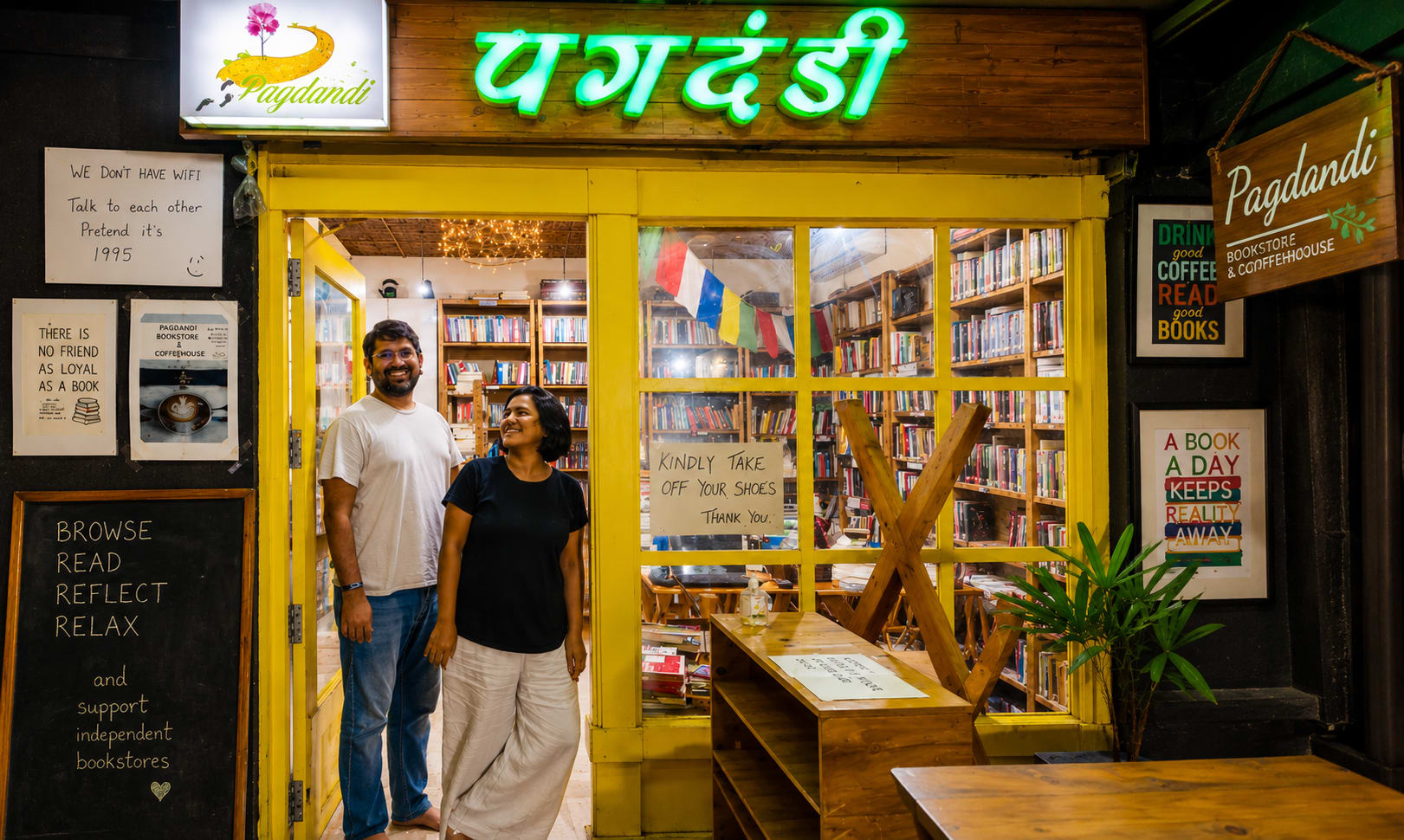
There is a growing assumption that reading is declining due to the proliferation of shorts, reels, and social media posts bombarding you every day. In the frantic pace of life, we often forget the slower pleasures of life, and reading could seem like a luxury afforded by a few, but that’s not true.
Pune has traditionally been a hotbed of cultural activities. Right from FTII to esteemed educational institutions, this city has a rich reading history documented through the libraries and bookstores it once housed in massive numbers. While the bookstores may have waned, with newer digital formats attracting audiences, some still preserve the legacy of such bookstores, and one of them is Pagdandi Bookstore and Coffeehouse.
Founded by Vishal Pipraiya and Neha Tiwari in 2013 as a lending library, Pagdandi has since evolved into a place loved by bibliophiles and coffee connoisseurs alike. It all started in 2010 when Vishal decided to quit his IT job and backpack through the country. He’d eventually meet Neha in 2011, who had left the confines of a media-based job as the corporate structure was too stifling for her. Less than a year after meeting, they decided to get married and move to Pune.
Escaping the Traditional Career Path:
Career choices for prior generations, who were not exposed to today's resources, were limited. One followed the formulaic educational paths such as engineering, medicine, and CA, but diverse passions still simmered beneath the surface. Its cliched to say that books had a big influence on any couple who runs a bookstore, but that’s exactly the case for Vishal and Neha.
The desire to share the impact of books with others birthed Pagdandi. Vishal recalls that there was pessimism around the business of books in 2013, owing to all the bookstores that had shut down.
Books are definitely not comparable to fast-growing tech or AI startups, and the potential for growth in such businesses is seldom present in a bookstore. While the growth trajectory may not mimic those of billion-dollar unicorns, Vishal believes that one can still sustain and earn a respectable livelihood in this space. Talking about his optimism for the industry, he says.
‘It’s a measured optimism, it's not an overenthusiastic optimism.’
Recommendations and the Love of Reading:
Despite everything, the joy of reading persists; the element of discovering new titles is what keeps the bookstore relevant.
The spark in his tone is evident when the conversation revolved around his favourite books. The Lord of the Rings by J.R.R Tolkien made it to the top of his recommendation list in fiction, followed by Siddhartha by Herman Hesse and Charlie Mackesy’s ‘The Boy, the Mole, the Fox and the Horse’.
In non-fiction, he recommends Atomic Habits by James Clear, The Psychology of Money by Morgan Housel and The Man Who Mistook His Wife for a Hat by Oliver Sacks.
Pagdandi is made unique by the people who run it. When visiting their bookstore, Vishal and Neha want you to discover something new, opening up a myriad of possibilities and worlds. Their curation of titles mirrors their taste, reflecting the store’s unique identity. He also believes that the books depend on the clientele that usually frequents them.
Overcoming the Setbacks:
Initially, the lending library had its own set of troubles, having to follow up with members to return titles. Additionally, the financial feasibility of running a bookstore is an omnipresent obstacle stuck in the back of the mind.
‘Can we justify the revenue for the space that is being dedicated to the books after paying rent and factoring in other operational costs?’
COVID was another big disruptor, forcing them to close the library, but it helped them focus more on the bookselling aspect. Despite all the odd challenges and setbacks, the thought of stopping or quitting never crossed Vishal and Neha’s minds.
Along with books, a love for coffee spurred them to start a coffee shop as well, selling bakery products, sandwiches, small snacks and speciality coffee. Their library has now been converted into a reading room, where people can simply sit and immerse themselves in their favourite book.
Independent bookstores worldwide have been growing after decades of predicted death. A deepening hunger for curated, human-mediated discovery in an age of algorithmic recommendations is what keeps Pagdandi and bookstores like it alive.