The Man Who Almost Went Bankrupt, Selling Water-Based Cooling: Achal Bakeri’s Remarkable Comeback with Symphony
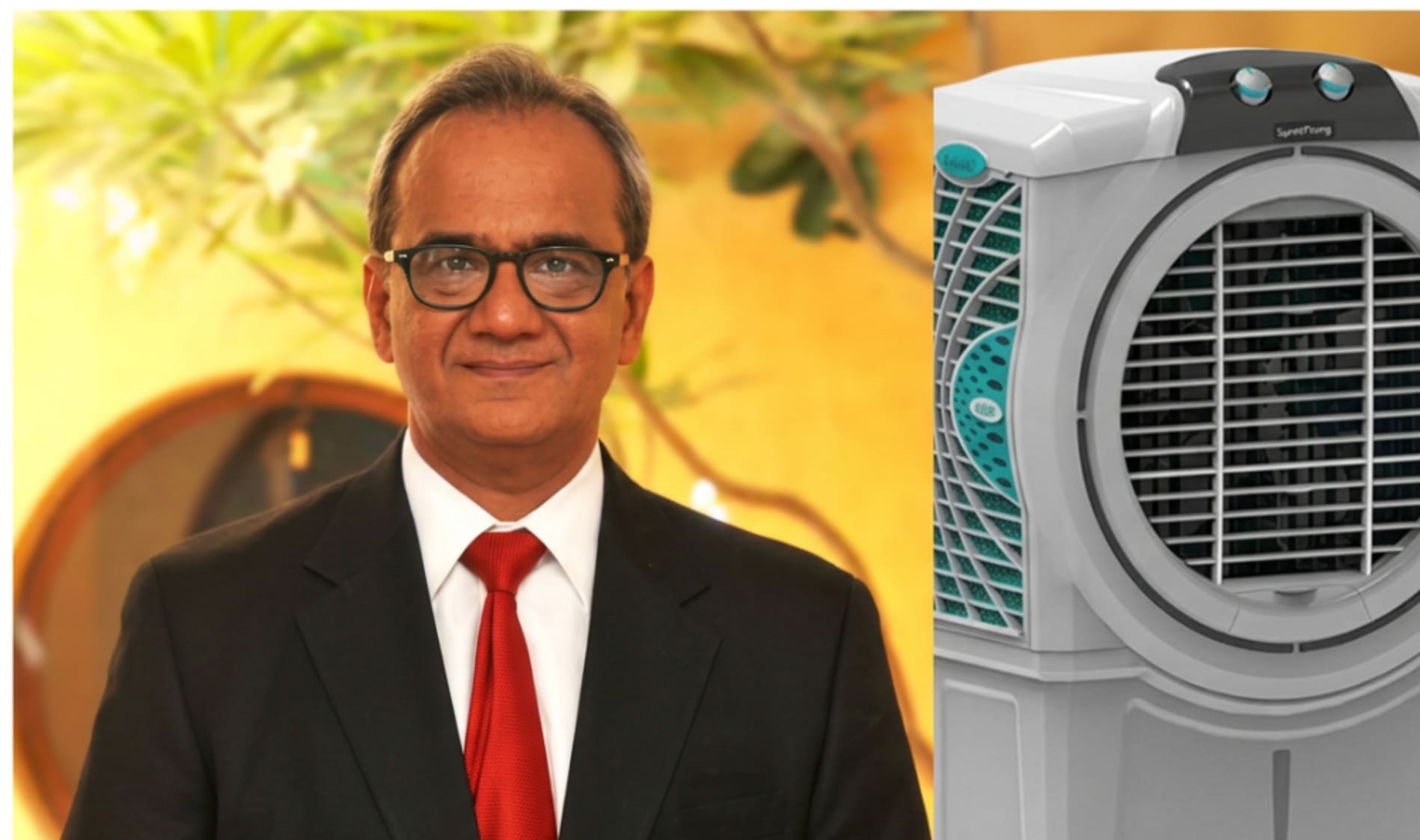
In the scorching summers of India, air coolers have long been a practical alternative to expensive air conditioners. But few know the dramatic story behind one of the world’s largest air cooler manufacturers. Achal Bakeri, founder of Symphony Limited, turned a simple idea into a global empire only to nearly lose everything through a classic founder mistake. His journey from near-bankruptcy to building a company with a market cap exceeding ₹6,000 crore and selling over 1.2 million units annually across 60 countries is a masterclass in resilience and focus.
Bakeri returned to Ahmedabad in 1987 after completing his MBA, initially planning to join his father’s real estate business. However, a problem in his own home sparked a new venture. Some rooms with high ceilings couldn’t be effectively air-conditioned, and existing air coolers were noisy, inefficient, and unattractive. His father’s casual suggestion, “Why don’t you make a better one?”—planted the seed.
In February 1988, Bakeri founded Symphony with ₹7 lakh in family seed capital. He personally designed the first model: a sleek, plastic-bodied cooler priced at ₹4,300, nearly double that of traditional metal coolers but far more affordable than an AC. He outsourced manufacturing and managed to sell the first batch of 1,000 units by the end of that summer in Ahmedabad.
The early years were spectacular. Sales grew from 7,000 units in 1989 to 21,000 the following year. By 1994, Symphony had listed on the Bombay Stock Exchange. Growth seemed inevitable.
The Costly Mistake of Diversification
Then came the turning point that almost ended the company. Like many successful founders, Bakeri fell into the trap of diversification. Once the core air cooler business gained traction, Symphony expanded aggressively into washing machines, water heaters, air conditioners, and exhaust fans.
The expansion diluted focus. R&D efforts scattered, quality suffered in the core category, and none of the new products gained meaningful traction. By 2001, Symphony was in deep trouble and filed for bankruptcy with the Board for Industrial and Financial Reconstruction (BIFR).
Bakeri later reflected on those difficult years: “We spent seven years digging a hole and then seven years getting out of it.” Despite having the family real estate business as a safety net, he chose not to walk away. Instead, he made the tough decision to shut down every product line except air coolers.
The Turnaround: Laser Focus and Global Ambition
This ruthless refocus became the foundation of Symphony’s eventual success. Bakeri doubled down on innovation in air coolers, improving design, efficiency, and aesthetics. More importantly, he shifted strategy from domestic expansion to international markets.
The global push paid off handsomely. In 2008, Symphony acquired a Mexican air cooler company, gaining a foothold in the Americas. By 2015, it acquired China’s largest air cooler manufacturer, significantly boosting production capacity and technological capabilities.
Today, Symphony is the world’s largest manufacturer of air coolers. The company sells over 1.2 million units annually across 60 countries. Its products are known for energy efficiency, modern design, and suitability for diverse climates, making them popular not just in India but in hot regions worldwide.
Key Lessons from Bakeri’s Journey
Bakeri’s story offers powerful insights for entrepreneurs:
The Diversification Trap: The instinct to expand into adjacent categories the moment one product succeeds is common but often deadly. Symphony’s near-collapse proved that depth beats breadth in the early-to-mid stages.
Resilience in Crisis: Bakeri could have easily pivoted to real estate. His decision to fight for the original vision during bankruptcy proceedings was pivotal.
Global Thinking: Instead of competing only in the crowded Indian market, Bakeri took Indian engineering excellence global through strategic acquisitions.
Focus on Core Strength: By returning to what Symphony did best innovative, affordable cooling solutions the company rebuilt its reputation and scaled sustainably.
Long-Term Vision: The seven years of “digging out” highlight that building a lasting company requires patience and endurance far beyond initial success.
Symphony’s transformation from a struggling domestic player to a global leader also reflects broader trends in Indian manufacturing. Companies that combine innovation, quality, and international ambition can compete effectively on the world stage.
Achal Bakeri’s journey is not just about building a successful company; it’s about the courage to admit mistakes, make painful corrections, and stay committed to the original mission. In an era where startups chase rapid diversification and quick exits, his story stands as a powerful reminder: sometimes the path to extraordinary success lies in going deeper into the one thing you do exceptionally well.
For aspiring entrepreneurs in India and beyond, Bakeri’s experience offers both caution and inspiration. Success often comes not from avoiding failure, but from how decisively one responds to it.