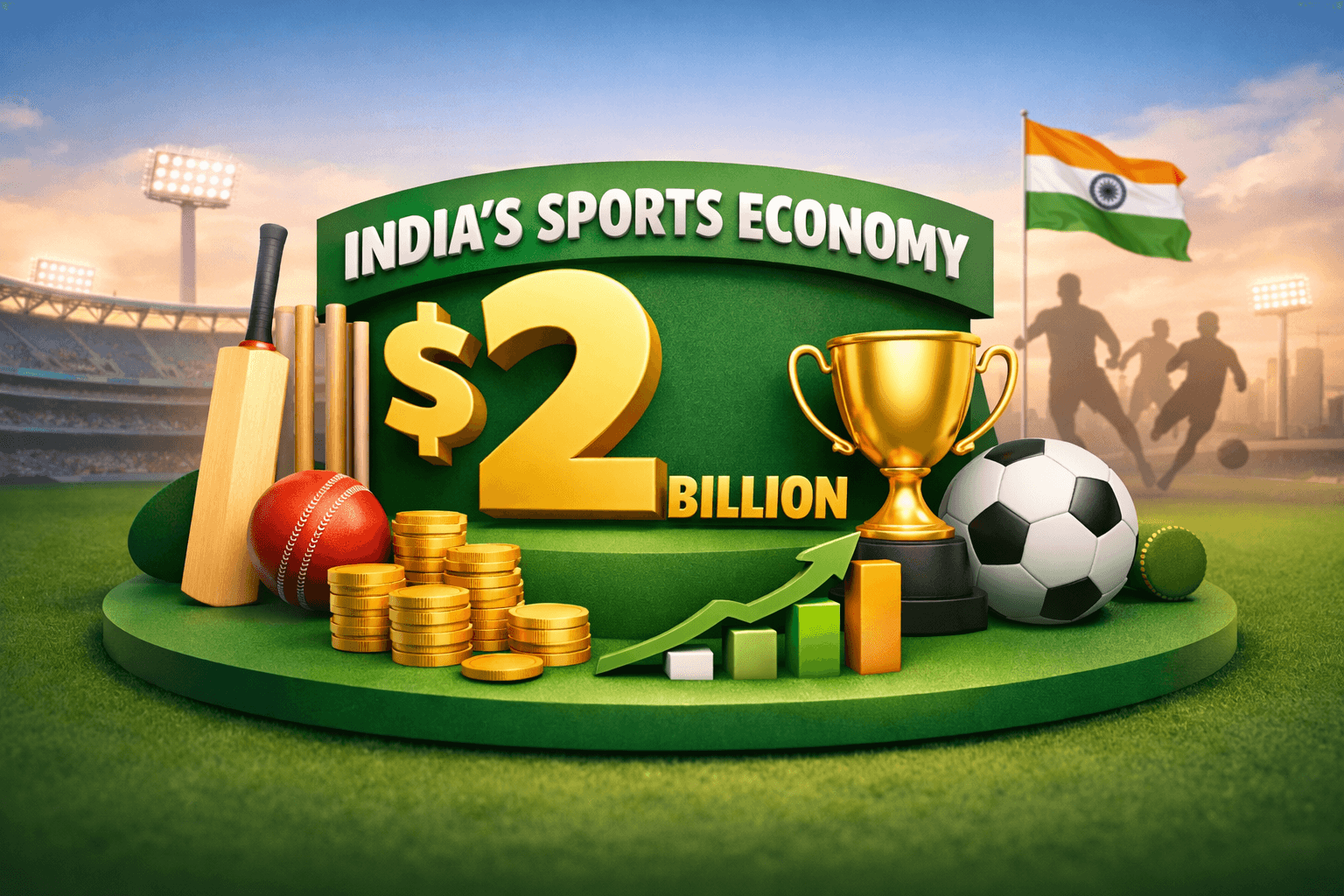
The sports economy of India has finally topped the 2 billion mark in history. The 13 th edition of the Sporting Nation report by WPP Media estimates the industry to reach Rs 18,864 crore (2.1 bn) by the year 2025, in increase compared to 16,633 crore in 2024, at the rate of 13.4% per annum. On paper that is a historic moment. A nation with a 1.4 billion population has finally emerged with a sports economy to match its aspirations or does it?
Three main pillars of revenue that are tracked by the WPP Media Sporting Nation report include sponsorship, media rights, and athlete endorsements. The rate of growth is also highly encouraging at 13.4% as compared to the nominal GDP growth in India which is approximately 10-11. It is also observed in the report that the ecosystem is becoming more mature with a greater range of revenue options, an investment in brand sustainability, and a transition to long-term brand-sport relationships in favor of short-term deals. That maturity is real. But it is very much concentrated in a single place.
The overbearing presence of IPL is an issue that no sincere discussion about the sports economy of India can be made without escalating into a discussion about the IPL. The Indian Premier League is not merely a leading sport in India, but it bends it completely out of proportion.
The media rights contract by IPL of the 2023-2027 cycle is estimated to be around Rs 48390 crore, or around Rs 9600 crore on average per season . It is only two months of that one tournament, which takes a huge portion of the whole sports media economy in India. Include franchise sponsorships, jersey offers, ground naming rights, and online partnerships and IPL itself consumes over fifty percent of the total amount brands in this country use on sport. Depending on industry calculations, it is always estimated that 80-85 percent of all or above sports sponsorship and media expenditure in India is in cricket. Much of the $2 billion achievement is, in its essence, a cricket achievement masquerading as a national sports saga.
It is not that IPL is so successful. The issue is that its popularity does not make other sports just as successful. It gives an illusion of a booming broad sports economy as kabaddi, football, hockey, athletics and dozens of other sports compete over the crumbs left behind.
Go outside the game of cricket, and the scene is altered completely. Pro Kabaddi League has cut a niche and collected real audiences but its media contracts and franchise values are still a quarter of IPL. The Indian Super League is never able to fill stadiums or even secure primetime broadcasts regardless of its years of corporate sponsorship. Football - a sport that has billions of fans across the world is still a marginal sport in India despite the high investment. Hockey the sport of historical icon in India and the modern time Olympic medalist, can only survive due to the institutional and government patronage. Business sponsorship is wafer-thin. There is a world-class talent in athletics, wrestling, boxing, and badminton - Neeraj Chopra, PV Sindhu, Nikhat Zareen, Vinesh Phogat - but this brings in a relatively small commercial ecosystem not necessarily linked to Olympic peak cycles. The approval market among other than cricketing athletes declines sharply beyond the top 1015 names. Even at the national level of Olympic sport, most athletes continue to rely largely on government plans such as TOPS as opposed to market earnings.
The behind-the- scenes truth of this headline number. India is also experiencing the national sports economy benchmark that is structurally a one-sport narrative.
Nonetheless, although there is the issue of concentration, the 13.4% growth is a reflection of real structural tailwinds which should be recognized. The concept of digital fragmentation has generated new types of inventory of sponsorship. Some of the ways by which brands can now activate are through team social media, player youtube channels, fantasy sports integrations, co-branding on OTT — formats that did not exist five years ago. The overall marketable sponsorship has truly increased. The franchise league concept has diversified business resources in disciplines. With Prime Volleyball League, Ultimate Table Tennis, and the re-packaged domestic hockey leagues, the new properties are entering the ecosystem and getting smaller yet actual brand investments. The emergence of D2C brands, nutrition brands and athleisure brands have introduced a whole new type of sports sponsors to the existing FMCG and telecom advertisers. These brands are starving on real sporting associations, and are ready to consider other areas outside cricket.
OTT and streaming platforms are also also cashing in on small-scale sports, which were formerly devoid of a broadcast home. The sporting events not worthy of free-to-air contracts now have a home digital platforms, where they can access advertising and subscription revenues, which cycled back into the ecosystem.
The amount of 2 billion dollars should also be put in global perspective. NFL is able to make revenues well over 20 billion US dollars each year - almost 10 times the sports economy of India. The English premier league alone earns approximately between 8-9 billion annually. The entire sports business in the US is beyond eighty billion every year. Even Australia, whose population is a hundred and eighty times less than India, has a similar sports economy. India with a population of 1.4 billion at 2.1 billion dollars is a sport economy of about $1.50 a person per year in per capita terms. The opportunity gap is astounding-- and that is why long term optimism over Indian sport can be made. There is gigantic growth potential. However, such a growth can only manifest itself in case the structural groundwork is established consciously.
The amount of 2 billion dollars should also be put in global perspective. NFL is able to make revenues well over 20 billion US dollars each year - almost 10 times the sports economy of India. The English premier league alone earns approximately between 8-9 billion annually. The entire sports business in the US is beyond eighty billion every year. Even Australia, whose population is a hundred and eighty times less than India, has a similar sports economy. India with a population of 1.4 billion at 2.1 billion dollars is a sport economy of about $1.50 a person per year in per capita terms. The opportunity gap is astounding-- and that is why long term optimism over Indian sport can be made. There is gigantic growth potential. However, such a growth can only manifest itself in case the structural groundwork is established consciously.
Rs 18,864 crore. $2.1 billion. 13.4% growth . These are real numbers representing real progress. But the honest version of this story is that India crossed a billion-dollar milestone largely on the strength of one sport and one league. The celebration is warranted. The complacency is not.
The milestone truly worth marking will come when India's sports economy hits $5 billion — and cricket accounts for only half of it. That day will mean India is genuinely a Sporting Nation. Until then, the number is impressive. The work has barely begun.
Visit Karostartup for more insights into the intersection of technology, policy, and the future of India.
Quick Share