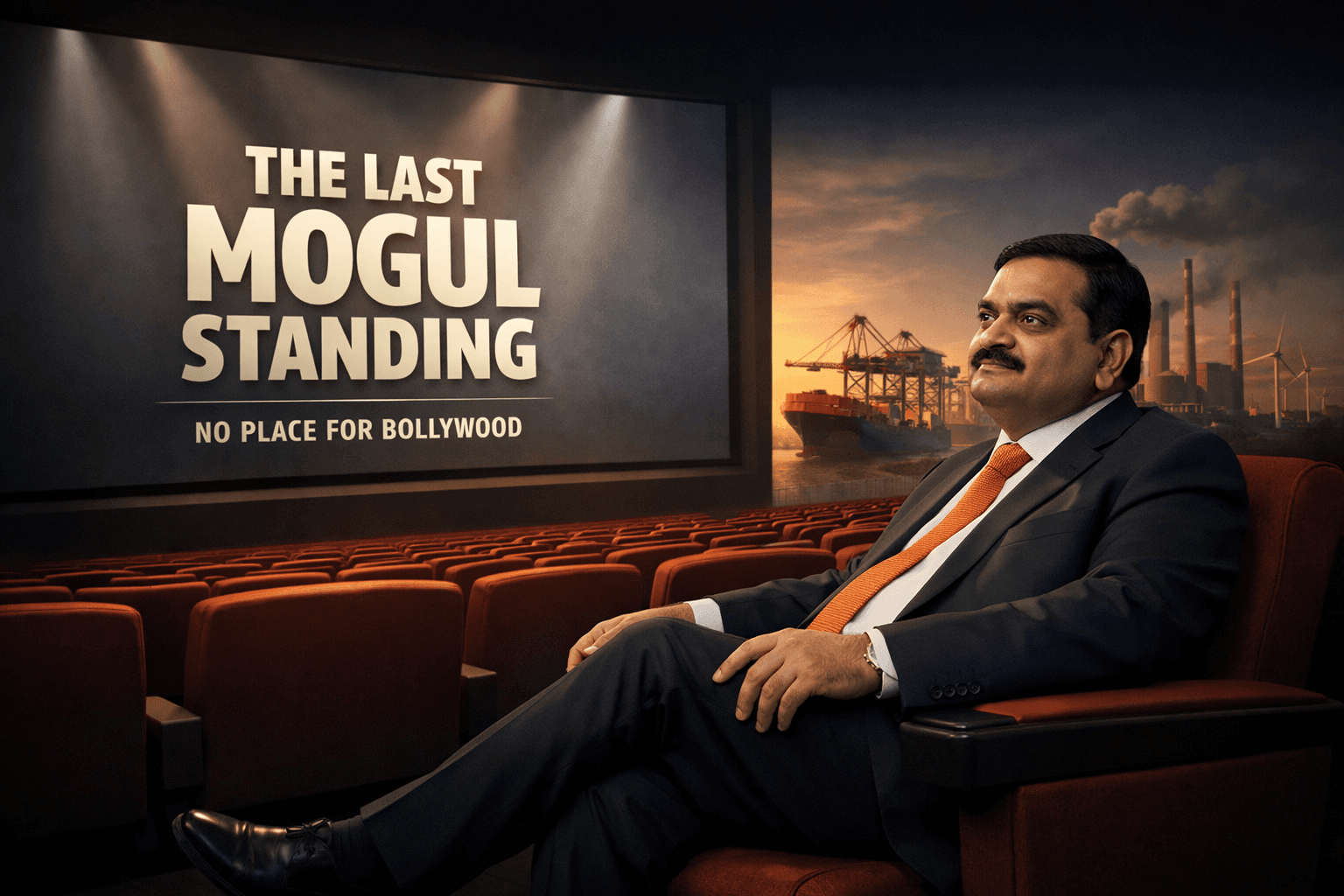
The corporate board rooms in India are becoming more and more film production offices. Dependable Industries, the long-established monarch of Indian conglomerates, has now firmly established its presence in the entertainment sector with its Jio Studios that have supported some of the largest Bollywood productions in recent times. The Birla Group, a customary brand of cement, textile and financial services, shocked the industry by opening Birla Studios, with the mandate of high-concept, prestige cinema. And in one of the most sensational moves of all vaccine billionaire Adar Poonawala picked up a 50 percent stake in the legendary Dharma Production of Karan Johar, putting severe institutional capital into one of the most famed creative institutions in Bollywood. However, amidst all this business stampede towards red carpet, there is one name that is not on the guest list at all: that of the Adani Group. In the case of a conglomerate which runs airports, ports, power plants, green energy infrastructure, data centres, defence manufacture and cement companies, the lack of entertainment is no accident. It is, all signs pointed otherwise, a voluntary and thought-out decision.
What makes Adani hesitant to get into Bollywood, it is important to first of all analyze what type of business Gautam Adani has created over the decades. At the basic level, the Adani Group is an infrastructure conglomerate. Its operations are capital-intensive, long-gestation and are heavily correlated with the priorities of national development its ports that move the cargo of the country, its airports that connect its cities, power plants that illuminate its houses and its green energy initiatives that are the hope of its future.
Entertainment on the other hand is a talent-driven, unpredictably creative business, where hits are the order of the day. The economy is quite different. A port will produce predictable and stable cash flows throughout decades. In a weekend, a film may lose hundreds of crores. To a group that is founded on the ideology of having control over important national infrastructure, the glamour of Bollywood, and the instability that comes with it, may not be very strategically valuable.
There is also a more subtle dimension to the Adani Group's absence from entertainment: the intense scrutiny the conglomerate already operates under. Following the Hindenburg Research report in early 2023 and the subsequent public and regulatory attention it attracted, the Adani Group has been focused almost entirely on consolidating its core businesses, strengthening its balance sheet, and rebuilding institutional investor confidence. Entering Bollywood at such a juncture would invite an entirely new layer of public attention — the kind that comes with film controversies, star disputes, and the notoriously unpredictable world of creative content. For a group that is already navigating complex geopolitical and regulatory headwinds, adding the media and entertainment sector's unique set of risks would appear to offer little upside.
India's other conglomerates have found entertainment attractive for specific strategic reasons. Reliance's entry through Jio Studios made perfect sense — it was a content play designed to drive subscribers to its Jio digital ecosystem, bundling movies and shows with telecom services in a strategy borrowed directly from the Netflix and Amazon playbook. Content, for Reliance, is not an end in itself. It is a tool to sell data and deepen consumer stickiness. The Birla Group's foray through Birla Studios appears to be a brand-building exercise — an attempt to associate the 130-year-old industrial house with modern, aspirational Indian culture. Poonawalla's Dharma deal, meanwhile, looks like a classic private equity-style investment in a trophy asset with strong IP and brand value. None of these motivations map neatly onto the Adani Group's strategic architecture. Adani does not have a consumer-facing digital platform that needs content. It is not a legacy brand seeking cultural reinvention. And its investment philosophy has historically favoured hard assets over intellectual property.
It is also worth noting that the Adani Group is not entirely absent from the broader media landscape. Its acquisition of NDTV — one of India's most prominent news television networks — marked a significant, if controversial, entry into media. That move, however, was about news and information, not entertainment. It aligned more closely with the group's interest in strategic influence and national narrative than with the business of making films and web series. In that sense, Adani has already made its media bet. It simply chose news over Nawabs, debates over drama, and prime time over premiere night.
In order to penetrate into entertainment, industry observers say that Adani would require an obvious infrastructure play - perhaps, the ownership of cinema exhibition chains, film city complex, or extensive studio real estate. These would be investments which pay a regular dividend, can be used as physical infrastructure, and are not at the mercy of directors and actors.
Interestingly, with the modernisation of India film production infrastructure, which is taking shape with the world state of art studio facilities, post-production centers as well as film cities, there may come a point where the Adani model would fit in.
For now, while Bollywood's opening credits increasingly read like a who's who of Indian big business, Adani remains in the audience, not behind the camera. In a landscape where every major conglomerate is chasing the content economy, that restraint is itself a statement one that reflects a group that knows precisely what kind of empire it is building, and what kind it is not.
Whether that changes in the years ahead will depend not on Bollywood's allure, but on whether entertainment can ever be made to feel like infrastructure.
And in the world of Gautam Adani, if it cannot be built like a port or powered like a plant — it may simply not be worth the investment.
Quick Share