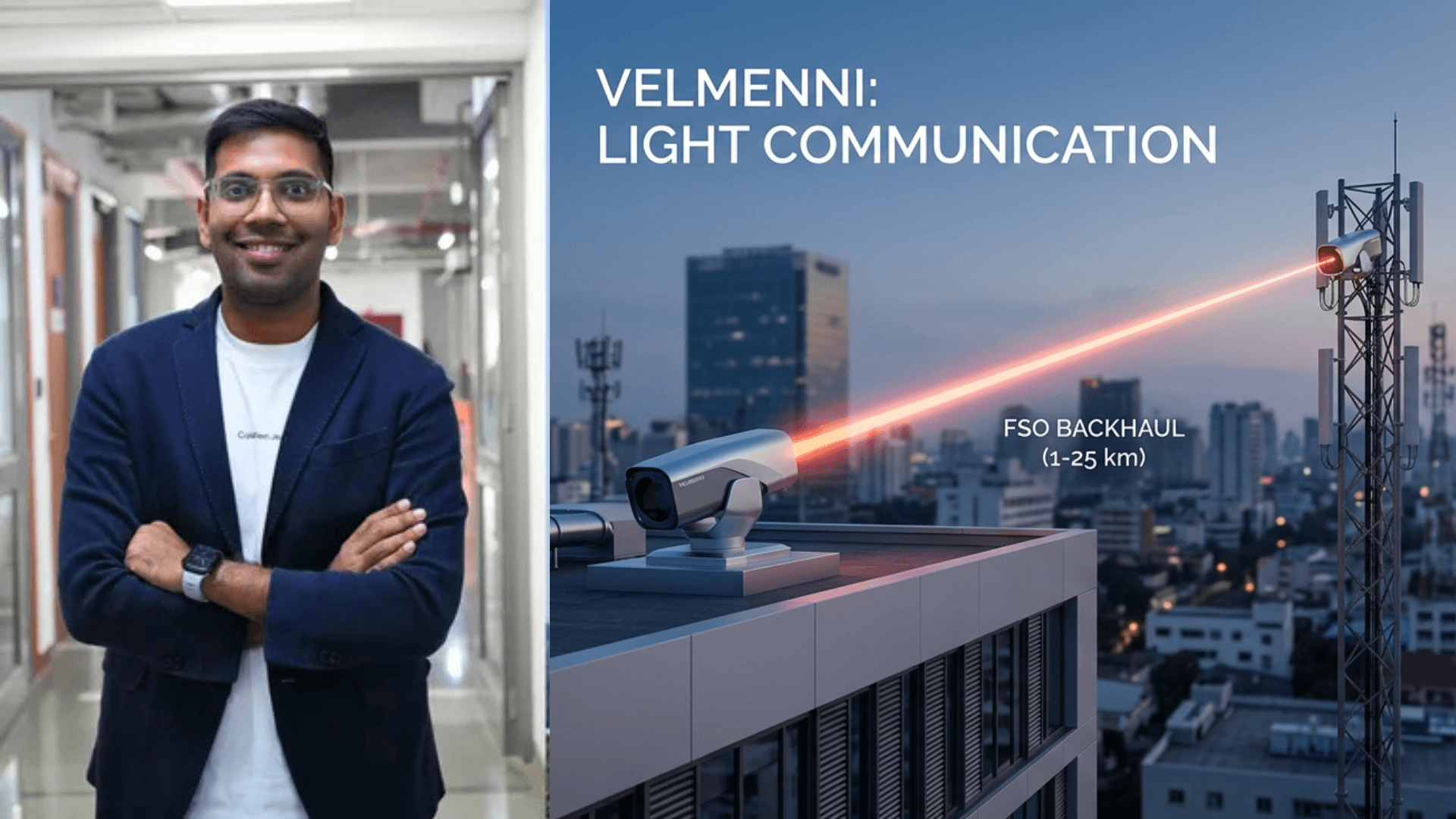
Delhi based startup Velmenni has raised a Pre-Series A funding round of Rs 30 crore (about USD 3.3 million) in a major move for both the deep tech and telecommunications ecosystem in India. The round attracted the attention of the round leader, pi Ventures, and such investors as MountTech Growth Fund-Kavachh and Apekso . The new capital will be the driving force of the new stage of the company development as it plans to introduce its light-based futuristic wireless communication systems to telecom networks, defence facilities, and enterprise clients globally. This most recent round is a big vote of confidence on a company that has been over ten years in transforming laboratory science into the real-world applications. It is another major milestone of the Delhi based company that had previously raised Rs 30 crore during a seed funding round , and had been granted approximately Rs 7 crore by the Department of Telecommunications via programmes like the Telecom Technology Development Fund, and also by the programme of Innovations to Defence Excellence run by the Ministry of defence.
Velmenni is a company based in 2014 that was founded by Deepak Solanki , and is dedicated to developing light-based wireless communication systems that provide secure and high-capacity wireless communication systems to telecom operators, defense systems, and corporate networks. Throughout a period of over ten years the company has progressively established itself as a leader in optical wireless communication, which is only now starting to be taken seriously as a commercial category in the global market place. The core of the offering by Velmenni lies in a reconsideration of the way information moves in the air. With the growing number of data consumption straining the already limited radio frequency spectrum, the solution proposed by Velmenni employs light and laser-based optical links to transmit data, removing the expensive requirement of spectrum licensing and heavy cable plant infrastructure, and providing secure and interference-free connectivity.
The two fundamental patented technologies in the company include Free Space Optics (FSO) and Light Fidelity (Li-Fi). Li-Fi spectrum is thousands of times wider than radio frequency spectrum with greater density of data, speed and protection against interference. FSO, in its turn, achieves high bandwidth data transmission over long distances by employing laser beams, which travel through the open air.
The fact that Velmenni is being raised when he is is not accidental. India has built the second largest 5G base in the world since its introduction in 2022 having 40 crore subscribers as of early 2026, and the It has 4.69 lakh base stations and has a heavy dependence on the technology in terms of connectivity. Nevertheless, alongside this growth, there are still enormous cover gaps particularly in last mile connectivity in large cities, remote areas, and strategic infrastructure points. Deepak Solanki, the Founder and CEO of Velmenni, put the opportunity in the right perspective. Velmenni seeks a compromise between fiber that is not fast enough to deploy, RF that is too prone to interference to rely on and communication in the licensed band that is too costly to justify a shorter reach. The solution to this challenge by his company is a one hundred percent indigenous solution. According to Solanki, the system at the company is capable of providing better than 10 Gbps of connection over a distance of 1 km to 25 km to provide an option to dense urban telecom networks and strategic defence targets. The system is also configured to work in any type of weather which is a very important consideration in any technology which is to be used to substitute fibre or radio linkage in operational activities.
The reason why Velmenni is not like other deep-tech startups is that its technology is not just on paper. The startup boasts of over 50 deployments in India, Southeast Asia, and with Tier-1 mobile network operators in the United States, as well as several pilot projects. Among its most successful performances is in Odisha. The company has also implemented carrier grade FSO backhaul links in India in a private 5G network in a thermal power plant with 99.999% availability exceeding 18 months under tropical weather conditions. This is a high degree of reliability which is sustained in the harsh conditions of the heat and humidity of the Indian coastline and a strong argument to skeptics why optical wireless links cannot be used to be reliable beyond controlled conditions. The same is true on the defence front. Velmenni has also won a multi-million dollar contract in the Indian defence industry with its specialised FSO solution, which will be implemented on the Indian submarines to provide the Indian ships with connectivity in harbour conditions. It is the adaptability of the company technology that is unique as seen in the light-based communication usage in submarine environments where radio waves are not feasible and where physical cables are not convenient.
One of the ongoing fears in optical wireless communication has been that it is easily affected by environmental interference. Atmospheric turbulence, rain, fog, and dust have traditionally led to the poor quality and reliability of links. Velmenni explains that it has overcome this issue by means of engineering innovation. The company has invented adaptative optics and first of its kind multicarrier adaptive modulation of FSO to ensure that the poor weather conditions like rain and fog does not affect the link. stability and yet remaining with the desired availability. Solanki also noted that such an innovation reduces the overall cost of ownership of communication service providers as well as the cost per bit is reduced and the business case of adoption is even greater. The firm has also developed a strong intellectual property. Velmenni has patented internationally and has had institutional support in the form of grants by the Department of Telecommunications and three grants by the ministry of defence. This proprietary technology coupled with government backing and practical deployments provides the firm with a high moat over its competitors.
The Delhi-based startup indicated that the new capital will be used to speed up the commercialisation of its FSO and Li-Fi technologies, create bespoke applications with its technology to defence and enterprise applications and enter global markets. Regulatory Velmenni has already received CE certification of its products, and claimed it would be granted FCC clearance, which would open the US market to the startup, already having partnerships with Tier-1 mobile network operators. An evident thesis is supported by strong global aspirations of the company. With telecom operators everywhere in the world scrambling to densify their networks to 5G and beyond, the importance of flexible, low-cost, and fast-to-deploy backhaul solution has never been more critical. This is exactly what Velmenni technology fulfils and especially in urban corridors where laying new fibre is a slow, costly and logistically challenging task.
The primary investor in this round was a firm believer in the direction that Velmenni is taking. Shubham Sandeep, Partner at Pi Ventures, stated that pi Ventures is solving a hard problem at the confluence of communications and infrastructure and has already proven to be able to take a new technology and apply it to real-world commercial implementations. He believed that Velmenni is in a good position to grow optical wireless communication across the globe and serve the increasing demand of worldwide secure and high capacity connectivity. The involvement of MountTech Growth Fund-Kavachh and Apekso, as well as the involvement of pi Ventures, indicates a larger institutional acceptance that light-based wireless communication is no longer an esoteric academic and intellectual activity, but a business category and strategically important technology category.
Velmenni's journey from a research-driven startup in 2014 to a company with defence contracts, international deployments, and institutional investors is a story of patient, methodical execution in one of the most technically demanding fields in deep tech. With Rs 30 crore in fresh capital, government backing, a growing customer base, and a technology that performs where fibre and radio frequency systems struggle, the company appears well positioned for its next phase of growth.
With this funding, Velmenni plans to expand its presence in international markets, while continuing to build customised solutions for defence and enterprise use cases. As global demand for secure, high-capacity connectivity grows, Velmenni is positioning itself at the forefront of the next wave of wireless communication, powered not by radio waves, but by light.
Visit Karostartup for more insights into the intersection of technology, policy, and the future of India.
Quick Share