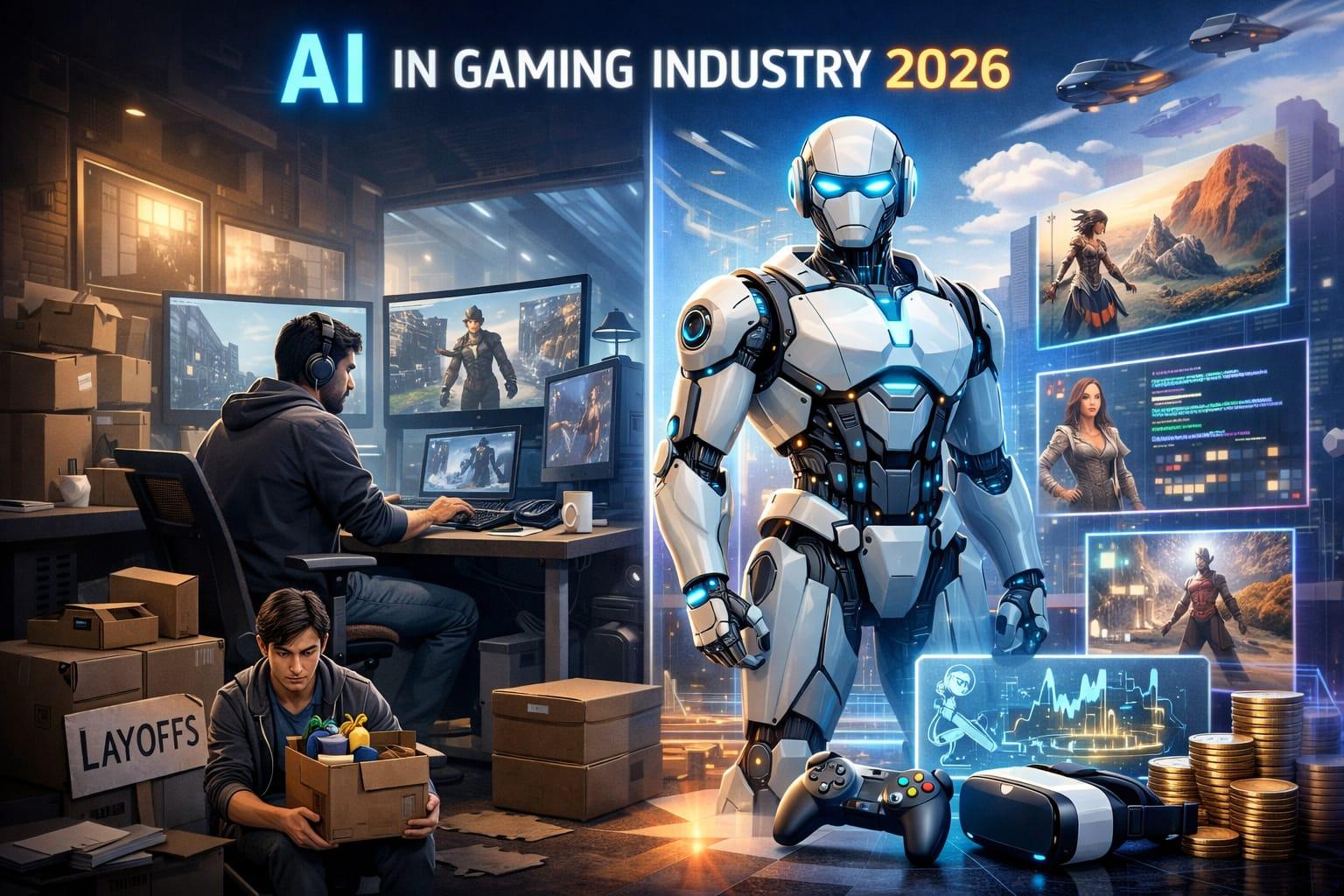
Imagine you have been in a developer's room for three years, building a game from scratch. A small team, crores of rupees, hundreds of hours of motion capture, voice recording, and bug testing. Meanwhile, the same game was built in just eight months by a solo developer. Sounds too unreal, but that’s what is happening in 2026. Things are moving so fast that people can build things in a blink. AI is taking over developers’ jobs and making tasks much simpler.
One day, you are sipping coffee, and AI enters like a close friend who accompanies you during breaks and becomes your lifeline. AI slowly approached the window. Initially, it cleaned up motion capture data faster than humans. Then, it began generating background textures and gradually started writing NPC dialogues. It ran overnight QA tests and began taking over parts of the gaming industry before developers even realised how AI was making tasks easier and replacing jobs. AI is not a tool anymore , that developers used to use. It has become the foundation of it in today’s world. 90% of the game developers have AI somewhere in the workflow 97% of the developers. Use it for acid creation and Half of all the Studios are building within its production pipeline right now. One and three games realised on Steam in 2026 officially disclose AI-generated content and 30% of the RPG dialogue is now written by AI. This is not what future stats are, this is what is happening today right now when you are sipping your coffee.
India is home to 59 crore gamers, accounting for 20% of the global gaming population. The country hosts 1,900 gaming companies employing 1.3 lakh skilled professionals. Most of the players in India do not come from Metro city tier two or tier three cities. Today The Indian gaming market has crossed 33 thousand crore by the year 2024. And in 2026, it is about to cross ₹. 10,487 crore with a growing rate of 24% per year. And it is estimated that by 2029. India’s gaming market can unlock ₹5,43,816 crore in investor value and create over 20 lakh new jobs. It seems that the opportunity in the gaming market is enormous, but only if the foundation and the ecosystem are built right. Nearly 30% of the Indian gamers already engage in gaming supported by ads or making an app purchase with the average spending of ₹1,610 per paying user annually. The foundation is already there. The players are present, the studios are operating, and the money is moving. AI is no longer sitting in the corner. It is sitting in the middle of all of this and deciding what gets built, who builds it, smaller teams, faster production cycles, lower costs per game and how fast it can reach 59 crore players. For a market growing this fast, that is either the biggest opportunity Indian gaming has ever seen or the moment it starts building on a foundation that leaves its own workforce behind.
In the past, adapting the difficulty of a game meant picking between easy and hard levels at the start and not thinking about it again. Now, with the help of AI, games can adjust in real time as you play. The AI can change how enemies act, the complexity of puzzles, and even the pacing based on how well you're doing. This innovative approach has led to a 20 % increase in how long players stick with a game, and 18 % fewer people quit within the first thirty minutes. Non-playable characters, or NPCs, have also seen a major upgrade. Gone are the days when they would just repeat the same phrases, forget about the heroic deeds they performed, or stand frozen in place for hours. A surprising 70 % of players say they would engage more with these characters if they actually remembered previous conversations, and AI is slowly bringing that to life.
On the financial side, the costs associated with gaming have decreased significantly. Setups that used to require investments of 1.5 to 2 lakh rupees now operate smoothly on systems costing less than 70,000 rupees. NVIDIA’s DLSS 3 technology boosts performance by up to four times on the same hardware, making high-end gaming accessible to more people than ever before. Moreover, AI is helping to combat toxic behaviour in gaming. Thanks to AI detection systems, incidents of negative behaviour have dropped by 40 %. Remarkably, 85 % of player support issues are now resolved automatically, without the need for human intervention. All of this adds up to a bright future for gamers, making their experiences richer and more enjoyable.
The people building these games, the picture is more complicated for them. Genuinely the productivity has gone up and is significantly reflected in the developers’ report. That is 10 to 30% coding efficiency on average. Repetitive tasks like fixing bug documentation and acid cleaner now take about 30 to 60% lesser time 40% of the studio's overall output jumps by more than 20% and 25% cut by the cost on a similar margin. 95% of the developers say AI is reducing repetitive tasks, and helping them to be more creative and strategic at work such as playing, tasting, balancing localisation code generation, which are all faster than before.
In India, specifically, 92% of the developers can find the comfort of using AI tools and 58% say they benefit from the output. The average game developer in India earns Rs 6 to 12 lakh a year. Studios that use AI need fewer developers for every three now, we need only one developer Unity’s CEO stated that 5 to 10 times productivity has been boosted after AI has been integrated by the developersThat is not gradual progress. That is the entire equation changing. But here is the uncomfortable flip side.
Generative AI use among game developers actually dropped from 36% in 2025 to 29% in 2026. And 47% of developers say AI could negatively affect game quality. Only 11% believe it will improve. The tools are more powerful than ever. The trust is not keeping up. The efficiency gains are real. But they come with a cost the industry is only beginning to reckon with.
The tools that enable experienced developers to code faster are making it a lot more difficult for novices. As recently as October 2023, junior developer jobs had a 59% chance of being targeted by AI. QA testing, usually an entry-level entry point into gaming, has a 70% risk factor. It’s higher for 3D artists at 75%. It’s troubling that the avenues for training the next generation of game makers are waning at a time when interest in entering the field is expanding. Other than that in India, over 1.5 million engineering graduates come into the job market every year and an increasing number of them have a passion for gaming. And the entry-level jobs that would traditionally take them are vanishing the fastest. Around the world, 74% of game design students report feeling job-hunting anxiety ahead of graduation compared with34% for other fields, research shows. Likewise, 87% of educators are either seeing this decline up close or preparing for it. The industry makes fewer roles for beginners than ever, but we need to keep in mind that that’s happening at the same time, there have never been more calls for those roles.
AI can most readily replace the roles that are disappearing the fastest. AI is producing results that are comparable to those of 3D artists who have spent years perfecting their character modelling techniques in a matter of minutes. Nowadays, voice actors must contend with artificial voices that can 95% accurately mimic human delivery. Procedural tools can complete the same tasks in a fraction of the time for level designers, who used to spend weeks creating environments by hand. 28% of game developers worldwide have lost their jobs in the last two years. Nearly half of those who lost their jobs haven't found new ones, which is concerning. The figures show that 8,549 jobs were eliminated in 2022, 10,466 in 2023, and 14,651 in 2024. In January 2026 alone, 900 more jobs vanished before the month was out. Alongside these numbers, the industry's mood has changed. Just 18% of developers believed AI was detrimental to gaming in 2022; by 2023, that percentage had risen to 30%, and it is currently at 52%. The people who use this technology directly are most worried about its potential effects.
The global market for AI in gaming was valued at about Rs 48,000 crore in 2024 and is projected to swell to Rs 3.1 lakh crore by 2034. In India, the market is expanding at an impressive rate of 28% annually, with 570 million active players, meaning this shift will be felt more prominently than elsewhere. The framework is already in place, and the investment has already begun. We can't go back now. Games are getting better and better for players, and tools are getting sharper for experienced developers. But for the new generation that wants to get into the business, the way has never been so narrow.
The gaming industry has created a culture that says anyone can play, but the people who are shaping the future are making it much harder for new players to help build those worlds. The world has changed, and sadly, not everyone gets a second chance.
Visit Karostartup for more insights into the intersection of technology, policy, and the future of India.
Quick Share