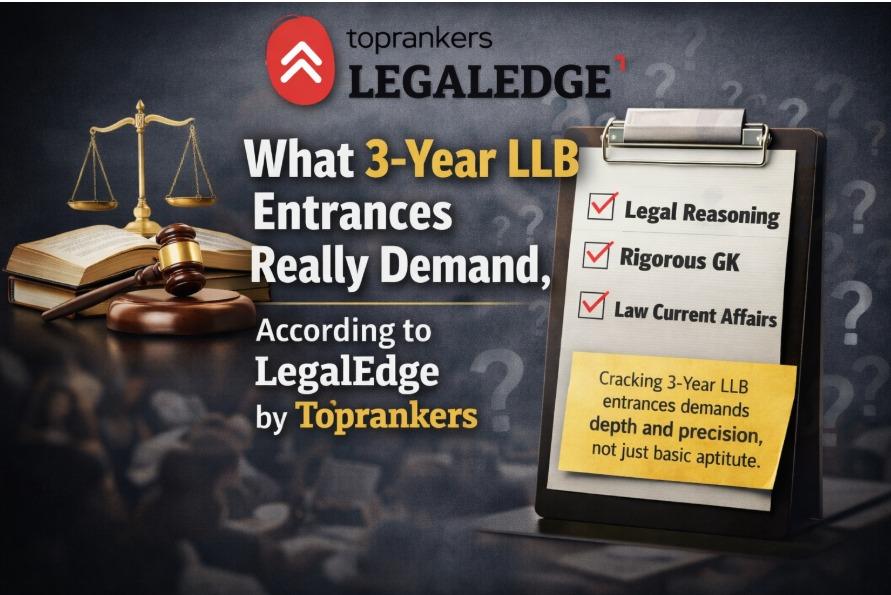
The 3-year LLB route is increasingly attracting graduates and working professionals who want a second, stronger career track. Yet the biggest mistake aspirants make is treating these entrances as “easy GK papers” or as tests that only reward memorisation.
In reality, most 3-year LLB entrances are built to measure law-readiness, meaning your ability to read, reason, and apply rules to real-life situations at speed.
LegalEdge , which works closely with graduate and working-professional aspirants across multiple 3-year LLB pathways, says the paper is less about what you know and more about how you think under time pressure. “If you can read accurately, structure your reasoning, and stay calm while attempting questions, you are already ahead,” Harsh Gagrani , Co-founder, Toprankers , quotes.
This is the most common query from first-time aspirants, and the answer is surprisingly consistent across exams.
Most 3-year LLB tests include principle-based questions. You are given a legal principle, then a short fact scenario, then you pick the best application. This checks issue spotting, clarity of logic, and discipline in applying a rule. For example, MH CET Law includes a dedicated “Legal Aptitude and Legal Reasoning” section in its 3-year paper structure.
This is where many working professionals do well because it rewards pattern recognition and decision-making, not rote theory. In MH CET Law, “Logical and Analytical Reasoning” is explicitly a separate section, indicating that argument evaluation and structured reasoning are central to scoring.
These exams are reading-intensive . In MH CET Law’s 3-year pattern, English carries substantial weightage, signalling that comprehension, vocabulary, and usage directly impact rank.
For aspirants returning to studies after a gap through an online/offline law entrance preparation , this becomes a decisive differentiator.
GK in 3-year LLB entrances is not only static facts. It often blends current affairs with awareness of institutions, governance, and social issues. MH CET Law lists GK with Current Affairs as a core section.
PU LLB’s exam pattern also includes current affairs and GK as a key area, alongside legal aptitude and reasoning.
For CUET LLB, the syllabus overview commonly includes language comprehension, general awareness, computer basics, and general aptitude with logical reasoning.
This indicates that some 3-year LLB routes also test fundamental test-taking aptitude beyond purely “law-themed” sections.
LegalEdge emphasises that the format itself is part of the test. The exam is not only about knowing topics but about managing time and maintaining accuracy over the full paper.
Consider MH CET Law. The pattern is computer-based, with 120 questions in 2 hours, and the referenced pattern states there is no negative marking.
That changes behaviour. It rewards candidates who can maintain pace and attempt more questions without fear of penalty.
Now compare PU LLB, the exam pattern described on TopRankers states 100 questions in 90 minutes with negative marking of 0.25 for an incorrect answer.
This makes intelligent selection vital. Over-attempting without control can reduce your score.
For CUET LLB, widely circulated syllabus and pattern overviews indicate 75 questions as part of the paper structure.
Even when the question count is lower, the breadth of sections demands balanced preparation.
For working professionals, preparation constraints are usually predictable: limited daily time, irregular schedules, and mental fatigue after work. The good news is that the exam’s core skills can be trained in short, repeatable blocks.
LegalEdge recommends building preparation around three anchors.
Do short, timed comprehension sets. Focus on accuracy first, then speed. Since English is heavily represented in MH CET Law and also relevant for other entrances, it becomes a consistent ROI activity.
Do daily application-based questions. The goal is to stop guessing and start following a repeatable method: read the principle, underline conditions, map facts, eliminate options. This directly aligns with legal reasoning formats used in major tests like MH CET Law.
Instead of chasing daily news endlessly, compile weekly notes. Focus on national developments, major international updates, governance, courts, rights-related issues, and landmark institutional changes. This matches how GK with current affairs is positioned as a scoring area.
LegalEdge describes a high-scoring candidate as someone who can separate inference from opinion. This shows up most clearly in legal reasoning, where the best option is the one that fits the given rule and stated facts, not the option that sounds morally satisfying.
The same discipline applies to negative-marking exams. In PU LLB’s pattern, the presence of negative marking pushes aspirants to develop risk control and smarter elimination.
This is why mock-based analysis becomes essential, especially for working professionals who cannot afford unstructured trial-and-error.
3-year LLB entrances are not designed to reward legal jargon or prior law study. They are designed to reward reading discipline, structured reasoning, awareness of the world, and smart time management. Once aspirants understand this, preparation becomes simpler and more predictable.
LegalEdge reiterates that the fastest improvements often come from fixing process mistakes: reading too fast, ignoring the principle conditions, guessing in negative marking, and skipping revision cycles for GK. With a structured plan, graduates and working professionals can convert limited time into consistent score gains.
LegalEdge supports law aspirants with structured preparation frameworks aligned to major entrance patterns, skill diagnosis through practice and mocks, and targeted improvement plans for working professionals and graduates who need efficient, high-impact study routines.
Quick Share

New Delhi [India], May 2: Amid growing global concerns over a widening employment gap, a new economic framework has been proposed to address what experts warn could become one of the most pressing...

Recognised for Scale, Consistency, and Operational Excellence Across India Mumbai, April 2026 — Tattva Wellness Spa, one of India’s leading wellness brands, has been awarded the Best Spa Chain (Audit...

In the midst of Goa’s transition toward smart electricity metering, a new and thoughtful voice has emerge. One that seeks not to oppose, but to understand. Francis Coelho , a global Goan and an...