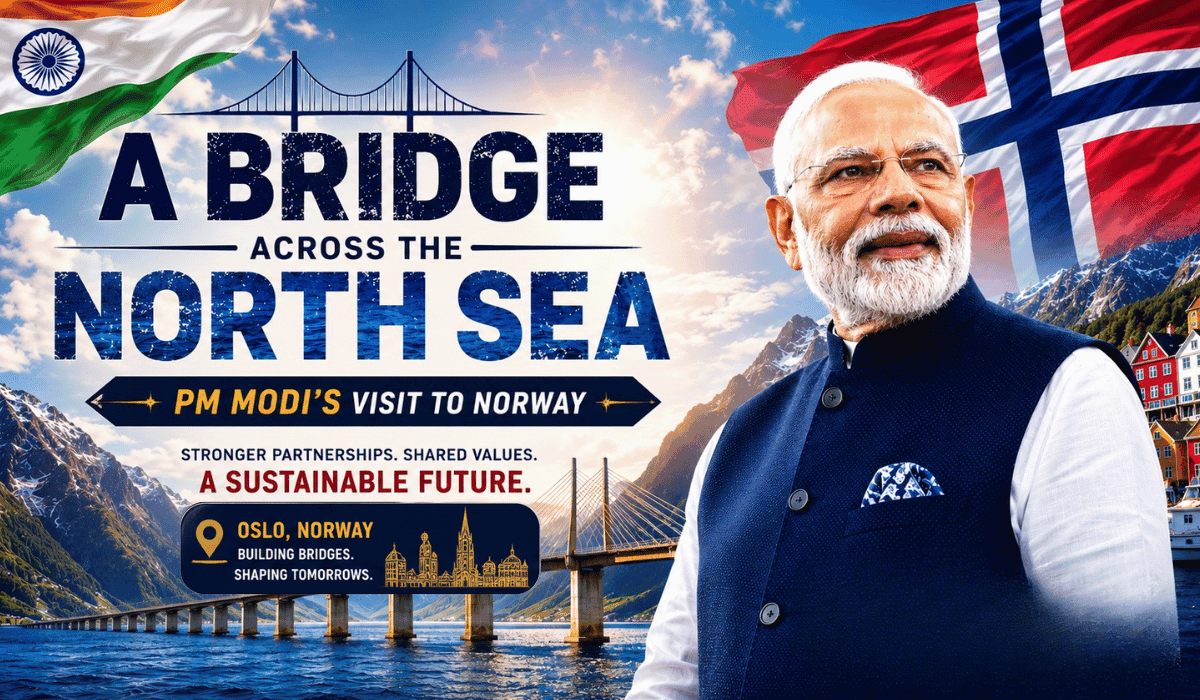
For the first time in four decades, an Indian prime minister has set foot in Norway. What looks like a diplomatic courtesy call is, in fact, a carefully choreographed recalibration of India's strategic posture in Northern Europe.
When Prime Minister Narendra Modi touched down in Oslo on Monday, he carried with him more than a diplomatic itinerary. His two-day visit to Norway, the first by an Indian head of government since 1983, signals something considerably larger: a strategic pivot toward the Nordic world at a moment when global trade architectures are being remade and India's ambitions demand new partnerships.
The centrepiece of the visit is the 3rd India-Nordic Summit, convening on May 19 in Oslo, where Modi will sit alongside the prime ministers of Norway, Denmark, Finland, Iceland, and Sweden. Previous summits were held in Stockholm in 2018 and Copenhagen in 2022, but this edition carries a sharper edge — shaped by a shifting multipolar order, a newly operative India-EFTA Trade and Economic Partnership Agreement (TEPA), and the growing urgency of clean technology, AI, and green transition as defining axes of inter-state competition.
$19B: India-Nordic bilateral trade in 2024
$28B: Norway's GPFG investment in Indian markets
43 yrs: Since last Indian PM visit to Norway
The business community on both sides has greeted the visit with barely concealed enthusiasm. Atle Brynestad, Owner, Chairman, and CEO of Hadeland Glassverk, who has engaged commercially with India for over four decades, spoke plainly about the moment's significance.
"India is an amazing place. I have been doing business with India for more than 40 years. The cooperation between India and Norway is growing, and it's absolutely a big, big future for cooperation."
— Atle Brynestad, Owner, Chairman & CEO, Hadeland Glassverk
Such sentiments are echoed across sectors. At the Norway-India Business and Research Summit, convened on the sidelines of Modi's bilateral with Norwegian Prime Minister Jonas Gahr Støre, industry leaders have zeroed in on three convergence points: sustainability, digital technology, and startup ecosystems.
"This particular summit will provide a good opportunity for both sides' startups to collaborate in technologies, in education, in skill development and towards sustainability."
On the startup front, industry voices have been particularly vocal. Representatives have pointed to India's third-largest startup ecosystem in the world as a natural complement to Nordic innovation culture. India's emerging strengths in artificial intelligence, robotics, and deep-tech, they argue, pair well with Scandinavia's established expertise in clean-tech, maritime innovation, and advanced manufacturing.
"India will play a very big and significant role in the years to come because now in the coming times we need to adopt many new technologies."
— Industry representative on India-Nordic startup cooperation, speaking to ANI
Norwegian Prime Minister Jonas Gahr Støre, who will host Modi for bilateral talks and a joint meeting with business representatives, has framed the visit in explicitly geopolitical terms. "India plays a central role on climate, technology, trade and international security," Støre said ahead of the summit. "This visit underlines the importance of cooperation with India, Norway and the Nordic countries in these times of global instability. We stand together in promoting international cooperation and a rules-based world order."
That last phrase, a rules-based world order, is deliberately loaded. As great-power competition strains multilateral institutions, middle and major powers are quietly consolidating new groupings. India and the Nordic five have found, in each other, partners who share commitments to democratic governance, open trade, and climate action, while remaining outside the sharpest edges of bloc rivalry.
The India-EFTA TEPA, which entered into force on October 1, 2025 marking India's first free trade agreement with a bloc of developed European economies provides the structural undergirding. Combined with the anticipated India-EU FTA and India-EFTA TEPA implications for supply chain resilience, Oslo is becoming a waystation on a larger diplomatic corridor.
Less visible but equally significant is the science diplomacy embedded in the visit. ISRO antennas at Norway's Svalbard archipelago became operational in 2026, enhancing India's polar satellite data capabilities. India's Himadri research station in the Arctic has hosted more than 400 scientists since 2008. Norwegian tunnelling expertise is being deployed in India's Char Dham railway project in the Himalayas. These are not decorative details, they represent a latticework of interdependence that takes years to construct and would be costly to unwind.
As India asserts itself as a consequential global actor, Nordic countries, long oriented toward the North Atlantic are recalibrating toward New Delhi on issues ranging from maritime security to Arctic governance. The summit is expected to yield concrete announcements on green transition, critical minerals, and people-to-people ties.
For business leaders watching from Mumbai, Bengaluru, and Oslo alike, the message is unambiguous: the India-Nordic chapter is no longer a footnote in either country's foreign policy. It has, over four decades of diplomatic hibernation, quietly become essential.
Quick Share