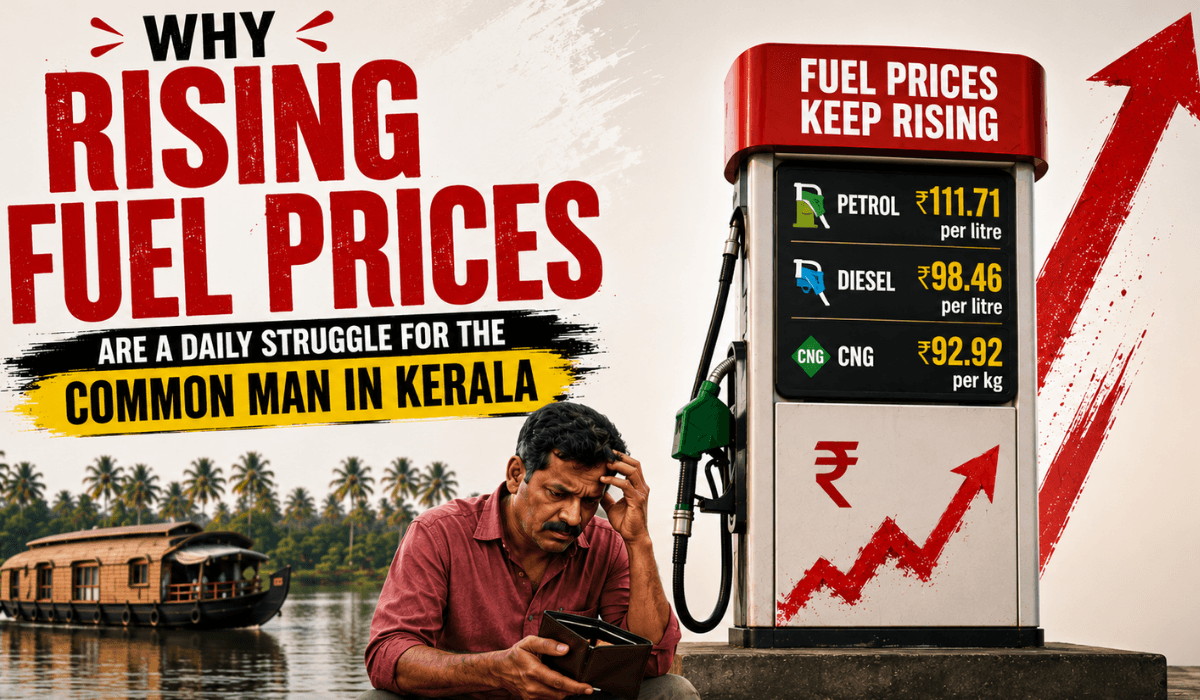
Fuel prices in Kerala are once again a topic that cannot stop people from talking about. Not in news studios or government offices, but at tea shops, inside autos, on WhatsApp groups, and at petrol pumps where someone stares at the meter and quietly does the math in their head. For daily commuters, delivery riders, and middle-class families already managing tight budgets, every small increase in petrol and diesel rates is not a number on a screen. It is a decision. Do I take the bike or skip the trip? Do I fill a full tank or just put in two hundred rupees and see how far it gets me? That calculation is now part of daily life for a large number of people in Kerala.
The short answer is that India imports most of its crude oil from other countries. So when global oil prices go up, the cost comes home with them. Refining, transportation, and distribution add to that. And then come the taxes, both central and state, which sit on top of the base price and make the final number at the pump significantly higher than what the crude oil market alone would suggest. Kerala, in particular, has always had high fuel taxes compared to several other states. That is not a new problem. But when international prices rise, and taxes stay where they are, the person standing at the pump feels it from both sides at once.
Ask a delivery rider in Kochi how much he spends on petrol every month, and the number will surprise you. For someone covering 80 to 100 kilometres a day across orders, fuel is not an expense. It is the difference between a profitable day and a day where the earnings barely cover the cost of running the bike. Auto drivers and taxi operators are in a similar situation. Their fares have not gone up proportionally with fuel costs. Raising fares means fewer passengers. Not raising them means working more hours for the same or less money. There is no clean solution there. For office-goers commuting long distances every day, the monthly fuel bill has quietly become one of the bigger line items in the household budget. Not dramatic enough to cause panic, but steady enough to be noticed every single month.
And then there is the indirect impact that most people do not immediately connect to fuel prices. When diesel gets expensive, transportation costs go up for everyone moving goods. That includes vegetables reaching the local market, groceries being restocked at the nearby store, and materials being delivered to construction sites. A portion of that extra cost always finds its way to the end price. So even people who do not own a vehicle end up paying for fuel price increases, just through their grocery bills and daily expenses instead of at the pump.
The frustration is not just about the money. It is about the pattern. Salaries in Kerala, for most working people, do not move the way prices do. Rent has gone up. Electricity bills have gone up. School fees have gone up. Groceries cost more than they did two years ago. And every few months, fuel joins the list of things that quietly became more expensive while income stayed mostly the same. People are not asking for petrol to be free. They are just tired of watching every basic expense inch upward while their capacity to absorb those increases stays flat. That specific exhaustion is what comes out in conversations at petrol pumps and in the comment sections of local news pages. It is less about any single price hike and more about what that hike represents in a longer, ongoing pattern.
Kerala is not a state where you can easily replace private transport with a quick metro ride or a reliable bus network on every corner. For a large portion of the population, especially in smaller towns and rural areas, a two-wheeler is not a convenience. It is the only practical option for getting to work, reaching a hospital, or picking up a child from school. That dependence on road transport means fuel price changes ripple through more sectors here than in states with stronger public transport infrastructure. Tourism takes a hit when travel costs go up. Local businesses that depend on delivery feel it. Farmers moving produce to markets feel it. The informal economy, which is large and deeply connected to transportation in Kerala, absorbs a significant amount of this pressure without much cushion.
The honest concern is not just about today's rates. It is about where things are heading. A lot of younger people who are just starting out, managing rent in a city, paying off an education loan, or trying to save for something, are already doing a careful version of financial juggling every month. Fuel being unpredictable is one more variable in a calculation that already has too many variables.
This is partly why electric vehicles are slowly becoming a genuine conversation in Kerala rather than just a future concept. Not because everyone is suddenly convinced, but because people are genuinely trying to find ways to step off the fuel price treadmill. The infrastructure is still catching up, and the upfront cost is still a barrier for many. But the interest is real, and it is coming from a practical place, not just environmental enthusiasm. For now, though, most people fill their tanks, note the amount, and get back to the day. Because what else is there to do?
The petrol pump was once just a stop on the way somewhere. For a lot of people in Kerala right now, it has become a small moment of stress built into an already demanding routine.
Quick Share