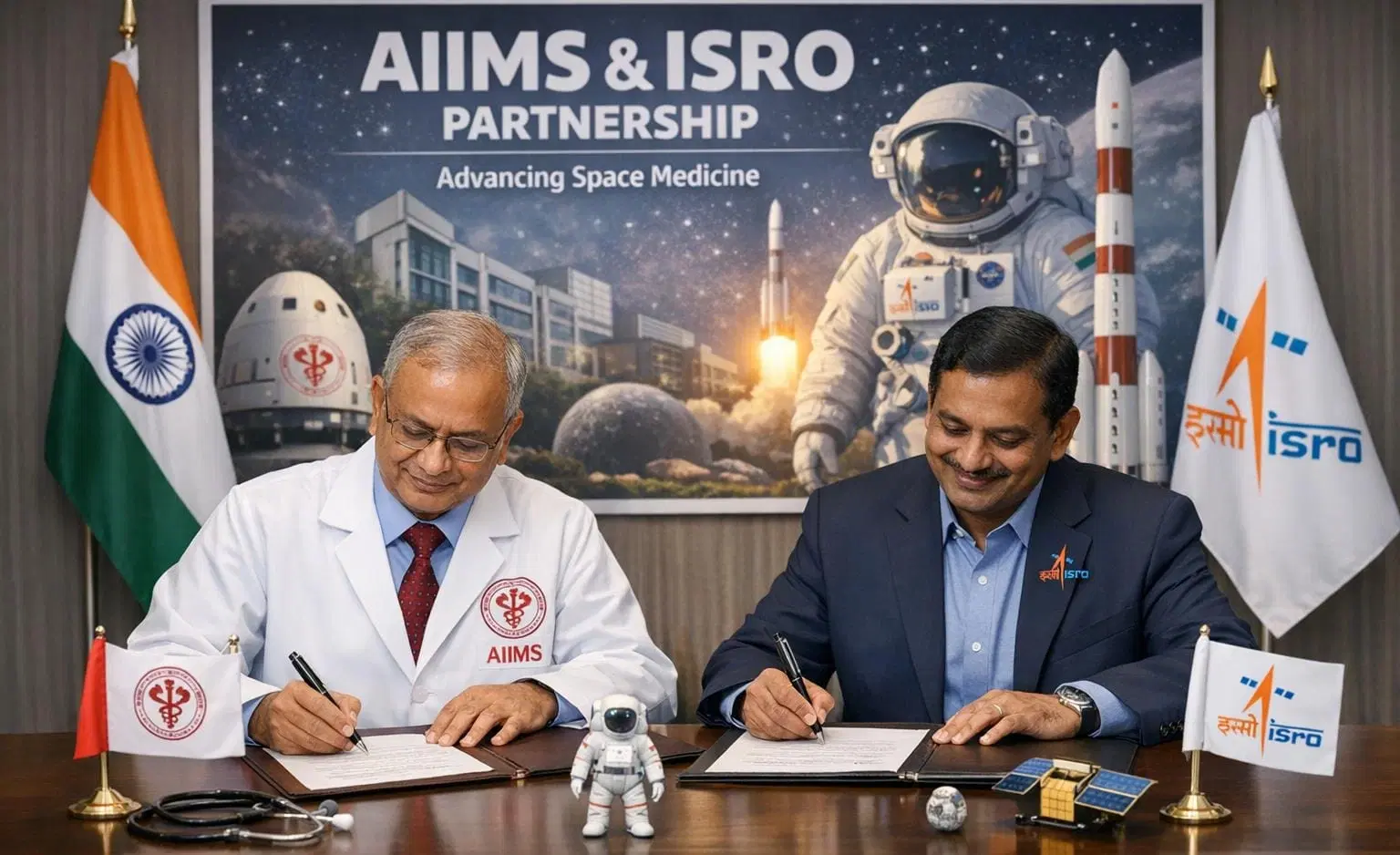
In a historic move as far as the expanding space programme in India was concerned, the All India Institute of Medical Sciences (AIIMS), Delhi, and the Indian Space Research Organisation (ISRO) have officially signed a long-term partnership accord with a view to establishing strong space medicine infrastructure to enhance the ambitious human spaceflight missions in the country. The cooperation is a major step in the history of India as a nation turning into a major spacefaring country having the greatest medical institution of the country hosting the national space agency on the same platform with cohesive scientific mission.
The collaboration was concluded by signing a ceremony with high-level officials of both organisations, where the representatives of the Ministry of Health and Family Welfare and the Department of Space were present, which indicated the high-level institutional support at the highest levels of government.
The breadth of the collaboration is large, covering practically all key physiological and psychological aspects of the human health when in the space environment. According to the officials of both institutions, the joint research agenda was said to be one of the most extensive medical-space collaboration in Asia, and it can lead to the position of India as a leader in space medicine research globally. It is an agreement that details the coordinated research, capacity building, clinical training, as well as technology development to a number of key areas that deal with a different set of issues human beings encounter when they take the risk of traveling outside the protective environment of the earth.
The research of the human physiology and cardiovascular health of people under the conditions of microgravity is one of the highest-priority research areas. The lack of the gravity changes the functioning of the human cardiovascular system fundamentally. No longer held in the mass of the lower part of the body by the force of gravity, blood and fluid are again, during, in relation to the head and upper part of the torso, subject to unusual exertions on the heart and blood-vessels, and on the autonomic nervous system, which controls involuntary effects in the body, such as the heartbeat and blood pressure. The applicants are AIIMS cardiologists and physiologists who will collaborate with ISRO biomedical engineers to study the impacts of such shifts on cardiac output, arterial stiffness and risk of orthostatic intolerance, or dizziness or fainting when astronauts resume gravity following the long missions. It is hoped that the results of the study may directly influence health monitoring tools and countermeasures that would be used among the Indian astronauts in future spacecraft and orbital platforms.
The other key pillar of the cooperation is that of musculoskeletal atrophy and bone density loss that are two of the most reported and severe physiological effects of extended spaceflight. Without gravity, the human body quickly becomes deficient of the mechanical loading of muscles and bones which makes them strong. Long-duration missions can result in astronauts losing their bone mineral density as well muscle mass in a percentage that is extremely dangerous to cause fractures and worsen physical functionality during missions as well as on Earth. The cross-disciplinary team will research various countermeasures, such as specially-designed exercise plans involving the use of resistance and aerobic equipment used in spacecraft, specialized nutritional plans high in calcium, vitamin D, and protein, and pharmacological countermeasures that can help to reduce bone resorption rate. This is aimed at coming up with India-specific, evidence-based guidelines that can be incorporated in mission planning and astronaut training to programmes like the Gaganyaan flagship crewed spaceflight mission, to the Moon or even further, in case of any future long-duration missions.
The partnership also places significant emphasis on neuroscience and neurophysiology, reflecting growing international recognition that the brain and nervous system are profoundly affected by the space environment. Exposure to microgravity, combined with radiation, disrupted circadian rhythms, and the psychological stresses of isolation and confinement, can alter brain structure, impair cognitive performance, disturb spatial orientation, and affect neural signalling pathways. For mission-critical operations where astronauts must make rapid, high-stakes decisions in emergencies the integrity of cognitive function is non-negotiable. AIIMS neurologists, psychiatrists, and neuroscientists will collaborate with ISRO to study these changes using advanced neuroimaging, cognitive testing, and electrophysiological tools. Research outcomes are expected to feed into astronaut selection criteria, in-flight monitoring systems, and cognitive support tools that can help sustain sharp mental performance across the arc of a mission.
It has been long known that space travel suppresses the immune system and disturbs the gut microbiome - the complex ecosystem of bacteria that can inhabit the human digestive system and takes center stage in immunity and metabolism, as well as even in mood regulation. In the orbit, astronauts are at a high risk of infection and inflammatory diseases, which are only aggravated by the fact that medical intervention is drastically restricted when they are out of the Earth. The AIIMS-ISRO partnership will implement the latest immunological and microbiome research techniques to chart the effects of spaceflight on these systems on the molecular- and cellular-levels, and to devise the interventions of probiotics, dietary changes, and immunomodulatory therapies that can be used to safeguard the health of astronauts during space missions. This study is especially applicable given that India is considering missions that last a long period that will subject the crew to the space environment.
Other than the direct research plan; the partnership will also be aimed at establishing long term institutional capacity. It is planned to create special space medicine training modules of physicians and researchers in AIIMS, develop a joint monitoring and research centre, and train telemedicine protocols that will be able to assist in monitoring the health of astronauts in real-time missions with the help of medical centres on the ground. According to senior officials of ISRO, the joint venture with AIIMS is a key-enabler of Gaganyan and future human missions, as it will enable astronauts of India - the so-called Vyomanauts - to be accompanied by the highest quality medical science during their missions. The AIIMS leadership, in its turn, highlighted the fact that the collaboration is the gateway to a whole new world of Indian medicine, with the research findings in the harsh environment of space, in turn, being likely to yield the discoveries that have wide implications in applying to the Earth patients, in particular, cardiovascular disease, osteoporosis, neurodegeneration, and immune disorders.
It is anticipated that the agreement will yield its initial joint research publications and preliminary discoveries in a period of 18 to 24 months with longer-term results in agreement with the ISRO human spaceflight mission programs. The AIIMS-ISRO relationship therefore is a strong indicator of the desire of the nation to see its space exploration program established on the best possible platform of scientific excellence and human concern.
Visit Karostartup for more insights into the intersection of technology, policy, and the future of India.
Quick Share