For years, Walmart held the title of the world’s highest-revenue company. Its vast network of physical stores, strong supply chain, and everyday low-price strategy made it the clear leader in global retail.
However, FY26 has marked a turning point .
For the first time ever, Amazon has overtaken Walmart in annual revenue, becoming the world’s largest company by sales. The difference in numbers may seem small, but it signifies a much bigger change in how businesses grow, compete, and serve modern consumers.
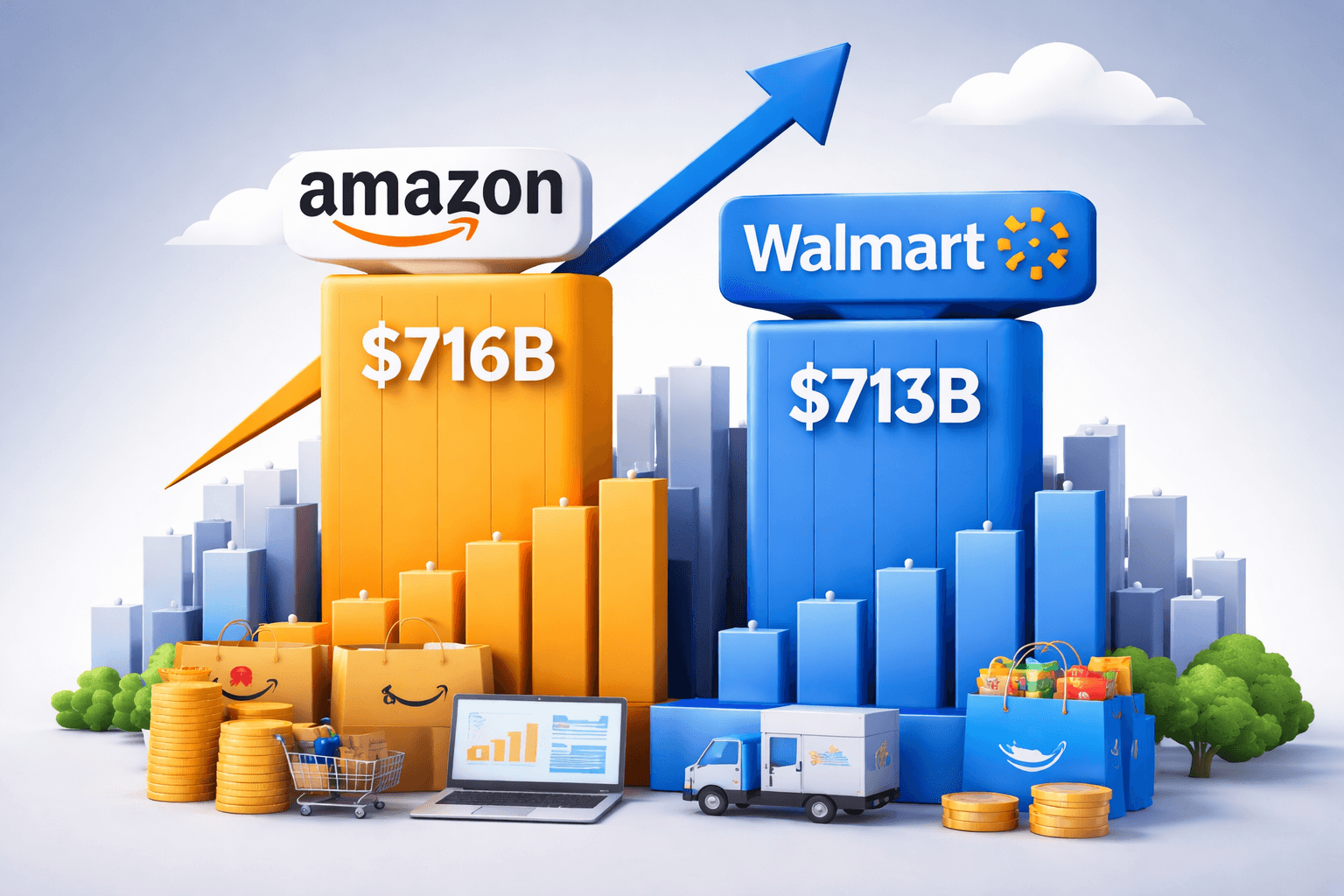
The latest financial results highlight just how close — and how massive — this competition is.
Amazon FY26 Revenue: $716.9 Billion
Walmart FY26 Revenue: $713.2 Billion
Combined Revenue: $1.42 Trillion
The difference between the two companies is just a few billion dollars, but their scale is remarkable. Together, these organizations make more money each year than the total economic output of many countries. More importantly, this achievement shows a bigger trend: the increasing power of technology-driven business models over traditional retail structures.
This leadership change did not happen suddenly. The shift had been developing for several quarters. About a year ago, Amazon surpassed Walmart in quarterly sales for the first time. That moment indicated that consumer behavior was evolving quickly. Online shopping, faster delivery expectations, digital subscriptions, and personalized experiences are becoming the new normal. The FY26 results have now confirmed what industry experts expected: the balance of power in retail is gradually shifting toward companies that combine commerce with technology on a large scale.
One of the biggest reasons behind Amazon’s rise is that the company is no longer just an e-commerce platform. Over the years, it has built multiple high-growth revenue engines that support and strengthen its core retail business.
Today, Amazon’s growth comes from:
Global E-commerce Marketplace serving millions of sellers and customers
Amazon Web Services (AWS), one of the world’s largest cloud computing platforms
Digital Advertising, a fast-growing and high-margin business
Prime Subscriptions, creating customer loyalty and recurring revenue
AI-powered logistics and recommendation systems that improve efficiency and customer experience
This diversified ecosystem allows Amazon to scale faster, operate more efficiently, and generate revenue from multiple sources — a major advantage in today’s competitive landscape.
While Amazon has taken the top spot, Walmart remains one of the most powerful companies in the world.
Its strengths include:
Thousands of physical stores across multiple countries
One of the most efficient supply chains globally
Strong purchasing power and pricing advantage
Rapidly growing e-commerce operations
Expansion into same-day delivery and digital services
In recent years, Walmart has significantly increased its investments in automation, data analytics, fulfillment technology, and online infrastructure. Rather than losing relevance, the company is actively transforming itself to compete in a digital-first environment.
The narrow revenue gap clearly shows that this rivalry is far from over.
The competition between Amazon and Walmart is now entering a new phase, where the key differentiator will be technology — especially artificial intelligence.
The future of retail will be shaped by:
Predictive demand forecasting
Automated and robotic warehouses
Smart inventory optimization
Personalized product recommendations
Faster and more efficient last-mile delivery
Real-time customer behavior analysis
Companies that can use AI to reduce costs, improve speed, and enhance customer experience will have a significant competitive advantage.
In this sense, the race is no longer just about selling products — it is about building intelligent, data-driven commerce ecosystems.
Amazon’s rise to the top reflects a broader shift in global business strategy.
Scale alone is no longer enough.
The companies that lead the future will be those that combine:
Large operational scale
Advanced technology integration
Multiple revenue streams
Strong customer focus
Continuous innovation
Amazon’s journey from an online bookstore to a global technology and commerce giant demonstrates how diversification and digital infrastructure can drive long-term growth.
The fact that just two companies can generate $1.42 trillion in annual revenue highlights the enormous scale of global retail and the vast opportunity that still exists in the sector. This level of performance reflects the high demand from consumers worldwide and the growing importance of efficient supply chains, fast delivery networks, and smooth shopping experiences. It also shows how quickly the industry is evolving as more people embrace digital solutions.
Online shopping, mobile commerce, subscription models, and data-driven personalization are no longer optional; they are becoming the backbone of modern retail growth. At the same time, this milestone indicates that technology is shaping the future of retail as much as scale is. Companies are no longer competing just on pricing or product variety; they are now competing on speed, convenience, customer experience, and smart operations. The ability to predict demand, optimize inventory in real time, automate warehouses, and deliver products faster than ever is now a key advantage. While Amazon may have taken the lead for now, the competition with Walmart remains intense and far from decided. The small gap between their revenues shows how closely matched these two giants are. Walmart is rapidly expanding its e-commerce services, boosting its last-mile delivery network, and integrating digital tools across its large physical store network.
At the same time, Amazon continues to invest heavily in cloud infrastructure, artificial intelligence, automation, and logistics innovation to improve efficiency and keep its edge. In many ways, the rivalry between these two companies represents the future of the entire retail industry—a race to combine massive scale with advanced technology. As both organizations invest billions into AI, automation, and digital infrastructure, the lead may continue to shift. What is clear, however, is that the next phase of growth in global retail will be defined by companies that can move faster, operate smarter, and provide a more personalized and seamless experience to customers around the world.
Amazon overtaking Walmart is more than just a change in rankings. It signifies a key moment in the evolution of global commerce.
This shift moves us from traditional retail dominance to technology-driven growth, from physical stores to digital systems, and from simple selling to data-informed customer experiences.
The leadership crown may have changed hands, but one thing is clear: the future of retail will belong to companies that mix size, speed, intelligence, and innovation. As the next phase of competition begins, the battle between the world’s two largest retailers is just getting started.
Follow Karostartup for more insights into the intersection of technology, policy, and the future of India.
Quick Share