There is a particular kind of frustration that only Bengaluru can produce. You order something urgent. You track it obsessively. You watch it sit at the Electronic City hub for two hours while the app tells you your delivery partner is navigating heavy traffic. You refresh. The estimated time moves again. Somewhere out there, a driver is doing everything right and still going nowhere, because that is just what the Outer Ring Road does to people.
For years, the only answer to this problem was more drivers, better routing software, and a quiet acceptance that some cities simply swallow time. Nobody seriously talked about going over the traffic. Until 20 April 2026, when FedEx and IIT Madras announced that they had done exactly that.
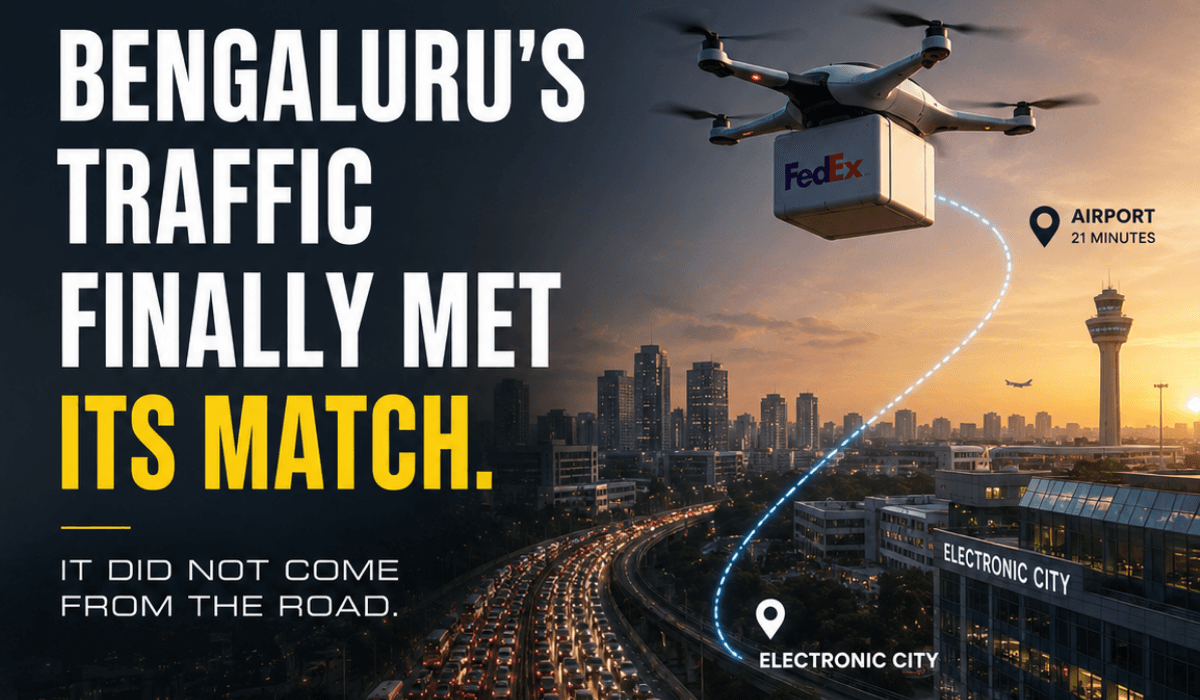
A Drone Left Electronic City And Landed Near The Airport In 21 Minutes
The route sounds simple when you say it out loud. Electronic City Phase II is to be built on a site near Kempegowda International Airport. But anyone who knows Bengaluru understands what that journey actually looks like on a regular weekday. Sixty minutes minimum. Often more. Sometimes significantly more, depending on what the city decides to do that day.
The drone covered it in 21 minutes. Flying at 120 metres above the city, cutting through roughly 39 to 42 kilometres of aerial distance instead of the 53 kilometres of stop-start road below. India's first intra-city drone delivery flight trial had just been completed, and it had been done inside one of the most complicated urban airspaces in the country. This Was Not A Quiet Field Somewhere. That last part matters more than the time saving alone.
Bengaluru sits next to an international airport, which means large sections of the city's airspace are designated as restricted zones. Yellow zones. Red zones. Areas where getting a drone through requires real-time airspace coordination, regulatory clearances, and a traffic management system that can handle the complexity of flying near active commercial flight paths.
The trial cleared all of it. Amber Wings, the IIT Madras-incubated drone startup behind the aircraft, operated through a UTM software partner that managed airspace in real time across multiple restricted corridors simultaneously. Vinay M K, CEO of Amber Wings, said it plainly: Bengaluru's airspace is one of the most complex in the country, and they achieved this at scale with full clearances. That is not something you say about a controlled experiment in an empty field. That is something that happens when the technology actually works in the conditions that matter.
The trial did not come from nowhere. It was built inside the FedEx SMART Centre at IIT Madras, a multi-year research collaboration focused on technology-enabled supply chains, aerial robotics, and sustainable logistics solutions. Amber Wings itself was incubated at IIT Madras, which means the aircraft, the institution, and the ambition behind the flight all came from the same place.
What FedEx brought was scale, a global logistics operation that understands exactly where the bottlenecks sit and what solving them would actually mean for a delivery network. What IIT Madras brought was the research infrastructure and the drone technology to test a real answer. Together, they built something that India's logistics sector had been waiting for someone to demonstrate properly.
Most people think about delivery in terms of the last mile, the bit from the local hub to the front door. But the part that often causes the real delay is what happens before that: moving goods between a large distribution warehouse on the city's edge and the smaller urban fulfilment centre closer to where deliveries actually happen. That middle segment, the mid-mile, is where hours quietly disappear in a city like Bengaluru.
A shipment that gets stuck in a two-hour hub-to-hub transfer does not make it to the customer by afternoon. It arrives the next morning. The courier did nothing wrong. The last-mile driver did nothing wrong. The time was lost in the part of the chain that nobody sees. A 21-minute aerial connection on that same corridor rewrites that equation. It changes not just delivery speed but how the entire network can be designed, where hubs need to be, and which shipments can make commitments about timing that road logistics simply cannot keep.
None of this means drones will be dropping parcels at your window by next month. Commercial deployment at scale requires infrastructure, sustained regulatory clarity, and investment that takes time to build properly. The drone ecosystem in India has been laying foundations through policy for a few years now. The Drone Rules 2021 created the framework. Production-linked incentive schemes encouraged domestic manufacturing. The Digital Sky platform built the structure for managing airspace approvals. What was missing was a real demonstration inside a genuinely difficult urban environment that proved the whole thing could work. That is what this trial provides. It is the moment the conversation about drone logistics in Indian cities moves from theoretical to demonstrated. Time-critical shipments are the obvious starting point. Medical supplies, urgent documents, small high-value packages. Categories where the 21-minute promise means something real to the person waiting on the other end.
Something is fitting about the fact that this happened here. A city that spent decades absorbing the country's technology ambitions, building campuses and corridors and companies out of traffic and heat and impossible rents, finally saw someone decide to stop fighting its roads and just fly over them instead.
The delivery guy did not beat Bengaluru's traffic this time. He simply stopped pretending the road was the only option.
Quick Share