Somewhere in India right now, a final-year engineering student is refreshing their email for the fifteenth time today. Their placement season technically ended two months ago. Their friends from college have scattered. Some got jobs. Many did not. The ones who did not are doing something familiar: waiting, applying, explaining to parents that it is just a matter of time, and quietly wondering if the four years were worth it. This is not a new story. But the numbers attached to it in 2026 are harder to ignore than they were before.
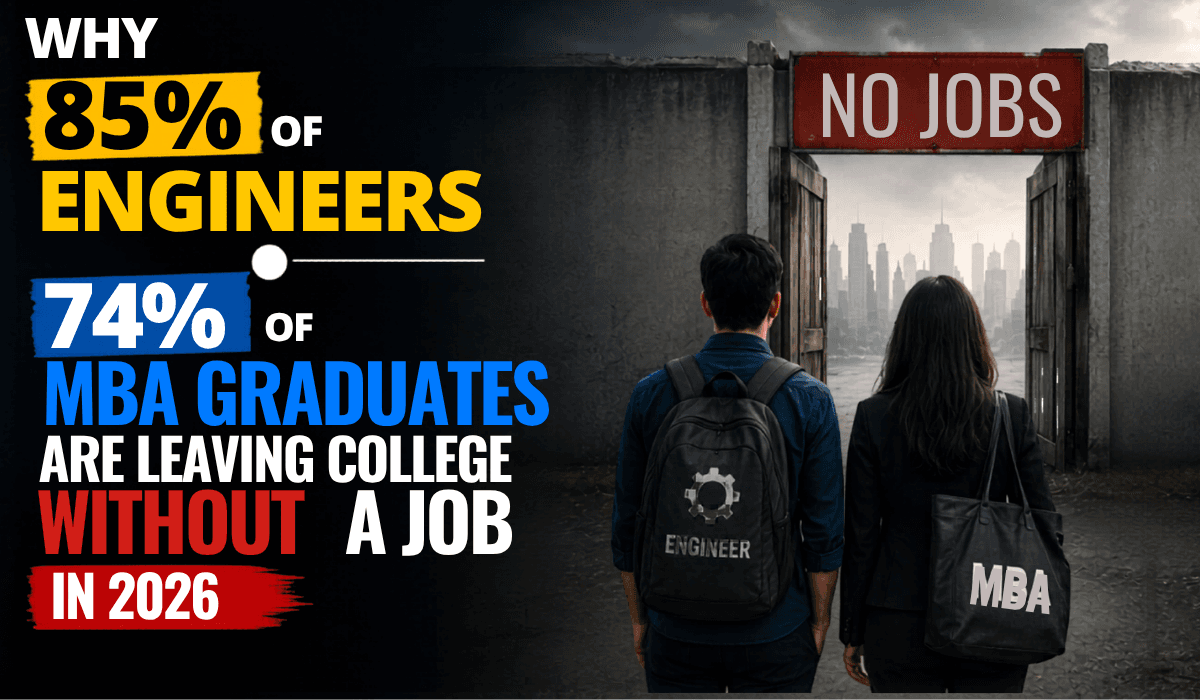
The Unstop Talent Report 2026, based on a survey of over 37,000 students and 500 HR leaders conducted between January and February this year, made something official that students on campuses had been whispering about for a while. 85 percent of engineering students are leaving college without a job offer. 84 percent of undergraduate students across streams are in the same position. 74 percent of MBA graduates, degrees that cost families significant money and three to four years of serious effort, are also unplaced. And 17 percent of students have faced offer disruptions, including delays and offers being pulled back entirely after they were made. These are not numbers from a struggling economy where companies are cutting costs and freezing hiring. That is the part that makes this harder to sit with.
87.8 percent of HR leaders surveyed in the same report said they are actively hiring. 90 percent said they are maintaining or increasing their hiring budgets in 2026. Companies are hiring. Money for hiring exists. And most fresh graduates still cannot get a job. That contradiction is the actual story here. This is not a situation where jobs have disappeared. It is a situation where a growing number of graduates are being filtered out before they get anywhere near those jobs. The report describes it plainly: jobs exist, but access to them is increasingly filtered and uneven. The question is what is doing the filtering.
64 percent of recruiters in the survey said they now prioritise skills like AI, data analysis, and cloud computing over degrees when screening candidates. 57 percent are using AI tools for initial screening and profile matching. 55 percent are running AI-driven interview processes. In other words, AI now sits at multiple points in the hiring funnel. And a student who does not understand how to work alongside these tools, not just theoretically but in practice, is being screened out before a human recruiter ever reads their name.
The engineering syllabus at most colleges in India has not kept pace with this. Faculty who have never worked outside academia are teaching frameworks that companies stopped caring about years ago. Placement cells at many institutions send a few emails to a handful of companies once a year and call it a process. The degree says one thing. The hiring market wants something else entirely. And the student in the middle is paying the price for that gap.
73 percent of fresh graduates expect a starting salary above Rs 5 lakh per annum. Only 40 percent actually secure an offer at that level. 39 percent of engineering graduates are earning below Rs 7 LPA. 30 percent of MBA graduates are earning below Rs 10 LPA. These are degrees that took years to complete and often cost families considerable money in fees, accommodation, and opportunity costs. The degree premium, the idea that having a certain qualification automatically puts a certain floor under your earnings, is quietly eroding. And students are beginning to sense it, even if nobody has said it to them directly.
Over 90 percent of the students surveyed said they are now willing to accept a lower salary if the role offers better learning and long-term career growth. 82 percent of MBA students said they now prioritise in-hand salary over perks. These are not the expectations of people who feel confident. They are the expectations of people trying to get a foothold in a market that keeps moving the entry point.
The picture is not uniform. Students from IITs and IIMs are largely still getting placed. Companies show up, competition is fierce, but the numbers at the top institutions hold up reasonably well.
The crisis is sharpest in the tier two and tier three colleges, the ones that charge substantial fees, make promises about placement records during admissions, and then struggle to deliver when the season actually comes around. These are also the colleges that enrol the largest number of students. The families sending children there are often making real financial sacrifices for a degree they believe will open doors.
When those doors stay closed, the damage is not just professional. It sits in the household for years.
Students in the survey are already adapting in the ways available to them. Between 80 and 86 percent are using generative AI tools for job applications and interview preparation. They are building projects outside the syllabus, taking online certifications, and doing whatever they can to show something beyond a CGPA. But individual effort can only go so far when the structural gap is between what colleges are teaching and what companies actually need. Until curricula get updated, until internships become mandatory and taken seriously rather than treated as a box-ticking exercise, and until the connection between institutions and industry becomes something real rather than ceremonial, the numbers are unlikely to shift meaningfully. 85 percent is not a rounding error. It is a generation of young people who followed the instructions given to them, studied hard, got the degree, and found the door they were promised was harder to open than anyone had prepared them for.
That deserves more than a survey report. It deserves a serious rethink of what the system is actually preparing people for.
Quick Share