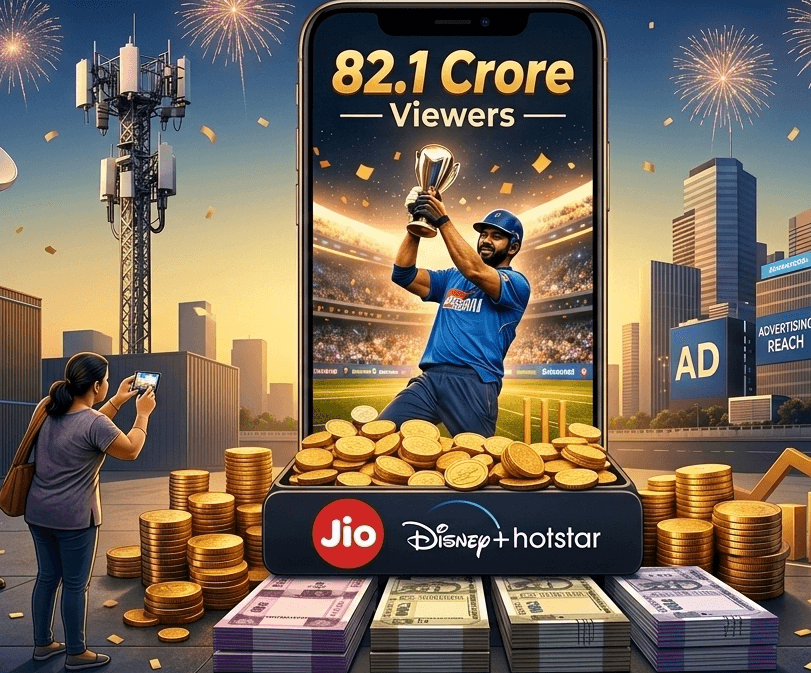
When 82.1 crore Indians watched a cricket match on their phones, they didn't just witness a sporting triumph — they became the product.
On the night India lifted the ICC T20 World Cup, JioHotstar registered 82.1 crore concurrent viewers on a single streaming platform. Let that sink in. That is more than the entire population of Europe watching one app, on one night, for one event. It is the largest digital viewership record in human history for a single live sports broadcast.
But here is the part that most post-match analysis missed entirely: this was not a television moment. It was a mobile moment. The majority of those 82.1 crore viewers were not sitting in front of a television set in a living room. They were hunched over a phone screen in a tea stall, a factory floor, a college hostel, or a commuter train. That distinction is not a footnote — it is the entire story.
India's digital advertising market is projected to reach ₹2.01 lakh crore in 2026, according to estimates from Storyboard18 and Madison. Of that enormous figure, 64% is digital — meaning brands are no longer debating whether to move budgets online. That war is over. The question now is: where exactly online does attention concentrate enough to justify premium pricing?
The answer, at least in India, is brutally simple: cricket. And within cricket, the answer is even simpler: peak moments.
Traditional television sold advertising by the clock. You bought a 30-second slot during prime time — roughly 9 PM to 11 PM — and hoped your audience was watching. The inventory was fixed, the pricing was negotiated weeks in advance, and the value was averaged across millions of passive viewers.
OTT platforms like JioHotstar have dismantled that model entirely. They do not sell prime time by the clock. They sell prime time by the moment. When Virat Kohli walks to the crease in a World Cup final, that single delivery — the three seconds before the ball is bowled — becomes the most expensive advertising real estate in the Indian economy. No office tower on Nariman Point, no highway billboard on the Western Express, commands that price per eyeball.
JioHotstar crossed 600 million registered users within three months of its consolidated launch, according to Reliance Industries data. This figure deserves more attention than it received in the business press. For context, that is roughly double the number of Americans who use any streaming service at all.
What this represents is not merely scale — it is the completion of a distribution network. Reliance, through the merger of JioCinema and Disney+ Hotstar into the unified JioHotstar platform, did not just acquire content rights. It built a toll road, and then made cricket the only legal route through it.
Every small-town cricket fan who downloaded the app to watch the World Cup is now inside an ecosystem. Their viewing data, their engagement patterns, their geographic location, and their device type are all monetisable signals. A farmer in Vidarbha who streamed the final on his Jio SIM is now, in the language of programmatic advertising, an addressable audience segment. This is the infrastructural shift that the 82.1 crore headline obscures: the viewers are not just consumers of content. They are the raw material.
The "attention economy" is a concept that economists and media theorists have discussed for decades. The basic proposition is straightforward: in a world of information abundance, the scarce resource is human attention, and whoever can reliably capture it can charge everyone else for access to it.
In India in 2026, JioHotstar is the most efficient attention-capture machine ever built. Cricket is the mechanism, and the World Cup is the peak moment where that mechanism operates at full throttle.
Consider the economics of a single high-stakes match. Brands pay vastly elevated CPMs — cost per thousand impressions — during live sports versus standard content. The reason is not just reach but intent and emotion. A viewer watching a thriller final is physiologically activated: heart rate elevated, attention undivided, social sharing at maximum. An advertisement inserted at that moment carries emotional spillover. The brand becomes associated, however fleetingly, with the feeling of national triumph.
This is why FMCG giants, telecom companies, fintech startups, and automobile manufacturers compete ferociously for IPL and World Cup inventory months before a ball is bowled. They are not buying airtime. They are buying emotional proximity to the most culturally significant shared experience in Indian life.
The shift this viewership record signals is not just about streaming versus television in a technical sense. It is about where the advertising rupee flows, and therefore where media power resides.
For decades, Star Sports, Sony Ten, and Doordarshan held the keys to cricket's audience. Cable and satellite operators were the intermediaries. Advertisers negotiated with broadcast networks. The money flowed through a predictable set of pipes, and those pipes were owned by established players.
JioHotstar has redrawn the plumbing. The platform now controls the relationship between the viewer and the content directly, with no cable operator in the middle, no set-top box rental, no geographic limitation. A viewer in Shillong and a viewer in Surat have identical access on identical terms. The advertising system built on top of that direct relationship is dramatically more precise and therefore dramatically more valuable.
Linear television sold demographics. Digital OTT sells individuals. That is not a marginal improvement in targeting efficiency — it is a categorical change in what the product is.
The 82.1 crore figure will not stand forever. The next World Cup, the next bilateral series that India enters as favourites, the next IPL season — each will set a new ceiling, because the platform keeps growing and mobile internet penetration in India has not yet peaked.
What this means for the advertising market is continued premium pricing for cricket inventory, continued consolidation of media power within the Reliance ecosystem, and continued pressure on every other content category to justify its place in a viewer's finite attention.
For the layperson who simply watched India win and felt joy, none of this machinery was visible. That invisibility is, in a sense, the product working perfectly. The attention was given freely. The economic value was extracted silently.
India did not just win a cricket match. It generated, in a single evening, the proof of concept for the most valuable media business on earth — an 82.1 crore-person demonstration that in the new economy, the scoreboard and the balance sheet are the same document.
The hook lands because it is true: JioHotstar does not merely stream cricket. At peak moments, it prints advertising currency. And on the night India won the World Cup, the mint was running at full capacity.
Visit Karostartup for more insights into the intersection of technology, policy, and the future of India.
Quick Share