The global electric vehicle industry may have just crossed a major technological milestone. Chinese EV giant BYD has unveiled the second-generation Blade Battery, a next-generation battery technology capable of delivering ultra-fast charging speeds that challenge some of the fastest EV charging systems currently available.
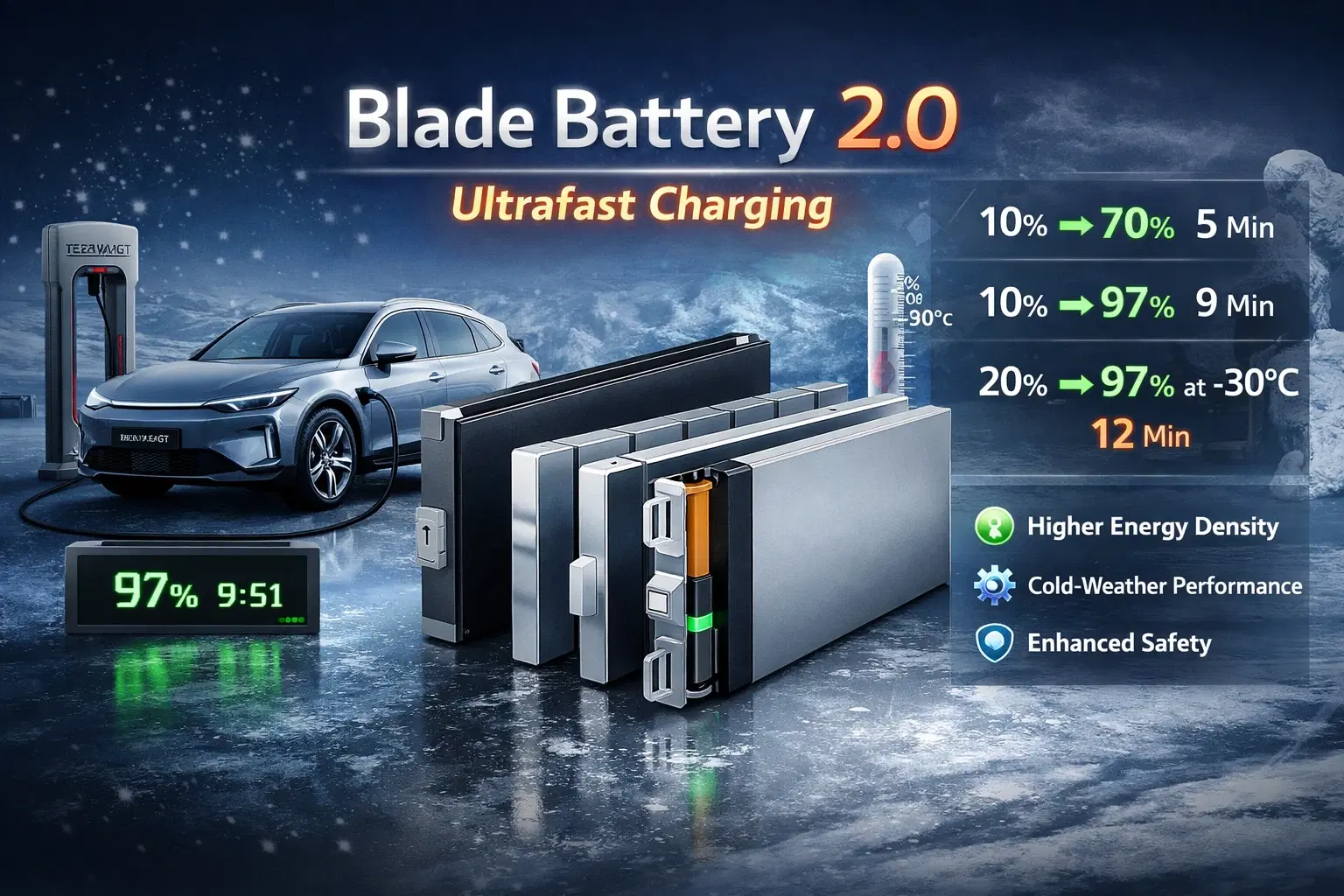
According to the company’s demonstrations, the new Blade Battery can charge from 10% to 70% in just five minutes, while 10% to 97% charging takes only nine minutes . Even under extremely cold conditions, where EV batteries usually struggle , the battery reportedly charges from 20% to 97% in just 12 minutes at –30°C.
These numbers are striking when compared with the charging speeds of existing EV infrastructure. For example, the Tesla Supercharger network, widely considered among the fastest in the world, typically takes 20–30 minutes to charge a vehicle from 10% to 80%. In contrast, BYD’s new technology can push the battery from 10% to nearly full (97%) in under ten minutes , potentially redefining expectations around EV charging convenience.
The technology was demonstrated in the Denza Z9GT, one of the first vehicles equipped with the second-generation Blade Battery. In a live demonstration shared on the Chinese social media platform Weibo, the vehicle was filmed charging from 9% battery (approximately 93 km of range) to 97% battery (around 1,008 km of range) in 9 minutes and 51 seconds .
If these numbers are replicated consistently in real-world conditions, they could significantly reduce one of the biggest barriers to EV adoption: long charging times. Charging an electric vehicle could begin to feel as quick as refueling a gasoline car.
The new battery continues to use Lithium Iron Phosphate (LFP) chemistry — the same chemistry used in the original Blade Battery. LFP batteries are already known for their superior safety, long lifespan, and cost efficiency compared with Nickel Manganese Cobalt (NMC) batteries, which are widely used by many Western EV manufacturers.
However, the second-generation Blade Battery introduces several important improvements.
BYD claims the new battery achieves 5% higher energy density, reaching approximately 190–210 Wh/kg on a gravimetric basis. While this may seem like a modest improvement, even small gains in energy density can translate into longer driving ranges or lighter battery packs for vehicles.
LFP batteries are already known for exceptional durability, often lasting thousands of charge cycles without significant degradation. BYD states that the second-generation Blade Battery offers even longer operational life than its predecessor, potentially extending the usable lifespan of EVs and reducing long-term ownership costs.
One of the most impressive breakthroughs is the battery’s performance in extremely cold environments.
Most EV batteries suffer significant performance drops in cold climates because the chemical reactions inside lithium-ion batteries slow down at low temperatures. As a result, charging speeds can become dramatically slower during winter months.
However, BYD claims that the Blade Battery 2.0 can charge from 20% to 97% in just 12 minutes even at –30°C (–22°F) — only about three minutes slower than charging at room temperature. This represents a major improvement for EV adoption in regions with harsh winters such as northern China, Europe, and North America.
Battery safety has always been one of the key selling points of BYD’s Blade Battery architecture.
The new version continues to pass multiple nail-penetration tests, one of the most demanding safety benchmarks used in the battery industry. During these tests, a nail is driven through the battery cell to simulate a catastrophic internal short circuit. Many battery chemistries can overheat, catch fire, or even explode during such tests.
BYD claims the Blade Battery 2.0 remains stable without catching fire or exploding, highlighting the inherent safety advantages of LFP chemistry and the company’s structural battery design.
The battery also reportedly complies with China’s newest and strictest battery safety standards, which are considered among the most rigorous EV battery regulations in the world.
Fast charging has long been one of the biggest challenges facing electric vehicles. While EV ranges have improved dramatically over the past decade, charging times still remain longer than traditional refueling.
If technologies like the Blade Battery 2.0 become widely deployed, they could bring EV charging times closer to the five-to-ten-minute refueling experience of gasoline vehicles.
This shift could have several major implications:
• Reduced range anxiety for drivers
• More efficient public charging infrastructure
• Faster long-distance travel with EVs
• Higher consumer adoption of electric vehicles
Additionally, BYD’s reliance on LFP chemistry — which avoids expensive and controversial materials like cobalt — could also help lower battery costs and improve supply chain sustainability.
BYD has already become one of the largest EV manufacturers in the world and a major global battery supplier. Innovations like the second-generation Blade Battery reinforce the company’s growing reputation as a battery technology leader, not just an automaker.
If the technology scales successfully into mass production, it could push competitors — including Tesla, European automakers, and emerging EV startups — to accelerate their own next-generation battery development.
The race for faster, safer, and longer-lasting EV batteries is intensifying. And with Blade Battery 2.0, BYD may have just taken a significant lead.
Visit Karostartup for more insights into the intersection of technology, policy, and the future of India.
Quick Share