Delhi already owns one of India’s most historic cricket venues — the iconic Arun Jaitley Stadium. With around 35,000 seats, it has hosted legendary Test matches, high-voltage IPL clashes, and packed international fixtures.
But 35,000 is yesterday’s number.
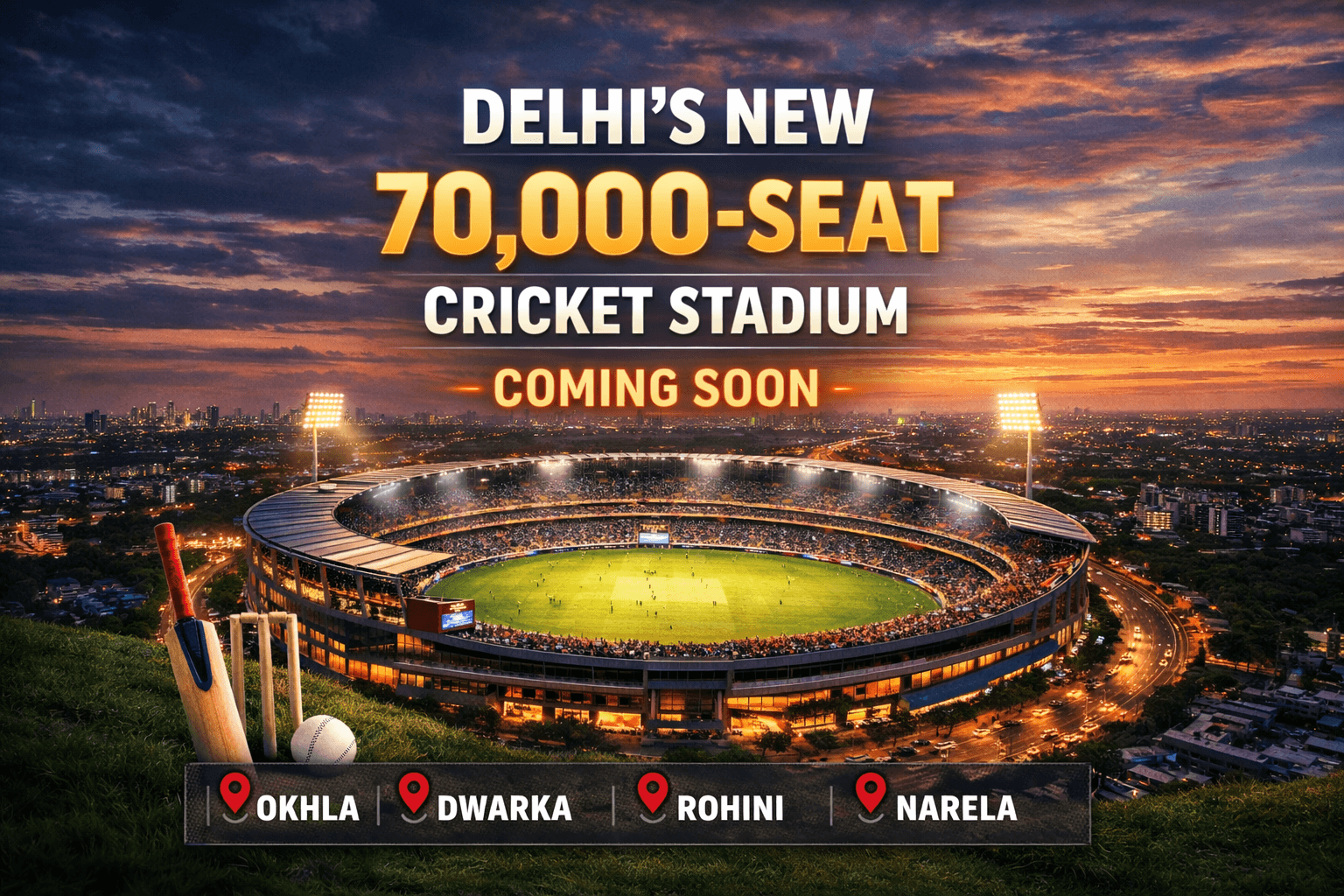
Now the Delhi & District Cricket Association (DDCA) is pushing for a brand-new stadium with a proposed capacity of 60,000 to 70,000 seats.
Not an expansion.
Not a renovation.
A completely new mega-arena.
And this is not just discussion-stage noise. Four locations — Okhla, Dwarka, Rohini, and Narela — have already been shortlisted. Land approval is expected by the end of 2026, which means groundwork conversations are already happening inside serious corridors.
This is Delhi thinking big
Doubling from 35,000 to nearly 70,000 isn’t cosmetic growth. It’s a positioning upgrade.
In modern cricket economics, capacity equals leverage. Larger stadiums unlock higher ticket revenue, stronger hospitality sales, premium box pricing, and greater sponsor visibility. Broadcasters prefer scale because it enhances visual energy and perception.
A 70,000-seat stadium moves Delhi into the same conversation as mega venues like the massive Narendra Modi Stadium. And once you’re in that league, tournament allocation dynamics shift.
Bigger venues strengthen a city’s bid for major tournaments. Whether it’s ICC events, IPL playoffs, or global exhibition matches, scale influences decision-making.
A high-capacity stadium in the national capital automatically becomes a priority venue. More knockouts. More finals. More prime-time matches.
And prime-time matches mean premium revenue.
Mega stadiums are economic catalysts.
Whichever location gets final approval — Dwarka’s expanding urban grid, Rohini’s developing zones, Narela’s growth corridor, or Okhla’s strategic connectivity — that area will likely see infrastructure upgrades.
Improved road networks.
Metro connectivity upgrades.
Hospitality growth.
Retail expansion.
Real estate value appreciation.
Large sports infrastructure projects rarely operate in isolation. They pull investment around them.
India is currently in an infrastructure escalation phase. Cities are competing to build statement venues that go beyond functionality.
Ahmedabad set the benchmark with the Narendra Modi Stadium. Other cities are modernizing their arenas.
Delhi responding with a 70,000-seat proposal signals ambition. It shows the capital does not want to remain mid-capacity while the rest of the country scales up
The national capital hosting mega cricket events carries symbolic weight. Diplomacy, political visibility, international tourism — everything connects when events happen in Delhi.
A world-class, high-capacity stadium enhances the city’s global sporting identity. It strengthens India’s ability to pitch for future multi-nation tournaments.
This isn’t just about the next IPL season. It’s a 20–30 year infrastructure bet.
Modern stadiums are designed as multi-purpose assets. Concerts, large-scale entertainment shows, international sports events — diversified usage increases return on investment.
If executed correctly, this venue could operate as a year-round revenue engine rather than a match-only facility.
Land approval by 2026 will be the first major checkpoint. After that comes architectural planning, funding structuring, environmental clearance, and phased construction timelines.
These projects take time — but once execution begins, momentum builds quickly.
Delhi isn’t just building another cricket ground.
It’s attempting to reposition itself in India’s sports power structure.
And if this 70,000-seat vision becomes reality, the capital won’t just host big matches.
It will command big moments.
Follow Karostartup for more.
Quick Share