A new EAC-PM working paper lays bare a devastating national trend — tobacco consumption has surged 33% in rural India, with household spending data revealing a stark inversion of priorities.
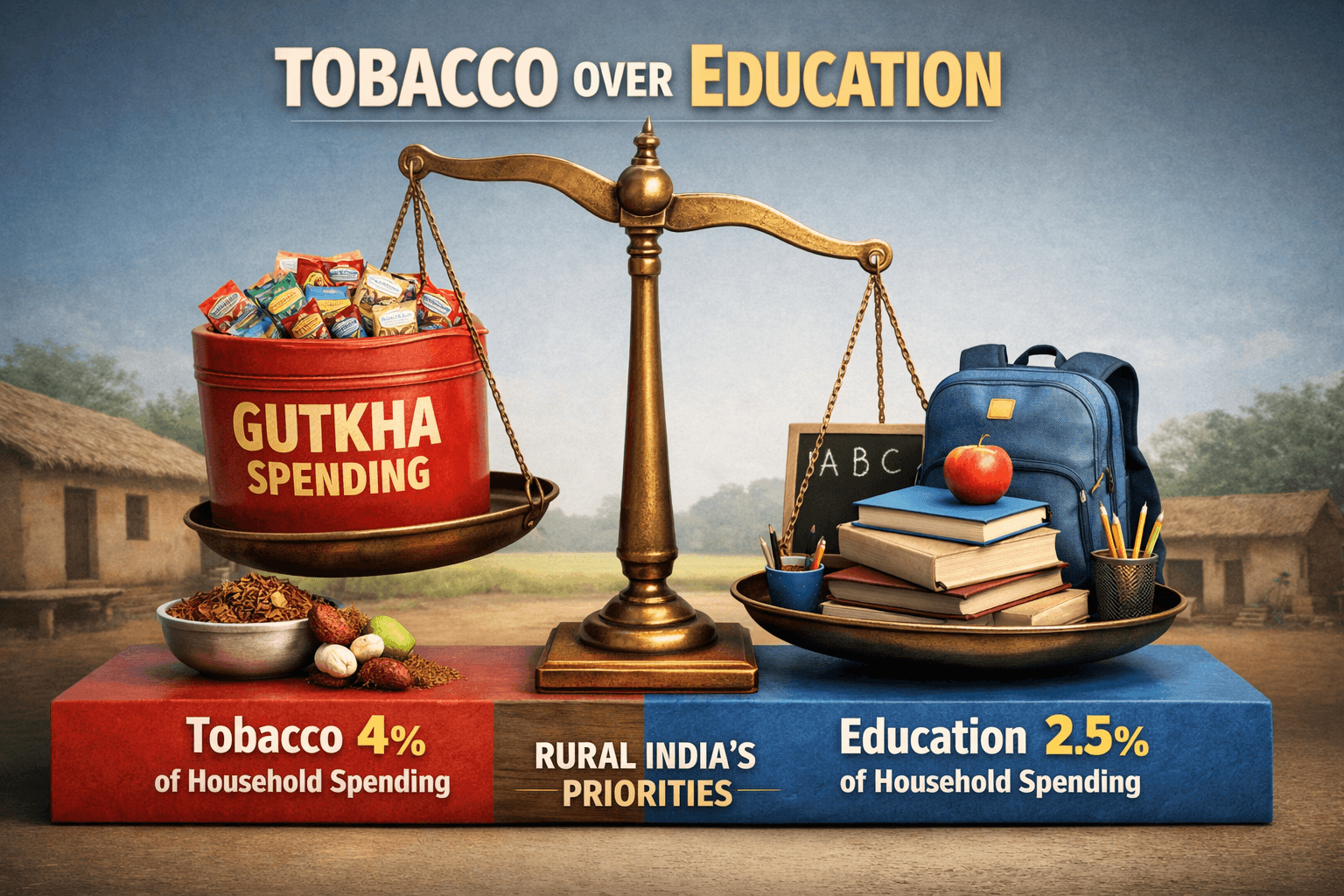
In a finding that lays bare one of India's most uncomfortable public health paradoxes, rural households across the country are now spending more of their income on tobacco products — primarily gutkha — than on the education of their children. The data, drawn from India's Household Consumption and Expenditure Survey (HCES), reveals that tobacco accounts for 4% of consumption expenditure in rural tobacco-using households, while education receives only 2.5%.
The figures have been highlighted in a working paper by members of the Economic Advisory Council to the Prime Minister (EAC-PM), which warns that tobacco consumption is rising sharply across both rural and urban India, and that the economic and health costs are now too large for policymakers to continue to overlook.
"Tobacco consumption is rising sharply across rural and urban India — an uncomfortable truth India can no longer afford to ignore." — EAC-PM Working Paper
The scale of the increase is striking. The number of tobacco-consuming households in rural India rose from 9.9 crore in 2011-12 — representing 59.3% of all rural households — to 13.3 crore in 2023-24, or 68.6% of rural households. That is a 33% increase in absolute numbers within just twelve years.
This means that more than two-thirds of all rural households in India now include at least one tobacco user. The EAC-PM paper describes this as not merely a health problem, but an economic one — a drain on household resources that directly competes with investments in nutrition, education, and future productivity.
Urban India is not immune either. While rural numbers dominate the headline figures, the working paper notes that tobacco use is rising in urban India too, compounding concerns about a nationwide public health emergency in the making.
KEY DATA AT A GLANCE
SPENDING PRIORITIES (Rural)
At the centre of rural India's tobacco epidemic is gutkha — a cheap, mass-produced smokeless tobacco product combining areca nut, catechu, slaked lime, and tobacco, often sold in small single-use pouches for as little as Rs 1 to Rs 5. Its low price point, discreet use, and wide distribution through local kirana shops and roadside stalls have made it deeply embedded in rural social culture.
Gutkha is classified as a Group 1 carcinogen by the International Agency for Research on Cancer (IARC) and is directly linked to oral submucous fibrosis, oral cancer, oesophageal cancer, and cardiovascular disease. India already bears the world's highest burden of oral cancer, with the disease disproportionately affecting working-age men in rural and semi-urban areas.
Despite being banned in multiple states under the Food Safety and Standards Act, gutkha continues to be widely available, often rebranded or sold as separate components — pan masala and tobacco — to circumvent regulations. Enforcement remains weak and patchy.
"India bears the world's highest burden of oral cancer — and gutkha is at its root."
The consumption expenditure comparison in the HCES data is particularly damning. For rural households that use tobacco, spending on tobacco products (4%) exceeds spending on education (2.5%). This is not simply a matter of individual choice — it reflects the grip of addiction on household budgets that are already stretched thin.
Economists note that this spending inversion has long-term multiplier effects. When education is chronically underfunded at the household level, it reinforces inter-generational poverty. Children in tobacco-heavy households are not only exposed to secondhand smoke and its attendant health risks — they are also, statistically, less likely to receive tutoring, school supplies, or the financial support needed to pursue higher education.
The EAC-PM paper frames this as a structural economic problem, not merely a lifestyle one. It argues that tobacco taxation policy, health literacy campaigns, and supply-side enforcement need to be integrated into a coherent national strategy, rather than being treated as separate silos within different government ministries.
India's tobacco control framework rests primarily on the Cigarettes and Other Tobacco Products Act (COTPA), 2003, and its subsequent amendments. COTPA mandates graphic health warnings on packaging, prohibits tobacco advertising, and restricts sale near educational institutions. However, implementation of these provisions has been inconsistent, particularly in rural areas where enforcement capacity is limited.
Tobacco taxes in India, while increased over the years, remain below the World Health Organization's recommended benchmark of 75% of the retail price. The WHO and public health experts have long argued that price increases through taxation are the single most effective tool for reducing tobacco consumption, particularly among price-sensitive lower-income populations.
Crucially, smokeless tobacco products like gutkha are taxed differently — and often less effectively — than cigarettes. This creates an asymmetry where the cheapest and most harmful products face the lowest deterrence.
The working paper from the Economic Advisory Council to the Prime Minister calls for a multi-pronged response. It advocates for higher and more uniform taxation on all tobacco products, including smokeless variants; stronger enforcement of existing bans on gutkha and pan masala in states where they are in effect; and a national awareness campaign targeted specifically at rural and semi-urban populations.
The paper also recommends that tobacco control be integrated into India's broader developmental agenda — linking it to schemes like Ayushman Bharat, school health programmes, and rural livelihood missions. The idea is to change the environment in which tobacco use is normalised, rather than treating it purely as a vice to be penalised.
Significantly, the paper calls on policymakers to use the HCES data more proactively. The finding that tobacco spending exceeds education spending in rural households should, the authors argue, be treated as a national emergency indicator — akin to malnutrition or infant mortality rates — and tracked with the same urgency.
"When a family spends more on gutkha than on their child's schoolbooks, we are witnessing poverty compounded by addiction — and policy has failed both."
Behind every data point is a human reality. In villages across Bihar, Uttar Pradesh, Madhya Pradesh, and Rajasthan — states with some of the highest tobacco use rates — oral cancer wards in district hospitals are filling with patients in their thirties and forties, often the primary breadwinners of their families.
Treatment for oral cancer is expensive, time-consuming, and frequently out of reach for rural families without insurance. The economic cost of losing a working adult to illness or death, combined with the medical costs incurred along the way, can push households into debt from which they may never recover. The tobacco companies that profit from gutkha sales bear none of these costs.
Public health advocates have long argued that India's tobacco epidemic is a crisis hiding in plain sight — too commonplace to generate outrage, too diffuse to mobilise political will. The EAC-PM paper represents an attempt to change that, by attaching hard economic numbers to what has too often been dismissed as a matter of personal habit.
The data is unambiguous. In the twelve years between 2011-12 and 2023-24, India did not reduce rural tobacco use — it increased it by a third. The proportion of rural households consuming tobacco has crossed two-thirds. And within those households, more money flows to gutkha pouches than to school fees and textbooks.
The EAC-PM paper does not mince its words, calling this an "uncomfortable truth India can no longer afford to ignore." Whether policymakers choose to act on it — with the urgency the data demands — will say much about the country's commitment to the health and human capital of its most vulnerable citizens.
The next edition of the Household Consumption and Expenditure Survey will show whether the trend has turned. For now, the numbers tell a story of a nation where addiction is winning the budget war against education — and where the consequences will be felt for generations.
Visit Karostartup for more insights into the intersection of technology, policy, and the future of India.
Quick Share