In a world still adjusting after pandemic disruptions, inflation spikes, and shifting geopolitics, three economies remain central to global economic projections: the United States, China, and India. Analyses from the IMF and Goldman Sachs suggest that by 2029 these three countries will continue to dominate the global GDP landscape.
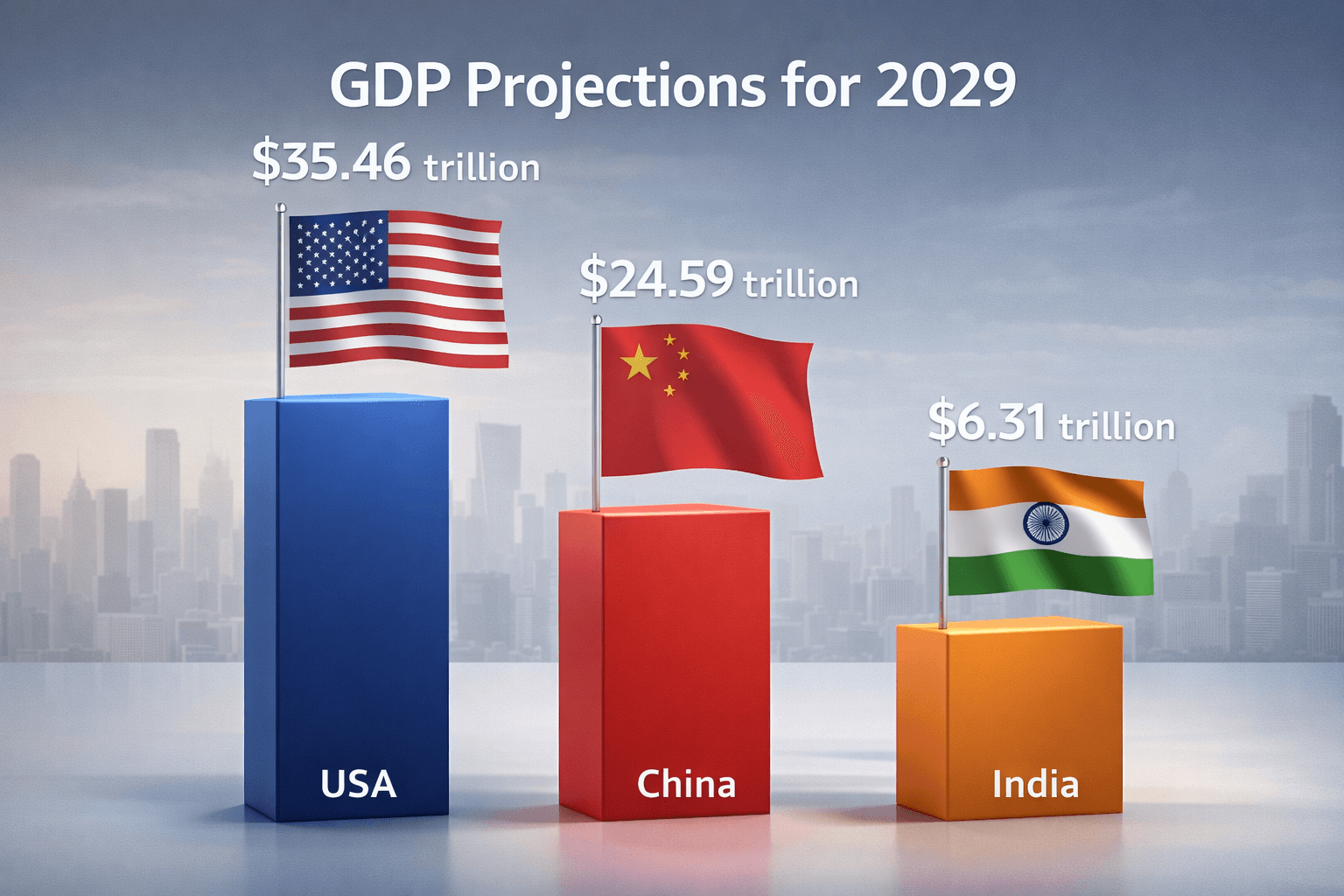
The headline figures illustrate this clearly. The United States is projected to reach approximately $35.46 trillion, maintaining its position as the world’s largest economy. China is expected to follow with $24.59 trillion, while India is forecast to grow to about $6.31 trillion, reinforcing its status as the world’s third-largest economy.
However, these projections come alongside a broader global slowdown. Average global growth is expected to reach only about 2.8% annually between 2024 and 2029, reflecting structural pressures across developed economies, China’s economic transition, and shifting global trade dynamics.
| Country | 2024 Estimate | 2029 Projection |
|---|---|---|
| United States | $28.78 trillion | $35.46 trillion |
| China | $18.53 trillion | $24.59 trillion |
| India | $3.73 trillion | $6.31 trillion |
The United States is projected to remain the world’s largest economy through 2029. Its economic strength continues to be supported by deep capital markets, strong consumer demand, technological innovation, and the global role of the U.S. dollar.
However, the path to $35.46 trillion GDP will not be without challenges. Elevated interest rates following the Federal Reserve’s battle against inflation have slowed borrowing, affecting housing and business investment. Meanwhile, federal debt levels — now exceeding $35 trillion — are becoming a growing fiscal constraint.
Technological innovation remains the country’s biggest advantage. Advances in artificial intelligence and automation could deliver major productivity gains, although economists note that the economic benefits of these technologies may take time to spread across the broader labor market.
At the same time, Washington has shifted toward more active industrial policy. Programs such as the CHIPS and Science Act and the Inflation Reduction Act signal a renewed focus on domestic manufacturing and technological leadership as global competition intensifies.
China’s projected $24.59 trillion GDP by 2029 reflects both remarkable economic growth and a period of structural adjustment.
For decades, China’s growth model relied on export-driven manufacturing, rapid urbanization, and massive infrastructure investment. That model lifted hundreds of millions out of poverty but is now entering a more complex phase.
One of the biggest challenges is the property sector slowdown, which has significantly affected household wealth and local government finances. The collapse of major developers and declining housing demand have forced Beijing to introduce targeted policy support.
Demographics present another long-term challenge. China’s working-age population has already begun to decline, largely due to the long-term effects of the former one-child policy. A shrinking labor force could gradually slow economic expansion.
Even so, China retains major structural advantages. The country remains a global leader in manufacturing and has invested heavily in electric vehicles, renewable energy, and battery technology. Its large domestic market and expanding middle class continue to provide a powerful engine for economic activity.
Among the three major economies, India’s growth trajectory is the most dramatic. A projected GDP of $6.31 trillion by 2029 would nearly double the country’s economic size within a decade.
Several structural factors are driving this expansion. India now has the world’s largest population and one of the youngest workforces, providing a long-term demographic advantage compared with aging economies in Europe, Japan, and China.
Digital infrastructure has also transformed India’s economic landscape. Systems such as the Unified Payments Interface (UPI) and the Aadhaar biometric ID network have brought hundreds of millions of people into the formal financial system. This digital ecosystem has improved financial inclusion, reduced government welfare leakage, and enabled rapid growth in digital commerce.
Foreign investment has also increased as multinational companies diversify supply chains beyond China. Technology companies and manufacturers have expanded operations across Indian cities including Bengaluru, Hyderabad, and Chennai.
Despite this momentum, challenges remain. Infrastructure gaps, logistics costs, educational quality, and regional income inequality continue to pose structural hurdles. Sustaining GDP growth of around 6.5–7% annually will be essential for India to reach the projected 2029 output levels.
These national trajectories exist within a global economy expected to grow more slowly than in previous decades. The IMF’s projection of roughly 2.8% annual global growth between 2024 and 2029 reflects several structural pressures.
Advanced economies are facing aging populations, higher debt levels, and slower productivity growth. Europe in particular continues to struggle with energy costs and demographic decline.
Meanwhile, emerging regions such as Southeast Asia are attracting manufacturing investment as global supply chains diversify. Countries like Vietnam and Indonesia are increasingly benefiting from this shift.
The global trade system itself is also evolving. Governments are increasingly prioritizing industrial policy, domestic manufacturing, and supply-chain resilience, which may reshape international trade patterns.
For investors, these projections highlight three distinct economic stories.
India represents one of the most compelling long-term growth opportunities, driven by demographics, digitalization, and expanding consumer markets. China remains a massive economic powerhouse, but its growth path is becoming more complex as structural adjustments continue. The United States, despite slower growth than emerging markets, retains unmatched strengths in innovation, capital markets, and global financial influence.
For policymakers, the implications are equally significant. Investment in education, digital infrastructure, and technological capability will play a decisive role in determining which countries capture the greatest share of future global growth.
The IMF and Goldman Sachs projections for 2029 reflect a global economy undergoing profound transformation. The United States remains the world’s largest economic power, China continues its transition toward a more sustainable growth model, and India is emerging as the fastest-growing major economy.
Global growth may be slower than in previous decades, but it remains dynamic and unevenly distributed. The countries that adapt most effectively to technological change, demographic shifts, and evolving trade patterns will shape the global economic order of the coming decade.
GDP projections are based on publicly available IMF World Economic Outlook and Goldman Sachs Research analyses. All figures are nominal GDP in USD. Projections represent forecasts and are subject to revision.
Visit Karostartup for more insights into the intersection of technology, policy, and the future of India.
Quick Share