Not long ago, the idea of an iPhone being assembled in India seemed far-fetched. Apple's supply chain was so deeply entrenched in China that the two had become almost synonymous. Foxconn's sprawling campuses in Zhengzhou and Shenzhen were the beating heart of iPhone production, and few imagined that would change in any meaningful way.
Then came a pandemic, a geopolitical rupture, and a policy window — and everything changed.
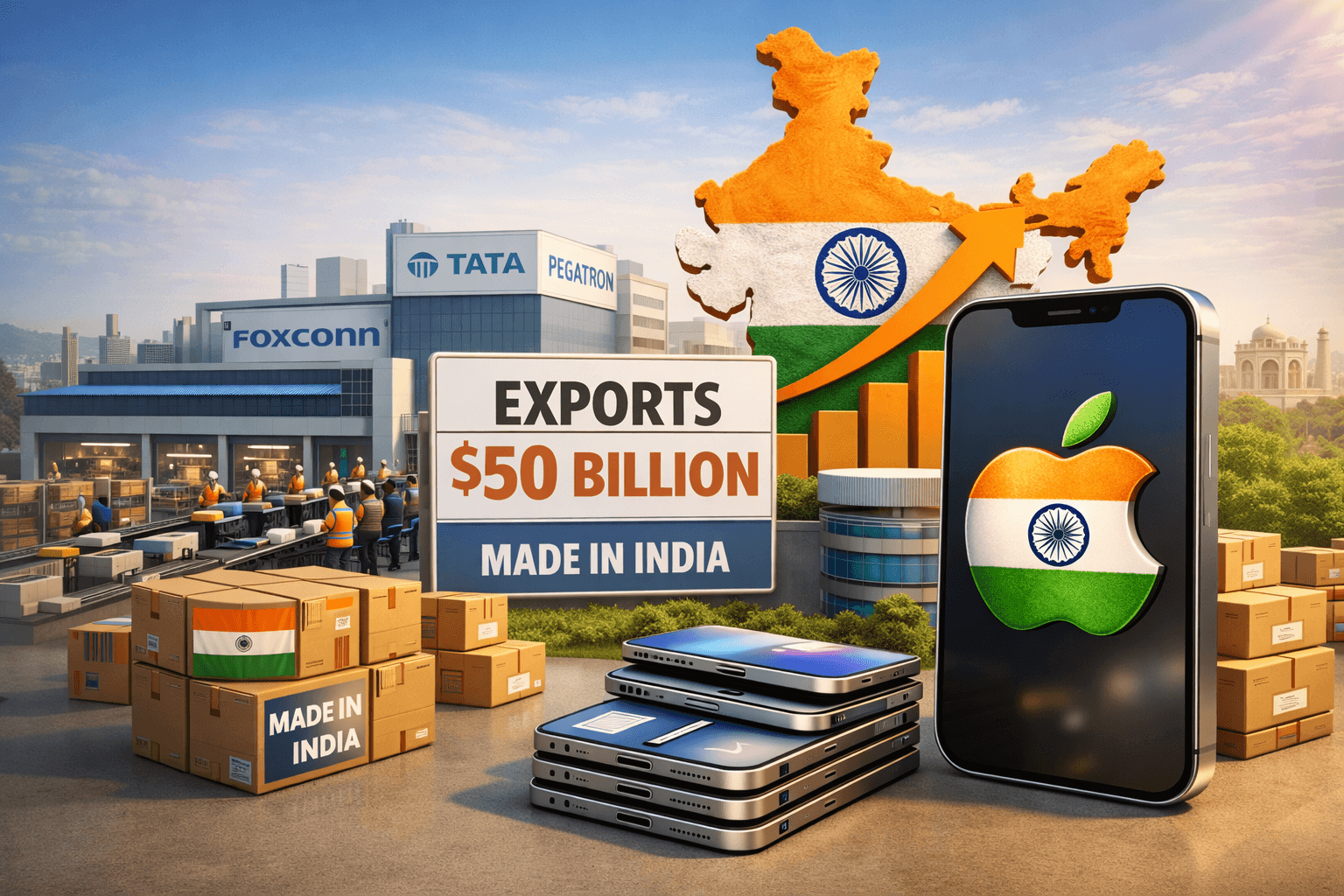
By December 2025, Apple had exported over $50 billion worth of iPhones from India, a figure achieved in less than four years of serious manufacturing scale-up. To put that in perspective, Samsung — which participates in the same government incentive scheme — managed roughly $17 billion in exports over a comparable period. Apple didn't just participate in India's manufacturing ambitions. It redefined them entirely.
Apple's shift toward India didn't happen overnight, nor was it driven by a single factor. It was the convergence of several forces arriving at roughly the same moment.
The China Risk Becomes Undeniable
For years, Apple's near-total dependence on China for iPhone manufacturing was an open secret and a quiet concern. When COVID-19 hit in late 2019 and early 2020, those concerns became a crisis. Factory shutdowns, logistics chaos, and supply disruptions cost Apple billions in lost revenue and exposed the fragility of a single-country supply chain. Then, as U.S.-China trade tensions escalated under successive administrations, the risk calculus shifted permanently. Tariffs, export controls, and the broader decoupling of American and Chinese technology ecosystems made diversification not just prudent but necessary.
Apple began looking seriously at India — a country with a massive and growing labor force, an English-speaking engineering talent pool, and a government that was actively, almost aggressively, courting global manufacturers.
In 2020, the Indian government launched the Production Linked Incentive (PLI) scheme for smartphones, offering financial incentives tied directly to incremental sales from India-based manufacturing. The scheme was designed precisely to attract companies like Apple and its contract manufacturers. It worked.
Foxconn, Pegatron, and Tata Electronics (which later acquired Wistron's India operations) all enrolled in the scheme and began ramping up capacity. Apple's manufacturing partners invested billions in new facilities across Tamil Nadu and Karnataka. The Chennai and Bengaluru ecosystems, already home to significant tech talent, began developing an entirely new industrial muscle around hardware assembly and component supply.
The scale of what has been built in India in such a short time is genuinely remarkable when viewed through the lens of hard data.
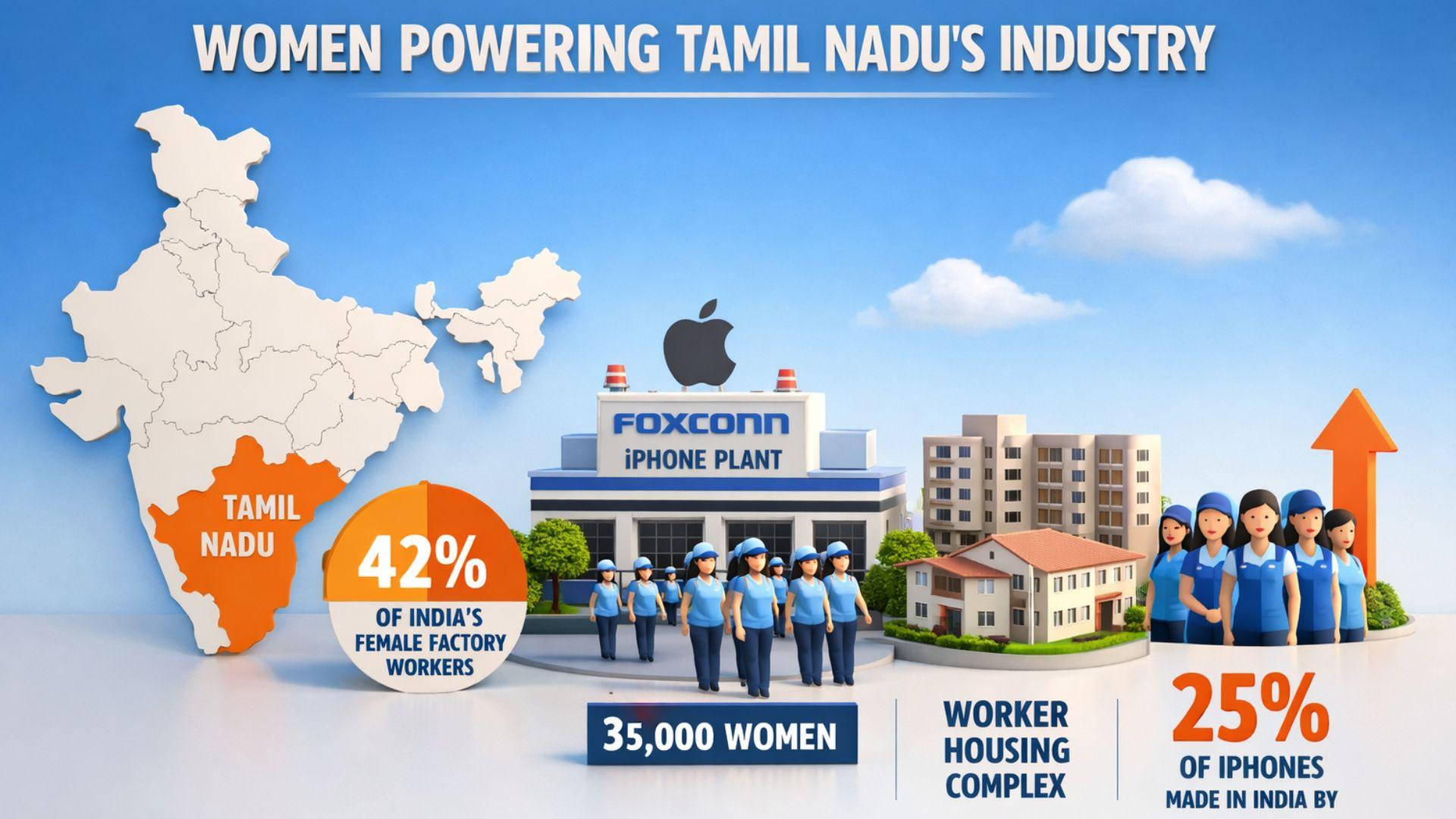
India now accounts for approximately 25% of global iPhone production — a share that was essentially zero less than a decade ago. China's dominance, which once stood at close to 100%, has fallen to around 75%. That 25-percentage-point shift represents one of the most significant supply chain realignments in the history of consumer electronics.
The export figures are even more striking. Apple crossed the $50 billion mark in cumulative iPhone exports from India by December 2025, doing so in under four years of meaningful scale. For context, India's total merchandise exports for FY 2023–24 were in the range of $437 billion. The fact that a single company's product line is now contributing tens of billions to that figure annually signals a structural transformation, not a statistical blip.
In FY 2024–25, smartphones became India's single largest export product category — surpassing petroleum products, gems and jewellery, and pharmaceuticals, categories that have historically dominated India's export basket. This is a historic first, and Apple is the primary reason it happened.
In just the first nine months of FY 2025–26, Apple exported nearly $16 billion worth of iPhones from India. Over the full year, Apple devices accounted for approximately $22 billion of India's total smartphone exports, representing roughly 75% of India's total smartphone export value. India is not just assembling phones for the domestic market anymore — it is a genuine global supply node for the world's most valuable consumer electronics product.
Apple's decision to deepen its India commitment is not simply about hedging against China. There are affirmative reasons why India is becoming a more attractive manufacturing destination over time.
Labor and Demographics
India has one of the youngest and largest working-age populations on the planet. With over 600 million people under the age of 25, the country offers a labor supply that China — which is aging rapidly due to the legacy of its one-child policy — simply cannot match at the same cost point. For a labor-intensive process like electronics assembly, this is a fundamental advantage that will only grow more pronounced over the next two decades.
Government Commitment
The PLI scheme is not a one-off program. The Indian government has made manufacturing scale-up a central pillar of its economic strategy, under the broader "Make in India" initiative. Successive union budgets have reinforced incentives for electronics production, eased import duties on components used in manufacturing, and worked to streamline the regulatory environment for large foreign investors. State governments in Tamil Nadu, Karnataka, and Telangana have competed aggressively for Apple-linked investment, offering land, infrastructure support, and single-window clearances.
Growing Domestic Market
India is also Apple's fastest-growing major market by revenue. The country's expanding middle class, rising smartphone penetration, and increasing appetite for premium devices create a natural alignment between manufacturing location and consumer demand. Producing in India for Indian consumers reduces logistics costs, eliminates some import duties, and strengthens Apple's positioning with local regulators and policymakers.
Geopolitical Insurance
In an era of rising protectionism, tariff uncertainty, and technology nationalism, having significant production capacity outside China gives Apple a meaningful hedge. If U.S.-China relations deteriorate further, or if new tariffs or export restrictions are imposed, Apple has a credible alternative supply base to fall back on. That optionality has real value — value that is difficult to quantify but impossible to ignore in the boardroom.
One of the most underappreciated dimensions of Apple's India story is the rise of Tata Electronics as a major iPhone assembler. When Tata acquired Wistron's India operations in 2023 and subsequently took a stake in Pegatron's India unit, it became the first Indian company to assemble iPhones at scale — a milestone that carried enormous symbolic and strategic weight.
Tata is not simply a contract manufacturer filling in for a foreign supplier. It is a deeply integrated part of India's industrial establishment, with political relationships, land holdings, and logistics networks that no foreign company could replicate. Its involvement gives Apple's India manufacturing a degree of local anchoring that makes the operation more durable and more defensible over the long term.
The Tata-Apple relationship also signals Apple's confidence in Indian corporate governance and execution capability — a validation that India's private sector is ready to participate in the most demanding global supply chains.
For all the momentum, it would be misleading to suggest that India's rise as an iPhone manufacturing hub is without friction or risk.
Component Localisation Is Still Low
While final assembly has been successfully shifted to India, the vast majority of components — displays, chips, camera modules, connectors — are still imported, predominantly from China, Taiwan, South Korea, and Japan. India's component ecosystem is nascent, and building it out will take years of sustained investment. Until local component sourcing improves, India's iPhone manufacturing is somewhat dependent on the very supply chains it is meant to diversify away from.
Infrastructure and Logistics Gaps
India's infrastructure, while improving rapidly, is not yet at the level of China's industrial zones, which benefit from decades of investment in roads, ports, power supply, and worker housing. Power reliability, port turnaround times, and the cost and efficiency of inland logistics remain areas where India trails its rival. These are solvable problems, but they require continued investment and policy attention.
Workforce Skilling and Scale
Assembling iPhones at Apple's quality standards requires a large, disciplined, and well-trained workforce. Building and maintaining that workforce in India — where labour relations, skilling infrastructure, and worker accommodation ecosystems are less developed than in China — is an ongoing operational challenge. Reports of quality control issues at early-stage Indian facilities have circulated, though Apple and its partners have worked to address them systematically.
Policy Continuity Risk
India's policy environment, while currently favourable, has historically been subject to change. Investors with long memories recall episodes of retrospective taxation and abrupt regulatory shifts. Sustaining Apple's confidence will require India to demonstrate that its commitment to manufacturing investment is stable across political cycles.
The $50 billion export milestone is not just an Apple achievement — it is an Indian achievement, and its implications extend well beyond a single company or product.
For the first time, India has demonstrated that it can execute at the highest level of global manufacturing complexity. If India can assemble iPhones to Apple's exacting standards and at the volumes Apple requires, the argument that India cannot do high-end manufacturing is permanently retired.
The iPhone supply chain has also seeded a broader electronics manufacturing ecosystem. Suppliers, logistics providers, tooling companies, and ancillary service firms have grown up around Apple's India operations. That ecosystem will serve other electronics manufacturers too, gradually transforming India from an assembly outpost into a genuine manufacturing hub.
The foreign exchange implications are significant as well. Smartphone exports alone are now contributing over $25–30 billion annually to India's export earnings, improving the current account and strengthening the rupee's external position. As volumes continue to grow, the macro impact will deepen.
Apple has signalled that it intends to manufacture all iPhones sold in the United States in India by the end of 2026 — an ambition that, if realised, would represent a further dramatic acceleration of the India shift. Given the trajectory of the past four years, that goal appears achievable.
The next frontier is component manufacturing. If India can develop — through a combination of domestic investment, foreign direct investment, and targeted policy support — a meaningful component supply base for smartphones, the value addition from Apple's presence will multiply several times over.
India's iPhone story is, at its core, a story about what is possible when government policy, private sector execution, and global strategic necessity align at the same moment. It is still early. The 25% share could become 40%. The $50 billion in cumulative exports could become $50 billion annually. The assembly hub could become a full-stack manufacturing ecosystem.
Apple came to India because it had to. It is staying — and expanding — because India has earned it.
Visit Karostartup for more insights into the intersection of technology, policy, and the future of India.
Quick Share