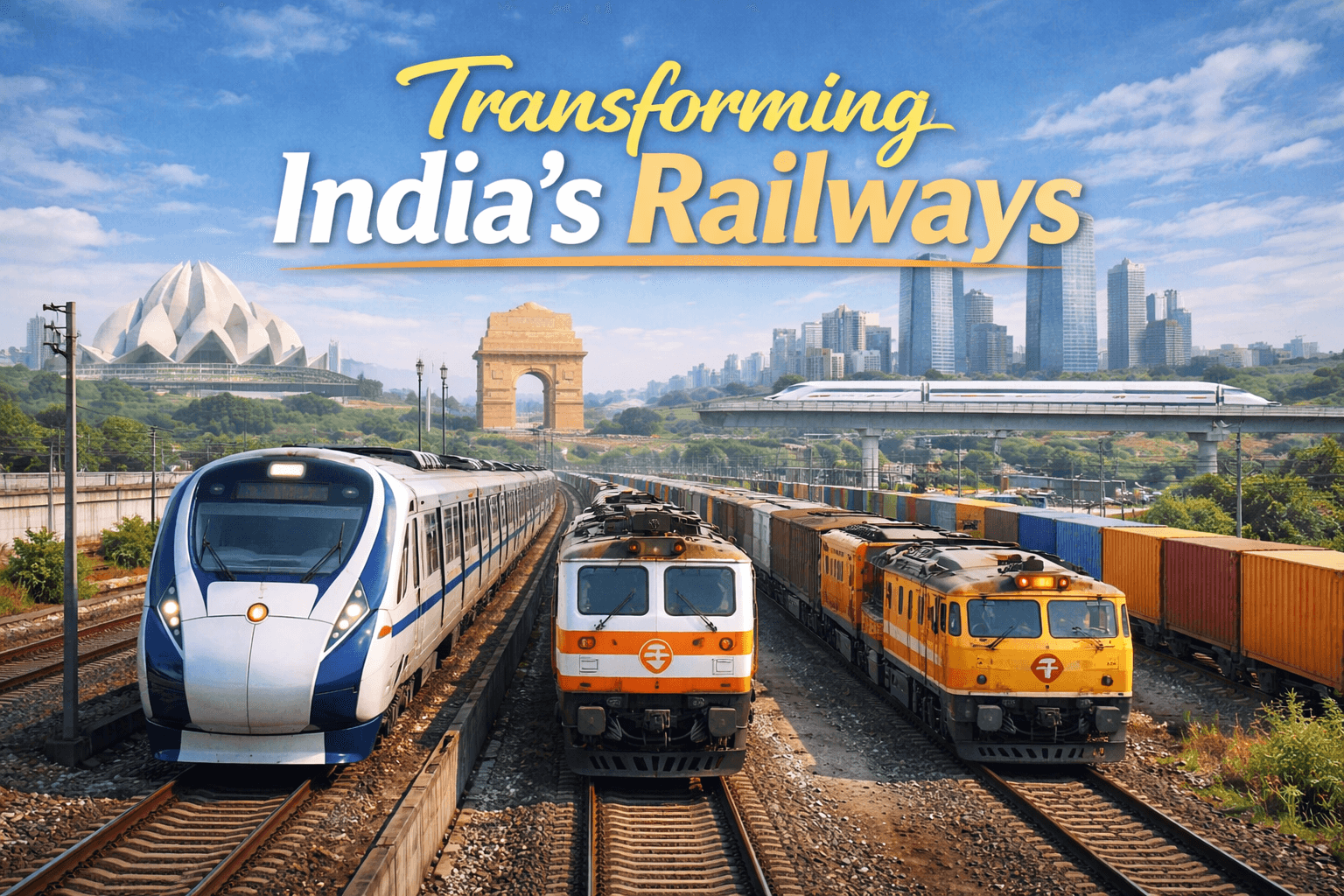
India has done something extraordinary - something that could have been thought to be outrageous even ten years ago. Now its railroad system spans more than 68,000 kilometres of electrified rail, second only to the American electrified rail system. It is ahead of countries that have traditionally been regarded as leaders in rail excellence, such as China and Japan. A figure to linger at. One of the nations that maintained the use of steam locomotives until the late 20th century is currently among the world leaders in railroad infrastructure. The magnitude of the change is historic.
Recently the Ministry of Railways has verified that 99.2 percent of the broad-gauge network in India has been electrified, a goal first projected in 2014 and deemed quite impossible a few years ago. Engineers have been on the fields in the last 10 years crossing mountains, deserts, floodplains and thick urban corridors to lay overhead electric lines on the national grid. India has created something out of the ordinary in pure infrastructure terms. But alas, get on a busy platform in a medium-level station at any weekday afternoon, and a different tale commences.
Electrification is not merely a mere milestone that is symbolic in nature, it radically changes the way railways are conducted. Electric locomotives are quicker to start, less costly to operate and much cleaner than the diesel engines. These allow more efficient operations, increased energy consumption, as well as higher possible speeds. This transition will save Indian Railways more than 13000 crore a year in fuel. Outside the economic front, electrification is an important part of the climate strategy in India. The railways also aspire to become a net-zero carbon emitter in 2030, which is a dream to a system that has more than 13 million passengers per day.
In its absence, there would be no possible efforts such as semi-high speed corridors, modern train sets and freight optimisation. It allows it to move forward - but not necessarily.
This is where the contradiction is obvious. Although the infrastructure of the railway system has been modernised at an alarming pace, the same has not been true with the passenger experience. Trains in most routes that are not of premium grade continue to travel at an average speed of 50 to 60 km/h. This is not a breakdown of electrification - it is a constraint of the larger ecosystem. The speed is an issue of the quality of the tracks, signalisation systems, traffic density, and the safety systems. The availability of close to 30, 000 level crossings in the Indian railway network is one of the greatest limitations. The crossings are a form of bottleneck that restricts the speed at which trains can travel. Contrarily, Japan has over decades undergone a systematic process of removing level crossings that allows its trains to operate more reliably and at a higher speed. This can not be resolved by electrification by itself, but it has to be accompanied by structural improvements. Another problem is punctuality. Historical official on-time performance of Indian Railways has been reported as between 70 to 75 percent with the maximum on time delay of 15 minutes. This is a huge difference by international criteria. The Shinkansen in Japan has second delay, rather than minutes. Even minute delays by trains can result in people being apologized. It is not only the technological difference but also the cultural and operational difference.
Still on the experience at the station, it is heavily inconsistent beyond the trains themselves.
New Delhi Railway Station and Howrah Junction are the major railway stations in India, and are among the busiest in the world. The bulk of them with which they have to deal day by day is appalling. However, infrastructure in most stations is not able to keep pace. The systems of real-time train information are not always reliable. Advertisements are not clear. During peak seasons, platforms would have many users, particularly the ones that are not utilized on a regular basis. To the elderly travelers, those with disabilities, as well as first time travelers, the system may be very difficult to navigate. Though the situation is being improved, the accessibility and passenger comfort remains a wide range across stations. These are not as large-scale engineering problems as electrification. They are operational issues, they need to be mindful, accountable and it needs to be more passenger-focused design thinking.
Any comparison with countries such as Japan is usually treated as unjust yet they are informative.
The railways in Japan are not only fast but precise. The Shinkansen has an average delay of seconds in a year. The operations of the station are well coordinated down to the minute, such as the amount of time taken to board the train, cleaning of the station among others. Such a degree of accuracy does not happen by chance. It is the outcome of decades of unremitting enhancement, rigorous accountability structures, and the culture of reliability. Another interesting comparison is a comparison with China. Within 20 years, it has created the biggest high-speed railway system in the world -more than 40000 kilometres. They have trains that travel at a speed of over 300km/h at a punctuality rate of over 95 percent. The achievements of China are not only in the development of infrastructure, but also in the congruence of the infrastructure with efficiency in operations and passenger experience.
The Indian ambitions can be traced in the launch of the Vande Bharat Express. Such new train sets developed indigenously and also modern are the new way forward of Indian Railways. They have additional features such as automatic doors, onboard information systems, better seating arrangements and GPS-based systems, improving the passenger experience to a much better level. The Vande Bharat trains that are capable of 160 km/h are a move in the right direction towards semi-high-speed travel in India. They however also point at the gap that exists. In most lines, the capabilities of these trains are limited by the quality of the tracks, the signalling and safety systems.
In basic terms: the trains are prepared, however the system surrounding them is not completely prepared.
The disconnect between infrastructure accomplishment and passenger experience can only be filled with a multi-layered approach. Track upgrades and renewals need to be done to enable higher speeds. The current committed freight corridor project will be instrumental in that it will decrease congestion in main lines by isolating freight and passenger traffic. The most significant change that can be introduced into India is signalling modernisation. The replacement of traditional systems with the latest technologies such as automatic block signalling as well as communications based train control can greatly enhance speed and safety. The single most chronic of the bottlenecks of the system will be taken out by the elimination of level crossings with overpasses and underpasses. A human factor is also important. With infrastructure, training, communication and accountability have to change. The passengers are supposed to be given correct and real time information. Efficiency should be adopted in issues of complaints. The system needs to be made more receptive to its service.
The achievement of electrification of railroads in India is a fact. It is a symbol of years of hard work, organization, and engineering quality. Not many cities have undergone the transformation on the scale, within this little time.
But infrastructure is not sufficient to be a success.
An all-electric network is not necessarily associated with swifter travels, improved timekeeping, and a more comfortable experience of the passengers. These results demand another form of investment one that concentrates on the operations, systems and quality of service. India is on the top list in terms of infrastructure today. The second difficulty is to increase the experience metrics, the ones passengers experience.
India has already demonstrated that it could develop on a large scale.
The question raised is whether it can perform at normal.
Visit Karostartup for more insights into the intersection of technology, policy, and the future of India.
Quick Share