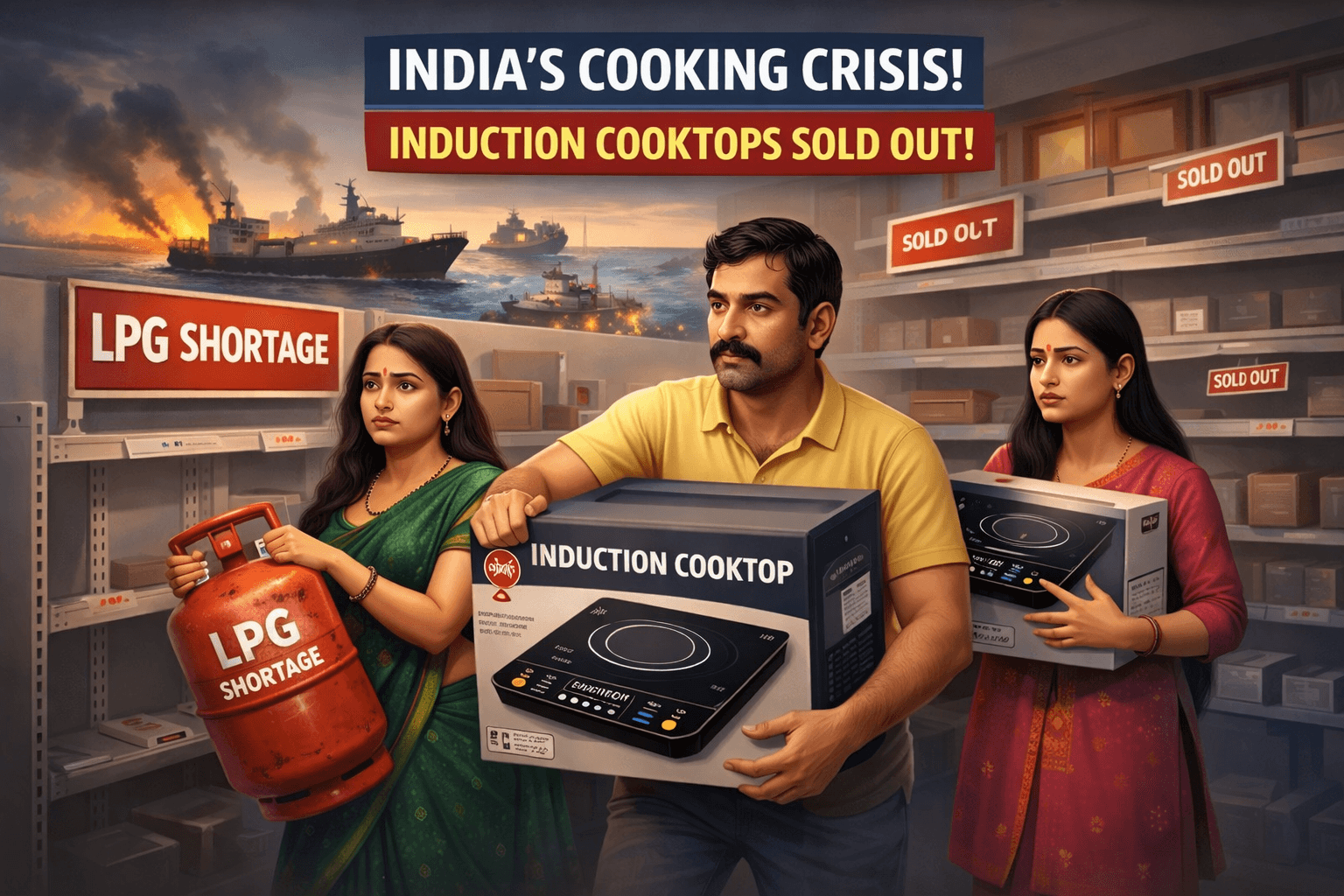
E-commerce platforms report sales surging up to 30 times as the Iran-Israel-US conflict chokes India's cooking gas supply chain
In living rooms, kitchens, and WhatsApp groups across India, the same anxious question is being asked: will the gas cylinder last? And in the frantic search for an answer, millions of Indians are doing something they have never done before — scrambling to buy an induction cooktop.
What began as a geopolitical crisis thousands of kilometres away in the Strait of Hormuz has, within days, upended the daily cooking routines of ordinary Indian households. The ongoing Iran-Israel-US conflict has severely disrupted global energy supply chains, and India — which depends on the narrow Persian Gulf waterway for nearly 90 percent of its LPG imports — is now staring at a cooking gas crunch of alarming proportions.
The consequences have been swift, chaotic, and deeply personal. Across Mumbai, Delhi, Bengaluru, Kolkata, Chennai, Hyderabad, Chandigarh, and Pune, consumers are panic-buying induction cooktops, electric kettles, rice cookers, and microwave ovens at a pace that has completely overwhelmed supply chains. Shelves in retail stores are empty. Quick commerce apps are flashing "sold out." Waitlists are forming on Flipkart and Amazon . And the frenzy shows no sign of slowing.
The scale of the demand shock has left even industry veterans speechless.
According to a Flipkart spokesperson, the platform witnessed an unprecedented surge in induction sales, with sales volumes quadrupling in just four to five days compared to the preceding weeks. That figure alone would be remarkable under any circumstances. But it was Amazon India that posted numbers that have truly stunned the market.
Amazon India reported that sales of induction cooktops rose 30-fold over just two days, while rice cookers and electric pressure cookers saw a fourfold increase during the same period.
Quick commerce giants Blinkit, Zepto, and Swiggy Instamart began flashing "Sold Out" or "Unavailable" on every induction cooktop search, unable to keep pace with the rush for electric alternatives.
Physical retail was no different. Shibashish Roy, CEO and MD of Croma, said their average daily run rate surged to nearly three times usual levels , and customers were purchasing multiple units at a time — something that was not common earlier — indicating precautionary buying.
At the street level, the desperation was even more visible. Retail sellers reported moving between 50 and 70 induction units per day, with many stores in major cities depleting their entire stock in a matter of hours. At a Prestige showroom in Chandigarh's Sector 22-B, the sales manager reported selling more than 30 units daily, compared to just one or two units per day before the crisis.
In Kerala, one appliance chain head noted that daily sales had jumped from around 35–40 induction cookers to nearly 150.
To understand why Indians are stripping store shelves of electric cooktops, one must look westward — to the Persian Gulf, where the world's most strategically vital shipping lane has become a flashpoint.
The US-Israel-Iran conflict has effectively strangled the Strait of Hormuz, choking approximately 90 percent of India's LPG imports and triggering a supply crunch that the government has been struggling to manage. With priority in domestic LPG allocation being given to homes and hospitals, commercial establishments have been left to fend for themselves, and households face refill delays that stretch beyond three weeks.
The government's commercial gas halt and a 25-day domestic refill gap sparked widespread public panic, as the compression of supply through the Strait of Hormuz made future availability deeply uncertain.
The financial markets have responded accordingly, with appliance stocks surging. Companies such as Borosil, Bajaj Electricals, TTK Prestige, and Hawkins saw notable gains as investor confidence in electric cooking alternatives soared. Shares of Jaipan Industries, TTK Prestige, and Butterfly Gandhimathi surged up to 20 percent amid the LPG shortage fears.
The crisis has not struck uniformly, but its footprint now covers virtually every major urban centre in the country.
Kolkata has been among the hardest hit. The Indane LPG Cylinder Distributors Association of West Bengal described conditions as catastrophic for the commercial sector, with many restaurants and eateries reducing operations. Some establishments, including Balaram Mullick, have cut production in half, while others such as Bawarchi and Bhooter Raja have shut down entirely. The food industry, the spokesperson said, is on the verge of collapse.
For private households, supplies are being maintained at roughly 70 percent of the regular quota. Many residents are stocking up on cylinders and some are reportedly purchasing them at inflated prices through unofficial channels, fearing the situation could worsen.
Delhi and Noida are witnessing their own version of the crisis. Black market LPG cylinder prices in parts of Delhi and Noida have reportedly surged to between ₹2,000 and ₹3,000. The surge in induction cooktop purchases has been particularly pronounced in Delhi, Kolkata, and Uttar Pradesh, where consumers are preparing for potential further price hikes and supply disruptions.
Mumbai faces a severe commercial crunch. Approximately 20 percent of Mumbai eateries have already closed due to the shortage of commercial 19-kg cylinders, with 50–60 percent more reported to be at risk by the weekend. Small restaurants and roadside stalls are snapping up high-power induction hobs as an emergency measure.
Bengaluru has seen near-total stockouts on quick commerce platforms. Key neighbourhoods including MG Road, Ashok Nagar, SG Palya, and CV Raman Nagar reported zero available induction cooktop stock, while Mumbai's Powai area saw complete sellouts. In Delhi, areas such as Greater Kailash I, Greater Kailash II, and Kalkaji showed out-of-stock listings. Similar shortages were reported in Kolkata's Behala and Chennai's Kodambakkam.
Chennai and Pune are experiencing the same pattern. In Chennai's T. Nagar, home appliance store owners reported a sudden increase in induction stove sales over three to four days, with customers citing the inability to get LPG cylinders as the primary reason for switching. In Pune's Raviwar Peth market, wholesalers noted a sharp parallel rise in demand for induction-compatible utensils such as flat-bottom pans and cookers, as buyers looked to equip their kitchens for electric cooking.
The sudden demand surge has exposed just how fragile India's appliance supply chain is when confronted with a genuine emergency.
Budget induction cooktops from brands like Lifelong, Pigeon, and Prestige — which were priced around ₹1,200 just the previous week — vanished first, leaving only higher-end multi-mode models priced above ₹3,000 available on Amazon and Flipkart. Delivery delays in Kolkata and Delhi are compounding the restock problem, as logistics networks struggle to move inventory fast enough to meet demand.
Amazon India confirmed discussions are underway with suppliers and distribution partners to expedite supply in response to the sudden surge. Manufacturers, caught off guard, are scrambling to ramp up production lines that were not calibrated for anything close to this level of demand.
The panic-buying wave has extended well beyond induction cooktops. Demand for electric rice cookers, microwave ovens, and OTG appliances has also risen sharply as households search for any and all alternatives to LPG-based cooking . Sales of electric kettles at Croma have nearly doubled during the same period as the induction cooktop rush.
The surge in induction cooktop demand has also driven a parallel rush for induction-compatible cookware, as consumers discover that their existing aluminium and traditional steel vessels are incompatible with induction technology.
Experts and retailers are urging consumers to be clear-eyed about what induction cooking involves before rushing to purchase.
Induction cooktops require special cookware — usually stainless steel or cast-iron utensils with flat bottoms — meaning many Indian households will need to invest in new pots and pans in addition to the cooktop itself.
The electricity bill impact also needs consideration. A home that normally uses around 180 units of electricity per month could see consumption rise to approximately 300 units after switching to induction cooking for all meals. Depending on the household's tariff slab, this could translate to a monthly electricity bill increase of ₹600 to ₹1,200.
Most experts advise against panic and instead recommend thinking of induction cooktops as a useful backup rather than a complete replacement for gas cooking. The future Indian kitchen, many suggest, will likely include both: the familiar gas stove for everyday meals and an induction cooktop for emergencies or supplementary use.
The government has attempted to calm public concerns by stating that there is no severe national crisis and that domestic LPG production has been increased to help stabilise supply. Despite these assurances, rising fuel prices and delays in refill bookings have continued to fuel uncertainty and precautionary buying. Authorities have also invoked the Essential Commodities Act to prevent hoarding and stabilise availability.
However, with the conflict in West Asia showing no immediate signs of resolution, retailers say demand for electric cooking appliances is expected to remain elevated, and restocking timelines are highly uncertain.
What is unfolding across India's kitchens right now is more than just a consumer frenzy. It is a stress test of the nation's energy import dependency, the resilience of its domestic supply chains, and the adaptability of its 1.4 billion people when the most basic of daily routines — cooking a meal — is suddenly thrown into doubt.
For now, those lucky enough to have secured an induction cooktop are counting themselves fortunate. For the millions still waiting for a restock, the gas cylinder — and the hope that it holds out a little longer — remains the only option.
Inputs from BusinessToday, The Week, Free Press Journal, The Tribune, News Today, and The Swipe Up.
Quick Share