Stockholm, March 2026 — In a Silicon Valley obsessed with headcount, burn rates, and decade-long paths to profitability, a two-year-old Swedish startup just made every traditional venture-backed company look deeply inefficient.
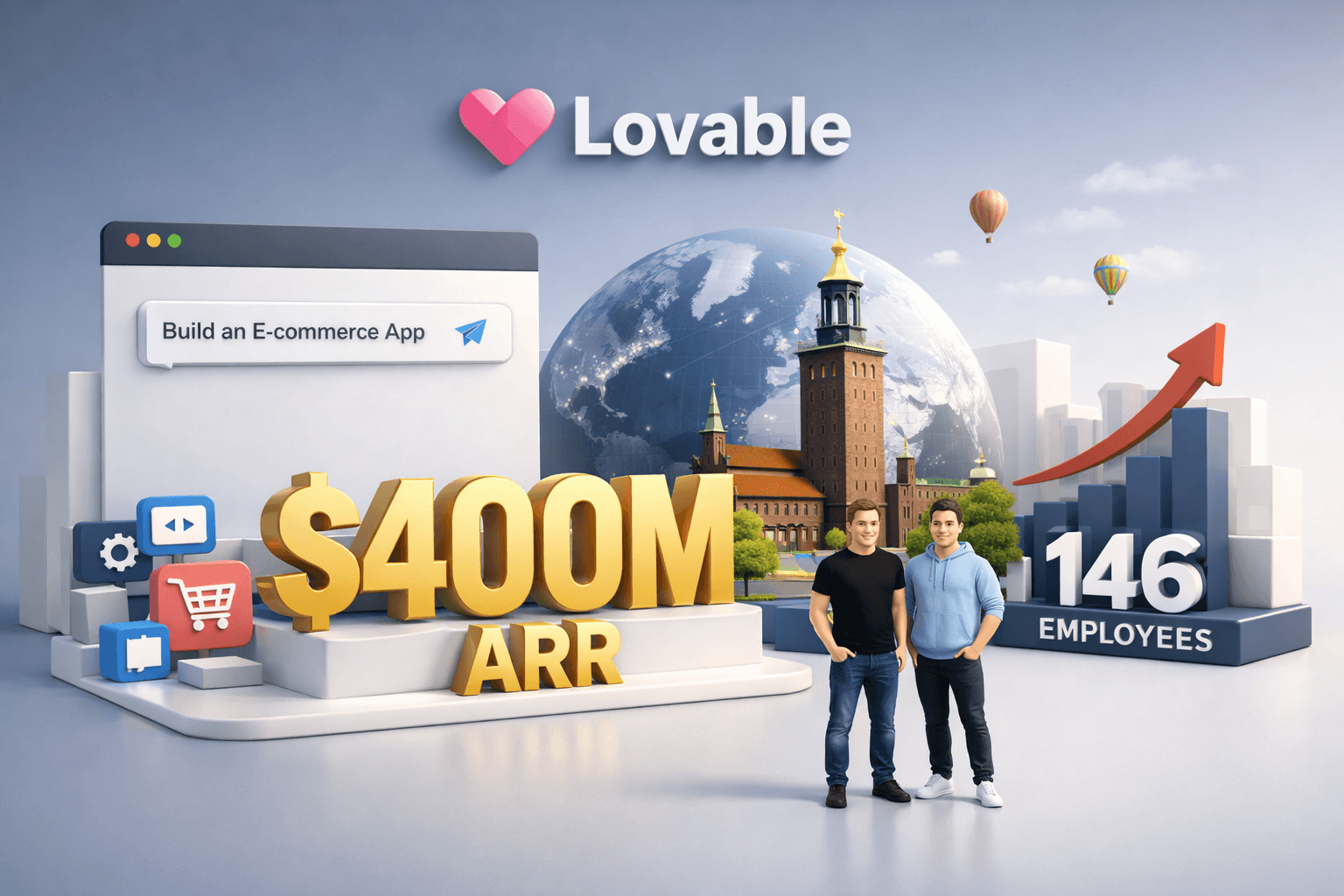
Lovable, an AI-powered app-building platform founded in 2023, has crossed $400 million in Annual Recurring Revenue — with only 146 employees on its payroll. More stunning than the number itself is the speed. The company added its last $100 million in ARR in a single month.
Let that sink in. One hundred million dollars. Thirty days.
At its core, Lovable is deceptively simple to explain. You type what you want to build — in plain, everyday English. Lovable's AI reads your instructions, writes the code, assembles the application, and deploys it. No developer. No designer. No technical co-founder required.
It is, in essence, a software factory that fits inside a chat box.
The product sits at the sharpest edge of the "vibe coding " movement — a growing wave of AI tools that are systematically removing the technical barrier between an idea and a working product. But while many competitors have talked about democratizing software development, Lovable has actually monetized it at a scale nobody anticipated.
The company's financials read less like a startup and more like a thought experiment somebody forgot to tell was impossible.
$400M ARR with 146 people works out to approximately $2.7 million in revenue per employee per year.
For context, Google — one of the most profitable companies in human history — generates roughly $1.6 million per employee. Meta sits at around $1.9 million. Lovable, a company that didn't exist three years ago, is beating both of them on the metric that arguably matters most: revenue efficiency.
Salesforce, the CRM giant that became the gold standard of SaaS growth, took ten full years to cross $1 billion in ARR. At Lovable's current trajectory, industry observers believe the company could cross that same threshold in under two years from founding.
Lovable was founded in Stockholm, Sweden by Anton Osika , 35, and Fabian Hedin, 26. The duo built the company on a straightforward but radical premise: if AI can write production-quality code, then the bottleneck in software creation is no longer talent — it's imagination.
The market agreed, loudly.
The company has raised $550 million in total funding, most recently closing a Series B round at a staggering $6.6 billion valuation, led by CapitalG — Google's independent growth fund — and Menlo Ventures. That valuation puts Lovable among the fastest companies in history to reach unicorn status, then blow past it entirely.
For a generation of startup founders, the playbook was fixed and familiar: raise a seed round, hire aggressively, build an engineering team of hundreds, scale slowly, and maybe — maybe — reach profitability in seven to ten years.
Lovable has torched that playbook.
Its model is the opposite in almost every dimension. Keep the team tiny. Let AI handle the engineering heavy lifting. Invest in product and distribution. Scale revenue without scaling headcount. The result is a company that grows like a technology platform but runs lean like a boutique consulting firm.
This is not simply an impressive outlier. It is increasingly being read by founders, investors, and operators as a new template — one that may define the next decade of company building.
The math is unforgiving for legacy structures. A 1,000-person engineering team burning $200 million a year in salaries is not competing on the same playing field as a 146-person AI-native company generating $400 million. One of these models is sustainable. The other is a slow emergency.
What Lovable represents goes beyond one company's success story. It is an early, vivid proof point of something the technology industry has theorized about for years but rarely seen at this scale: AI as a genuine force multiplier for human productivity, not just a feature or a workflow enhancement.
The age of the thousand-person engineering org is not ending with a bang. It is ending quietly, deal by deal, month by month, as AI-native companies like Lovable demonstrate that software can be built faster, cheaper, and at greater scale with a fraction of the traditional workforce.
For employees, founders, investors, and enterprise leaders alike, the message arriving from Stockholm is clear and a little uncomfortable:
The rules changed. And the scoreboard already reflects it.
Lovable is headquartered in Stockholm, Sweden. The company's platform is available globally.
Quick Share