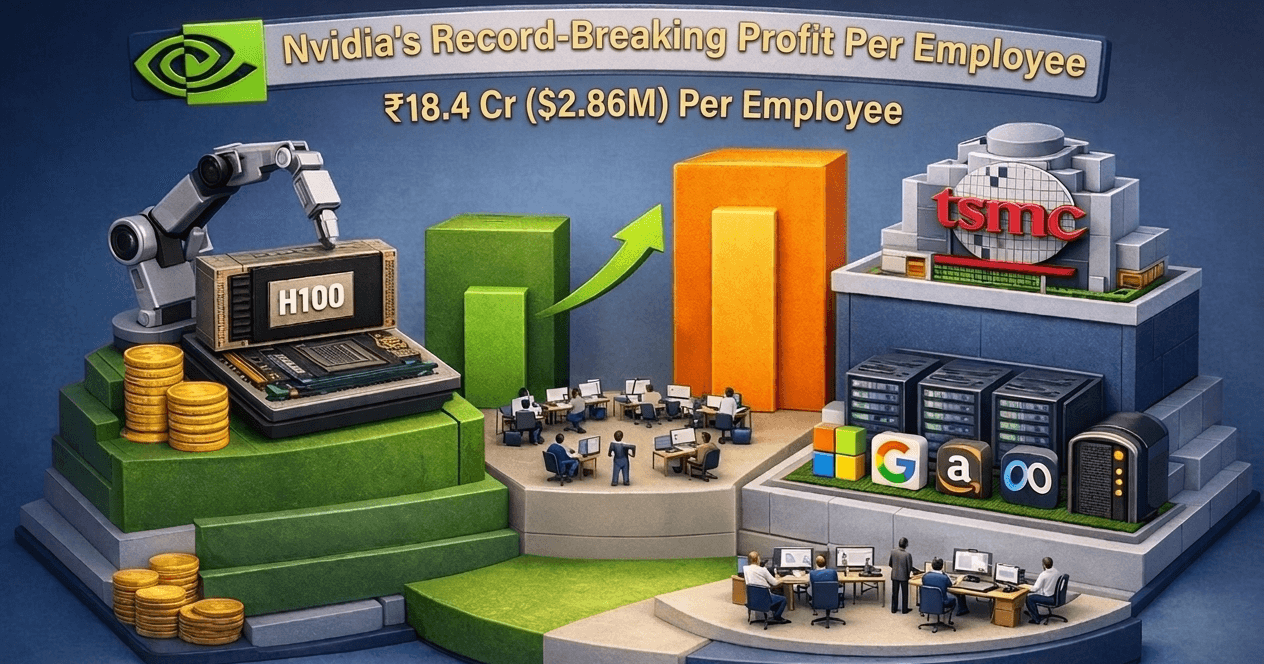
In a milestone that underscores just how dominant Nvidia has become in the artificial intelligence era, the American chipmaker now generates approximately ₹18.4 crore (~$2.02 million) in net profit per employee annually — a figure that has no parallel in modern corporate history. As the company closes out FY2026 with revenues of $215.9 billion, a staggering 65% jump year-on-year, the numbers tell the story of a company that has quietly become the most efficient profit machine on the planet.
Nvidia's financial trajectory over the past two fiscal years reads less like a corporate earnings report and more like a work of speculative fiction. In FY2025, the company posted total revenues of $130.5 billion and a net income of approximately $72.8 billion. By FY2026, revenues had surged to $215.9 billion while net income held strong at around $73.5 billion.
What makes this truly extraordinary is the denominator in this equation: Nvidia employs just about 36,000 people — a headcount that has remained essentially flat even as revenues exploded. The result is a net income per employee of roughly $2.02 million in FY2025, translating to approximately ₹17–18.4 crore, with FY2026 figures pushing that figure even higher toward $2.86 million, or close to ₹24 crore per employee.
To put that in perspective, Apple — long considered one of the most profitable companies in the world — generates around $600,000 in profit per employee. Google's parent Alphabet sits at roughly $400,000. Nvidia doesn't just lead the pack; it laps it.
Several structural forces have converged to make Nvidia's profit efficiency almost unprecedented in corporate history, and understanding them requires looking at both how the company is built and the moment in history it finds itself in.
The AI chip monopoly and its extraordinary pricing power. Nvidia's H100 and H200 GPUs — the workhorses of modern artificial intelligence — sell for anywhere between $25,000 and $40,000 per unit, commanding gross margins above 75%. These are not interchangeable commodity products. They are, as analysts have often described them, the picks and shovels of the AI gold rush, and Nvidia holds a near-monopoly on the mine. Competing alternatives from AMD, Intel, and even custom silicon developed in-house by Google and Amazon have so far failed to dent Nvidia's dominance in any meaningful way. The combination of proprietary CUDA software architecture, years of developer ecosystems built around it, and sheer performance benchmarks means customers keep coming back — and paying whatever Nvidia charges.
The fabless model keeps the payroll lean. One of the most important and underappreciated aspects of Nvidia's business is what it does not do: manufacture chips. That capital-intensive task is handed off entirely to TSMC, the Taiwanese semiconductor giant. This fabless model means Nvidia does not need tens of thousands of factory workers, engineers running production lines, or the enormous infrastructure that comes with physical manufacturing. The company focuses almost exclusively on design, architecture, software, and sales — activities that require far fewer people but generate disproportionate returns. In a world where traditional chip companies like Intel employ well over 100,000 people, Nvidia's 36,000-strong workforce is a deliberately chosen structural advantage.
Revenue scales; headcount doesn't. Perhaps the most remarkable feature of Nvidia's recent growth is how it has defied the conventional relationship between revenue and hiring. In FY2026, revenues grew 65% year-on-year. The employee count, by contrast, barely moved. This is a phenomenon more typically associated with software companies — once the code is written, you can sell it a million times without hiring a million people. Nvidia has essentially applied that logic to hardware. Once a chip architecture is designed and the software stack is built around it, scaling revenue is largely a matter of taking more orders, not adding more engineers. The leverage this creates is extraordinary, and it shows up directly in the per-employee profit numbers.
An AI supercycle that shows no signs of slowing. The final piece of the puzzle is demand — and the demand for Nvidia's products right now is unlike anything the technology industry has seen in decades. Every major hyperscaler on the planet is in the midst of a multi-year, multi-hundred-billion-dollar buildout of AI infrastructure. Microsoft, Google, Amazon, and Meta have collectively committed to spending over $300 billion on AI-related capital expenditure in 2026 alone, and virtually all of it is built on Nvidia hardware. The company has become infrastructure — as essential to the modern internet as the undersea cables that carry data across oceans. That kind of structural demand creates pricing power, long-term contracts, and a revenue visibility that most companies can only dream of.
The implications of Nvidia's per-employee profitability extend well beyond the company itself. It represents a new benchmark — and a new question — for how we think about the relationship between a company's workforce and its financial output.
For decades, the most celebrated companies in the world were celebrated in part for the scale of their workforces. Jobs created was a proxy for value created. Nvidia's ascent suggests a different model is possible — one where a relatively small, highly skilled group of people, empowered by the right technology and operating in the right market at the right moment, can generate wealth at a scale that once required armies of workers.
That is both a remarkable achievement and, for many observers, a quietly unsettling one. As Nvidia continues to build the infrastructure that will power the next generation of artificial intelligence, the company's own story serves as a case study in what that technology makes possible: more output, from fewer people, at margins the world has never seen before.
All financial figures are based on reported and projected earnings for Nvidia's fiscal years 2025 and 2026. Currency conversions approximate ₹86 to $1.
Visit Karostartup for more insights into the intersection of technology, policy, and the future of India.
Quick Share