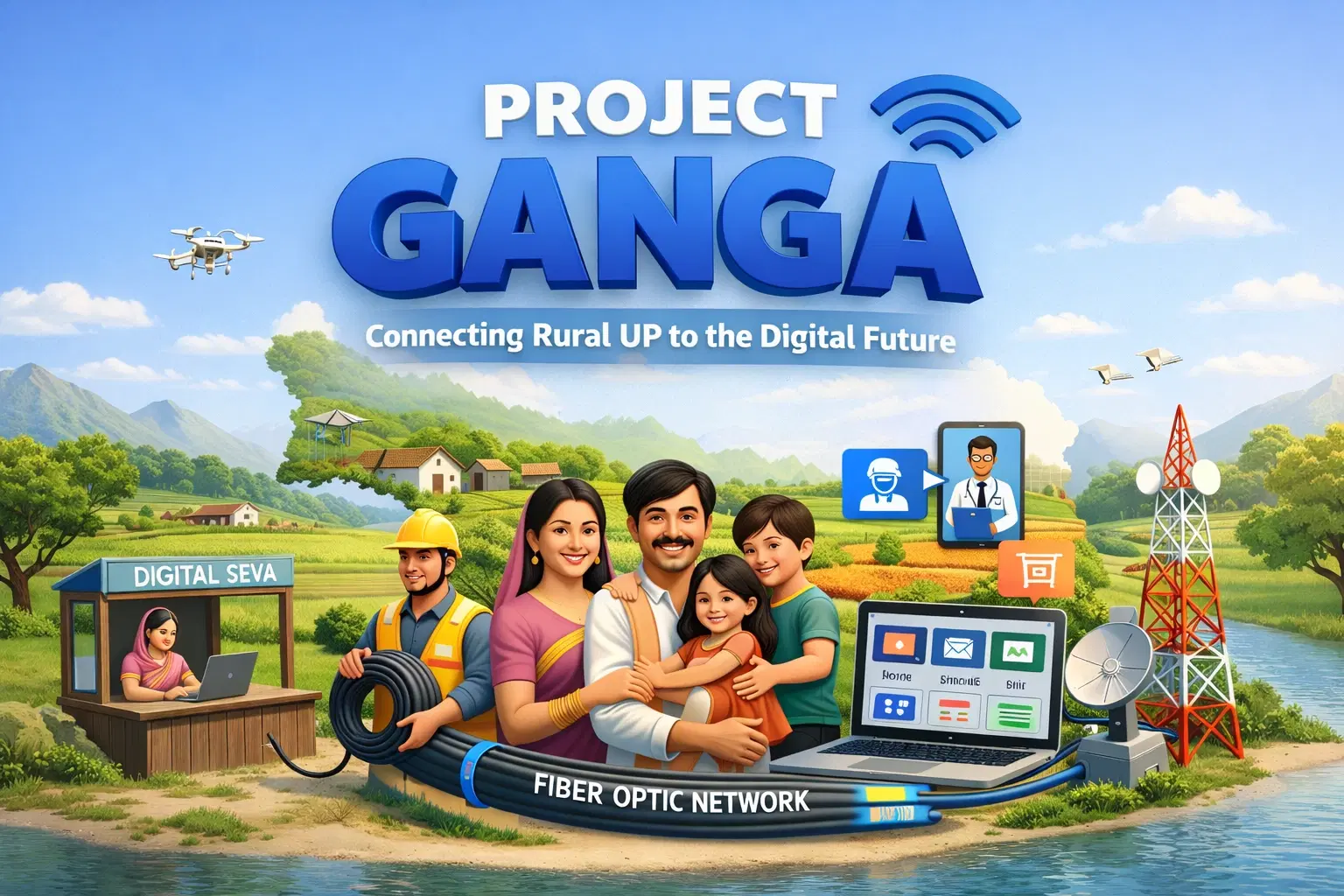
In what could be one of the most transformative digital infrastructure initiatives in India's most populous state, the Uttar Pradesh government has officially launched PROJECT GANGA — an acronym for Government Assisted Network for Growth and Advancement — a landmark broadband connectivity program aimed at bringing high-speed internet to the deepest corners of rural Uttar Pradesh.
The initiative was formalized through a Memorandum of Understanding (MoU) signed between the Uttar Pradesh government and OneOTT Intertainment, a venture backed by the powerful Hinduja Group, signaling serious private sector commitment to India's rural digital transformation story.
Project GANGA is not just an internet rollout. It is a comprehensive socio-economic intervention disguised as a connectivity drive. At its core, t he initiative seeks to connect 20 lakh (2 million) rural households across Uttar Pradesh with reliable, high-speed broadband internet — and to do so within the next 2 to 3 years.
But the ambition doesn't stop at laying cables. The program is designed to create an entire digital economy ecosystem at the grassroots level, generating livelihoods, empowering women, and bringing border communities into the mainstream of India's digital growth story.
The sheer scale of Project GANGA is staggering when you break it down:
20 lakh homes will be connected with high-speed broadband — a figure that translates into an estimated 1 crore (10 million) people directly impacted by the initiative . In a state where hundreds of thousands of villages still struggle with poor or zero internet connectivity, this represents a genuine leap forward.
The project is also projected to generate 1 lakh jobs — both direct and indirect — across the broadband installation, maintenance, customer service, and digital services sectors. This employment generation component makes Project GANGA as much a livelihood scheme as it is a technology project.
Perhaps the most innovative dimension of Project GANGA is its local entrepreneur model. The government plans to onboard 8,000 to 10,000 local entrepreneurs at the Nyaya Panchayat level — the most granular unit of local governance in Uttar Pradesh — to act as the last-mile delivery agents for broadband services.
These entrepreneurs will not just be resellers. They will be the backbone of the digital infrastructure in their communities, managing connections, assisting users, and building small businesses around the digital ecosystem that Project GANGA creates.
To make entrepreneurship accessible and not just aspirational, the government has announced ₹5 lakh interest-free, collateral-free loans for young digital entrepreneurs who want to participate in the program. This removes the single biggest barrier that prevents rural youth from entering the formal business economy — access to startup capital without the burden of debt servicing or asset pledging.
In a state that has historically grappled with gender gaps in economic participation, Project GANGA takes a deliberate and bold stand. 50% of all entrepreneur seats under the program are reserved for women.
This means that out of the 8,000–10,000 local digital entrepreneurs to be onboarded, at least 4,000–5,000 will be women from rural Uttar Pradesh . Combined with the interest-free loan facility, this creates a genuine pathway for rural women to become business owners, not just beneficiaries of government schemes.
The move aligns with the broader national push toward women-led development and could serve as a replicable model for other states looking to blend digital infrastructure with gender equity.
Project GANGA takes particular care of Uttar Pradesh's border districts — areas that have historically been underserved due to their remote geography and proximity to international boundaries. The districts in focus include:
These districts share borders with Nepal and have long suffered from developmental lag. High-speed internet connectivity in these regions could unlock access to education, telemedicine, e-commerce, digital banking, and government services for communities that have been cut off from these opportunities for decades.
The strategic inclusion of border districts also carries a national security and social integration dimension — connected communities are more informed, more economically stable, and better integrated into the national mainstream.
The choice of OneOTT Intertainment, a Hinduja Group entity, as the private sector partner lends significant credibility and capital muscle to Project GANGA. The Hinduja Group is one of India's oldest and most diversified conglomerates, with deep expertise across banking, infrastructure, media, and technology.
OneOTT Intertainment's involvement suggests that the broadband rollout will likely be bundled with content and digital services — potentially making the connectivity offering more attractive and stickier for rural households who might otherwise struggle to see the immediate value of a broadband subscription.
The MoU framework also signals that this is not a purely government-funded project. Private investment will be central to execution, which typically improves delivery timelines and operational efficiency compared to purely state-run programs.
Uttar Pradesh, with a population of over 24 crore people, is effectively a country within a country. What happens in UP reverberates across India's economic, political, and social landscape. A successful Project GANGA could:
Most critically, if the entrepreneur model works at scale, Project GANGA could become a blueprint for rural digital economy building that other Indian states adopt, replicate, and adapt.
The 2–3 year timeline is ambitious. Rolling out broadband to 20 lakh homes across UP's vast and varied terrain — from the Terai belt to the Bundelkhand plateau, from dense urban peripheries to remote border villages — will require flawless execution, sustained political will, and genuine community-level buy-in.
The success of the entrepreneur model will be crucial. If local entrepreneurs are properly trained, adequately financed, and effectively supported, they become self-sustaining engines of digital adoption. If the program turns into just another government scheme with poor last-mile execution, the infrastructure investment risks going underutilized.
For now, the ambition is undeniable. Project GANGA represents the kind of thinking that India needs as it races toward its Viksit Bharat 2047 vision — combining hard infrastructure with human capital development, private sector energy with public sector purpose, and technological progress with social equity.
The river Ganga has long been the lifeline of Uttar Pradesh. If Project GANGA delivers on its promise, a new kind of lifeline — digital, invisible, but equally vital — may soon flow through every corner of this ancient land.
Visit Karostartup for more insights into the intersection of technology, policy, and the future of India.
Quick Share