Bengaluru | March 2026
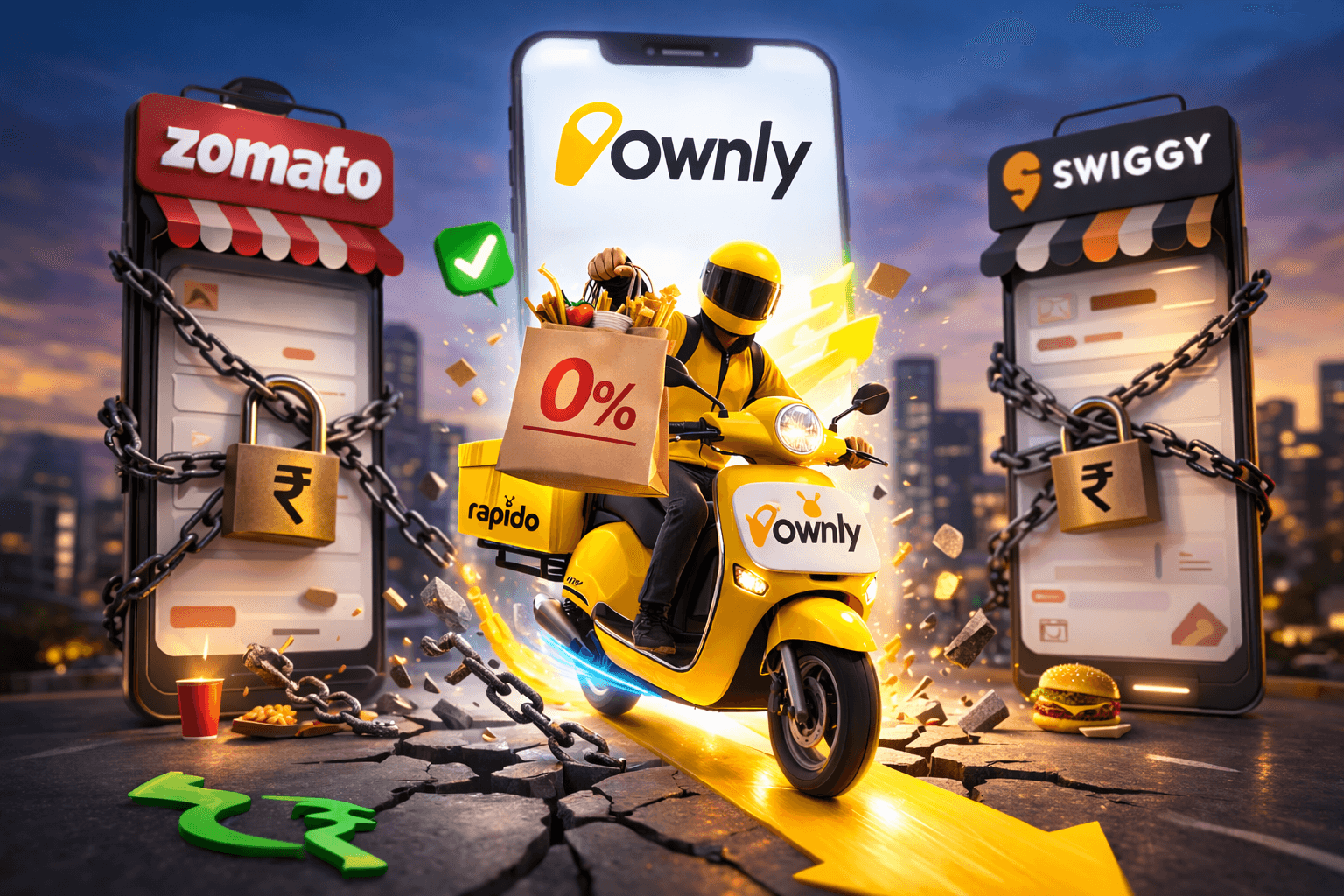
Rapido, the bike-taxi aggregator that once rattled the dominance of Ola and Uber in India's ride-hailing market, is now setting its sights on a far bigger and more entrenched battleground: food delivery. The Bengaluru-based startup has quietly launched Ownly, a standalone food delivery application, in its home city, marking its boldest diversification move yet and opening a fresh front against industry giants Zomato and Swiggy.
Rapido built its reputation by doing one thing differently — being cheaper. By deploying bike taxis at a fraction of the cost of four-wheelers, it carved out a loyal user base in tier-1 and tier-2 cities across India. Now, with Ownly, the company appears to be running the same playbook in food delivery: strip out the middleman margin, simplify the fee structure, and let price transparency do the marketing.
Ownly operates on a zero-commission model for restaurants. Rather than charging eateries a percentage of every order — a standard industry practice that typically ranges between 18% to 30% on platforms like Zomato and Swiggy — Ownly levies only a straightforward delivery fee on the consumer, calculated purely on the basis of actual logistics costs. No platform commissions. No hidden markups. No smoke-and-mirrors discounting.
To understand why Ownly's model is significant, one needs to understand the economics of food delivery as it currently stands in India.
For years, restaurant owners across the country have complained loudly about the commission structures imposed by dominant aggregators. A restaurant that sells a dish for ₹200 on its own menu might list it at ₹230 or ₹240 on an aggregator platform to absorb the commission cut, effectively passing the burden on to consumers. Alternatively, platforms run deep discount campaigns — often funded partly by restaurants — which create an illusion of savings while masking the true cost dynamics underneath.
The result is a system where consumers believe they are getting deals, restaurants struggle to maintain healthy margins, and the platforms capture an ever-growing slice of the transaction value.
Ownly's pitch to restaurant partners is direct: list your real, everyday prices without inflating them to cover commission costs. The promise to consumers is equally straightforward — what you see is what you pay, with no surprise charges or artificially engineered discounts.
Rapido is not entering this fight from a position of weakness. The company has raised $574 million (over ₹4,200 crore) in total funding to date, giving it a substantial financial runway to absorb the early-stage losses that are almost inevitable in the food delivery business.
More tellingly, Rapido posted FY25 revenues of approximately ₹934 crore, reflecting a robust 44% year-on-year growth — a signal that its core ride-hailing operations are generating healthy cash flows that can help cross-subsidise its food delivery ambitions in the short term.
The Bengaluru launch is currently a pilot, but given the city's status as India's startup and tech capital — and Rapido's own home turf — it represents a strategically deliberate entry point. Bengaluru's dense, food-delivery-savvy urban population makes it an ideal testing ground before any potential national rollout.
Rapido has accompanied the Ownly launch with a satirical courtroom-themed digital video commercial that pulls no punches. The film puts the food delivery industry's worst practices — hidden fees, misleading discounts, opaque price manipulation — quite literally on trial, before positioning Ownly as the transparent verdict the market has been waiting for.
The ad, live on Ownly's official YouTube channel, is designed to go beyond product promotion. It is a provocation — a direct, humorous indictment of how incumbent platforms have conditioned Indian consumers to accept a broken pricing system as normal. It is the kind of bold, adversarial brand communication that startups typically deploy when they want to signal to the market: we are here, and we are here to challenge the status quo.
The challenge ahead for Ownly is formidable. Zomato and Swiggy together control the overwhelming majority of India's online food delivery market, a segment that has matured significantly since the pandemic-era surge. Both companies have spent years and billions of dollars building logistics infrastructure, restaurant partnerships, consumer habit, and brand loyalty.
Rapido's advantage is its existing delivery fleet, its established brand recognition in urban India, and a value proposition that genuinely addresses a pain point that both restaurants and consumers have articulated for years. If Ownly can demonstrate in Bengaluru that the zero-commission model is operationally sustainable — that restaurants do actually list lower prices, that consumers do notice and prefer it, and that unit economics hold — it has a credible story to tell investors and expand aggressively.
The Indian food delivery market is large enough that even a meaningful share of it would represent enormous value. And if Rapido's disruption of the cab aggregator market taught observers anything, it is that in India's consumer internet space, a sharper value proposition backed by patient capital can move mountains.
Rapido's launch of Ownly is more than a product release — it is a strategic declaration. The company that proved bike taxis could humble Ola and Uber is now betting that price honesty can take on the Zomato-Swiggy duopoly. Whether the market rewards transparency over the deeply entrenched habits built by years of discount-driven delivery culture remains to be seen. But one thing is clear: the food delivery wars in India just got a new, and potentially formidable, contestant.
Ownly is currently live in Bengaluru. Rapido has not officially announced a timeline for expansion to other cities.
Visit Karostartup for more insights into the intersection of technology, policy, and the future of India.
Quick Share