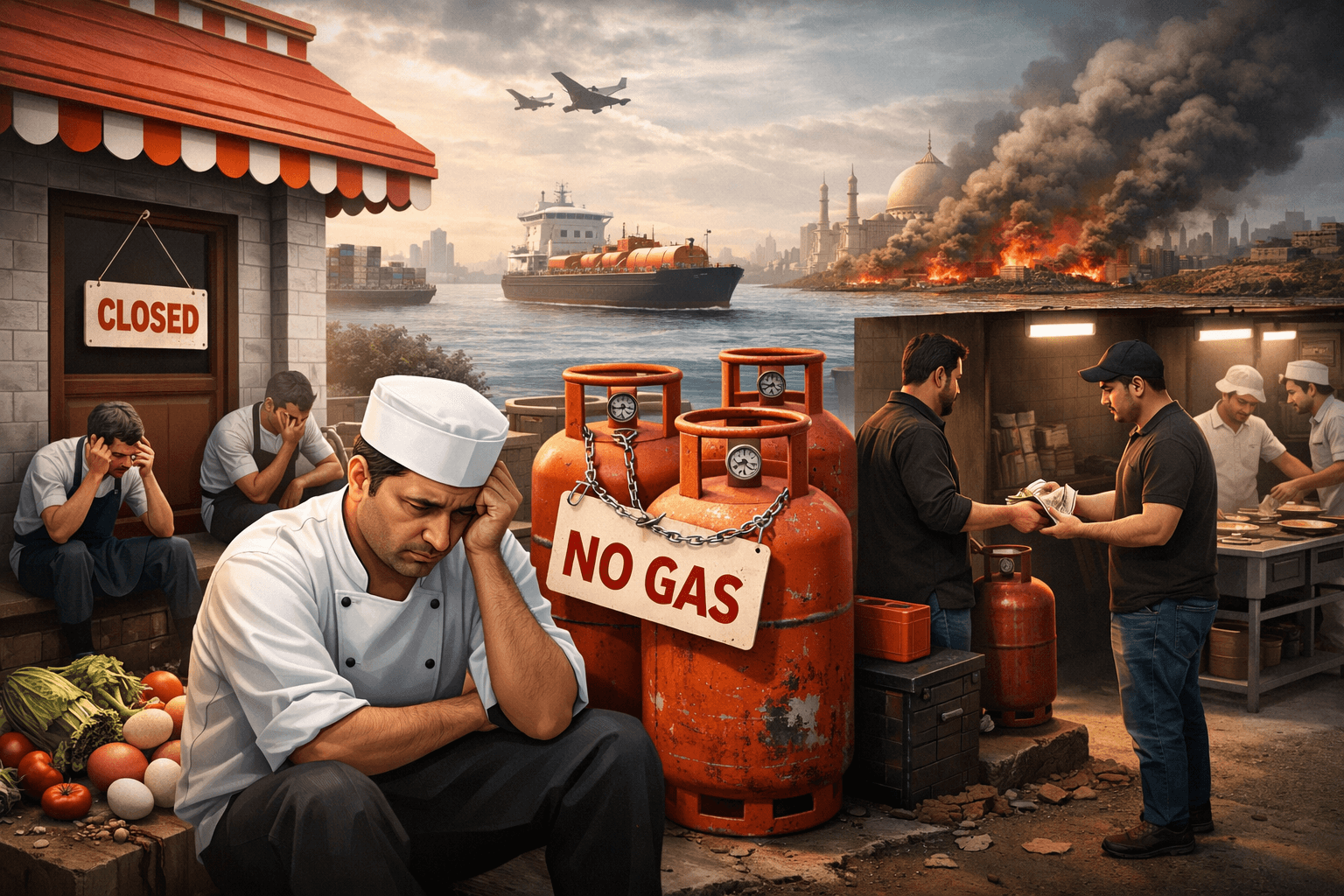
India's restaurant industry is staring down a crisis that has nothing to do with food quality, customer footfall, or economic slowdown — it stems from a conflict raging thousands of kilometres away. The ongoing war in the Middle East has disrupted global energy supply chains so severely that commercial LPG cylinders — the lifeblood of India's kitchens — are becoming dangerously scarce, and the country's food service sector is on the brink of a mass shutdown.
According to Sagar Daryani , President of the National Restaurant Association of India (NRAI) and co-founder and CEO of Wow! Momo Foods Pvt. Ltd., as many as 50 to 60 per cent of India's approximately 5 lakh restaurants could be forced to shut their doors within the next two to three days if the supply of commercial LPG cylinders is not restored to normal levels.
"Shutting would be a last resort; we are in the business of serving people ," Daryani told The Indian Express. "Restaurants will try to give you something — snacks, whatever they can manage. Nobody wants to shut. But in the larger sense, I think we're looking at two to three days before it becomes untenable."
This is not merely a supply chain hiccup. It is a full-blown crisis that threatens the livelihoods of millions — from restaurant owners and chefs to delivery personnel, suppliers, and daily wage workers who depend on the food service ecosystem.
India imports a significant portion of its LPG from the Middle East, particularly from countries like Saudi Arabia, Qatar, and the UAE. The region accounts for a substantial share of India's total LPG import requirements, making any geopolitical disruption there a direct threat to India's domestic supply.
The ongoing conflict — roughly 3,000 km from India's shores — has disrupted shipping lanes, slowed tanker movements, jacked up freight costs, and created widespread uncertainty among energy importers and distributors. Insurance premiums for cargo ships passing through conflict-adjacent waters have surged. Some suppliers have scaled back operations or delayed deliveries, creating a cascading shortage that is now felt at the most ground level: the kitchen of a neighbourhood restaurant.
What makes the current situation particularly dangerous is not just the actual shortage — it is the fear of shortage, which is driving irrational behaviour across the supply chain.
Daryani pointed out the dangerous ambiguity surrounding the situation. "There's either a misalignment or ambiguity, where a narrative is being created that LPG commercial cylinders are going to be banned or made unavailable. This is leading to a severe shortage of supply, which in turn is leading to black marketing, hoarding, and prices going up by 1.5 times. The fear within restaurants is about continuity."
This fear-driven hoarding is creating a self-fulfilling crisis. Distributors are holding back stock, middlemen are inflating prices, and smaller restaurants — which lack the purchasing power or storage capacity to stockpile cylinders — are being squeezed the hardest. A cylinder that once cost a certain price is now being sold at 1.5 times its usual rate on the black market, an unsustainable cost for restaurants already operating on razor-thin margins.
While large restaurant chains and quick-service restaurant (QSR) brands like Wow! Momo, Domino's, or McDonald's may have the financial reserves to absorb short-term shocks or pivot to alternative fuel sources, it is the small and medium restaurants — the dhabas, the tiffin centres, the neighbourhood eateries — that face existential risk.
These establishments typically operate on margins of 5 to 15 per cent. They cannot afford to pay black market prices for LPG, nor do they have the infrastructure to quickly switch to alternatives like piped natural gas (PNG) or induction-based cooking. For them, no gas means no service, and no service means no income — even for a single day.
India's unorganised restaurant sector employs tens of millions of people. A two-to-three-day widespread shutdown would result in:
Massive daily wage losses for kitchen staff, servers, and helpers
Spoilage of perishable raw materials worth crores of rupees
Loss of customer trust and business continuity
Potential permanent closure for financially fragile establishments
The National Restaurant Association of India has been vocal in its calls for immediate government intervention. The association is urging authorities to:
Clarify the policy stance on commercial LPG availability and dispel rumours of a ban or restriction, which are fuelling panic buying and hoarding.
Ensure uninterrupted supply of commercial LPG cylinders to the food service sector, treating it as an essential service.
Crack down on black marketing and hoarding by distributors and middlemen who are exploiting the situation.
Expedite alternative supply routes and diversify India's LPG import sources to reduce dependence on Middle Eastern suppliers.
Provide short-term relief to small restaurant owners in the form of subsidised cylinders or emergency allocations.
This crisis is not just about one war or one commodity. It is a stark reminder of India's structural vulnerability in its energy import dependency. India imports over 50 per cent of its LPG requirements, and a dominant share of that comes from a region that is perpetually susceptible to geopolitical volatility.
Energy experts and industry analysts have long called for India to accelerate its transition to piped natural gas networks in commercial zones, promote induction cooking infrastructure in restaurants, and build strategic LPG reserves — much like it does with crude oil — to buffer against exactly these kinds of external shocks.
The current crisis presents both a warning and an opportunity. If India acts decisively now — not just to resolve the immediate shortage but to structurally reduce its dependence on imported LPG for commercial cooking — it can prevent future wars, conflicts, or geopolitical tensions from walking into Indian kitchens uninvited.
As of Tuesday morning, restaurants across major cities are scrambling for cylinders. Some have reduced their menus. Others are rationing their remaining gas. A few have already moved to partial operations. Industry stakeholders are in emergency talks with government officials, and all eyes are on whether the administration will intervene quickly enough to prevent the worst-case scenario from unfolding.
For now, the message from the NRAI is clear: the clock is ticking. India's restaurant industry — a sector worth over ₹5.99 lakh crore and employing more than 7.5 million people directly — cannot afford to wait.
A war 3,000 km away may have started this crisis. But whether it ends well or badly for millions of Indian food businesses will depend entirely on decisions made right here, right now, in New Delhi.
Visit Karostartup for more insights into the intersection of technology, policy, and the future of India.
Quick Share