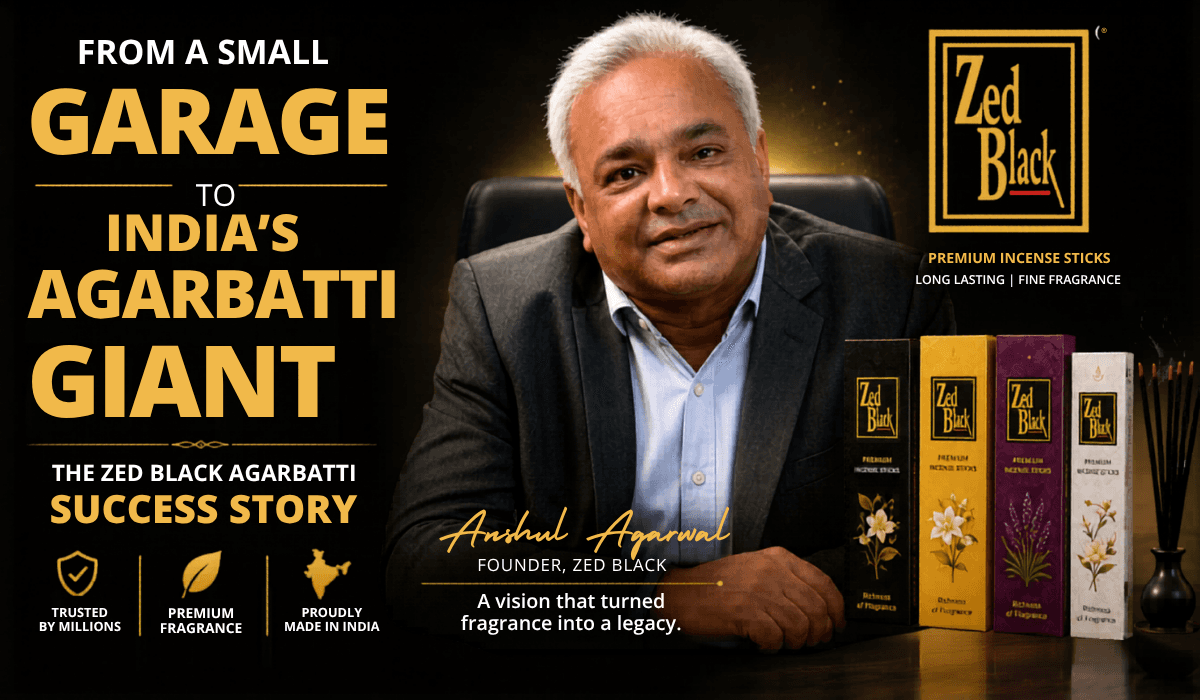
• Zed Black was started by Prakash Agrawal in 1992 from a small garage in Indore with a Rs 5 lakh loan, after years of failed business attempts in soaps, detergents, and hair oils
• Despite Bengaluru dominating the agarbatti industry, Prakash built Zed Black by focusing on local customer preferences, affordable pricing, modern packaging, and long-lasting fragrances
• What began as a small family-run business has grown into one of India’s biggest agarbatti brands, producing 3.5 crore incense sticks daily, exporting to 45 countries, and becoming a Harvard Business School case study
Walk into any Indian home during morning prayers, any temple at any hour, or any small grocery shop in any corner of the country, and agarbatti is already there. It has always been there. The smell of incense is not something Indians consciously choose. It is part of the air, part of the ritual, part of something that happens before breakfast without thinking about it.
And yet, despite that daily presence, the agarbatti business in India in the early 1990s was not something most aspiring entrepreneurs took seriously. Bengaluru dominated the industry. Any brand not from Bengaluru was quietly ignored by distributors and retailers. The market had its established players, its established supply chains, and very little room for someone with no pedigree, no budget, and an address in Indore.
Prakash Agrawal was that someone. And he walked into this market after failing at almost everything else.
Prakash had quit a sales assistant job at a textiles store in Indore with the intention of building something of his own. That was the easy part. The hard part was the next seven years. He tried soaps. He tried detergents. He tried hair oils. Every single attempt failed. His mother watched this happen and eventually told him plainly: " If you cannot succeed as a manufacturer, become a distributor for an established brand instead. He heard that as a challenge rather than advice.
In 1992, instead of distributing someone else's agarbatti, Prakash decided to make his own. He took a Rs 5 lakh loan, set up production in the garage of his Indore home, and started Mysore Deep Perfumery House. His brothers joined him on the floor. His mother, Mohini Agrawal, stepped in to supervise labour and production. His wife Amita later took over the fragrance formulations, the most confidential part of the business, while Prakash shifted focus to marketing and distribution.
What Prakash discovered quickly was that being outside Bengaluru was a genuine commercial disadvantage. Distributors and retailers in Indore had grown up giving shelf space to Bengaluru brands. Any manufacturer from elsewhere was simply not taken seriously. Getting his product into stores was not a matter of having a good product. It was a matter of being from the wrong city. He spent six years fighting this. Not loudly, not with complaints, but by doing the one thing that eventually overrides geography: understanding local taste better than anyone else. He built his first brand, Purab Paschim Uttar Dakshin, around fragrances that matched what people in central India actually liked. It took six full years before he made enough money to move production out of the house and into a proper factory.
By 2000, the original brand was doing well enough. But Prakash wanted something more. He wanted a brand with an English name, modern packaging, and a wide enough range of fragrances that any customer could find something they liked at a price that made sense. That idea became Zed Black.
The name stood out immediately on shelves crowded with traditional-sounding agarbatti brands. The packaging was colourful and eye-catching in a category that had mostly not bothered with visual identity. The fragrances were designed to last longer than what the market was used to. And the pricing stayed accessible because Prakash understood that agarbatti in Indian homes is not a premium purchase. It is a daily one. Within a few years, Zed Black had become one of the fastest-growing agarbatti brands in the country.
In 2010, MDPH opened a second plant in Indore. In 2012, the brand made its first export, to Mauritius. In 2014, Zed Black launched its now iconic 3-in-1 agarbatti pack, a single package offering three fragrance types that became enormously popular with customers who could not decide and retailers who appreciated the convenience. Bollywood actress Bhagyashree came on as the first brand ambassador that same year.
By 2015, Zed Black had become one of the top 3 agarbatti brands in India.
In 2017, the brand signed MS Dhoni as its brand ambassador, an association that is now in its eighth year. Hrithik Roshan fronts the Manthan Dhoop range. The brand opened its first international office in Kathmandu in 2017 and a second in New York in 2018.
Every one of these decisions came from the same instinct Prakash had in the garage in 1992: understand what people want, show up where they are, and keep the price at a point where they do not have to think twice.
One part of the Zed Black story that does not get enough attention is who builds the product every day. Of the 4,000 people employed by MDPH, 80 percent are women. Many of them are from the communities surrounding the Indore facilities, women who joined the production lines and have stayed for years, some for decades. The fragrance formulations that define the brand's identity are kept strictly within the family and passed on carefully. The production itself is carried on by thousands of hands that roll, pack, and ship 3.5 crore incense sticks every single day.
15 lakh retail packs of Zed Black leave the facility daily. The annual turnover crossed Rs 650 crore in FY21 and has grown since. The manufacturing space now spans 9.4 lakh square feet.
From A Garage In Indore To Harvard Business School
In 2025, MDPH and Zed Black became a case study at Harvard Business School, believed to be the first recognition of this kind for both an Indore-based company and the Indian agarbatti sector. The case is already part of the curriculum at institutions including the Fashion Institute of Technology in New York.
Anshul Agrawal , Prakash's son and now Director at Mysore Deep Perfumery House , described what the Harvard recognition meant: it is a celebration of Indian entrepreneurship rooted in values and powered by vision. A journey from incense sticks to essential oils, from bamboo-less innovation to luxury perfumery, from a garage in Indore to shelves in 45 countries.
But the story that matters most is still the one that happened before any of that. A man who failed for seven years, heard his mother tell him to give up, and decided instead to prove her wrong by making something in a garage that the entire industry said could not be done from Indore.
Quick Share