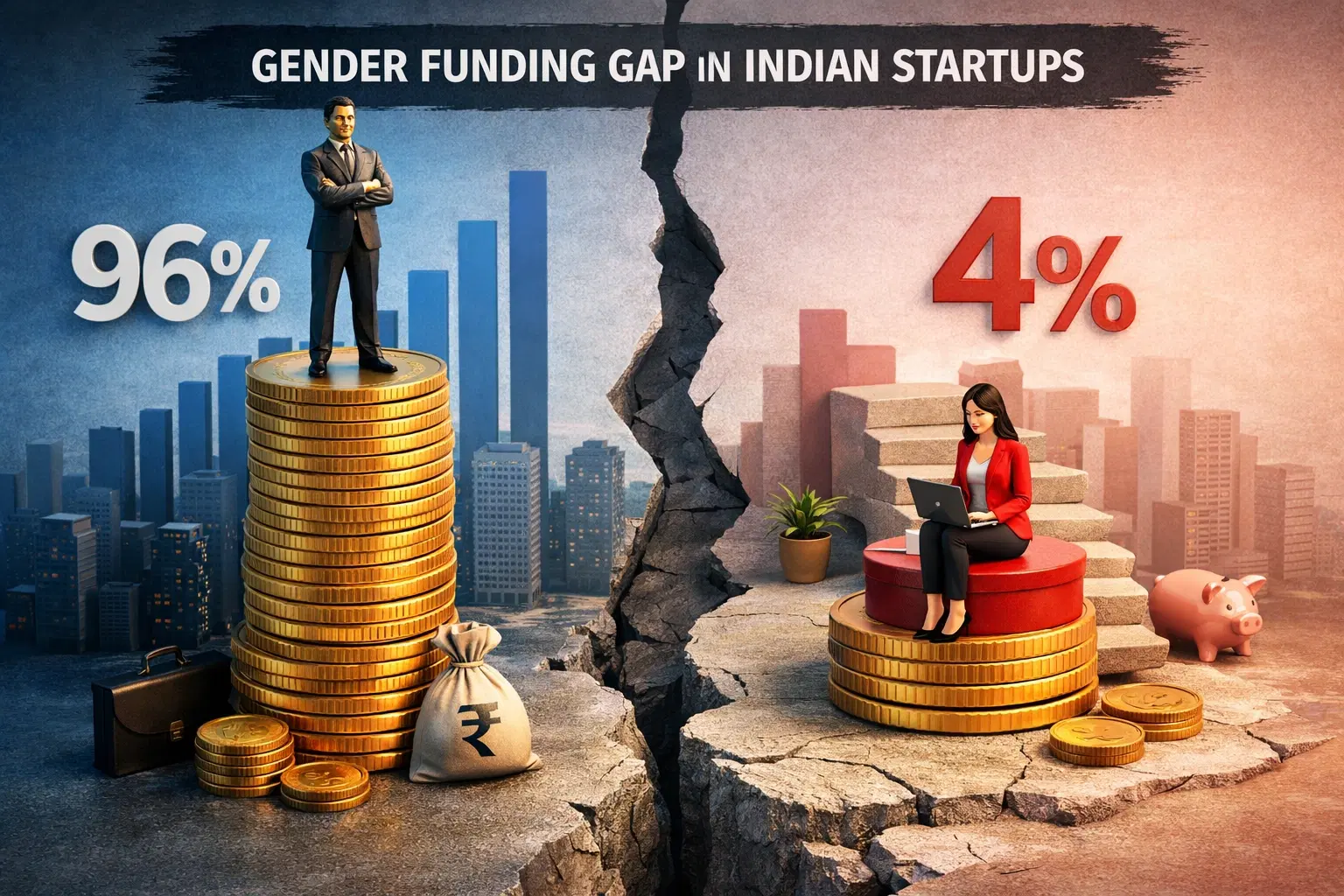
In a revealing report published by Kalaari Capital, one of India's most prominent early-stage venture capital firms, data has confirmed what many women entrepreneurs have long experienced firsthand — female-founded startups receive a staggeringly low 4% of total startup funding in India . The findings have sent shockwaves through the Indian startup ecosystem, reigniting conversations around systemic gender bias, structural barriers, and the urgent need for reform in how venture capital is allocated across the country.
The report, which analyzed funding patterns across hundreds of startups over multiple years, paints a troubling picture of an ecosystem that claims to celebrate innovation and meritocracy, yet continues to sideline nearly half its potential talent pool based on gender.
According to Kalaari Capital's analysis, out of every ₹100 deployed by venture capital firms in India, less than ₹4 reaches startups that are founded or co-founded by women . The remaining 96% flows overwhelmingly to male-led ventures . This is not merely a funding gap — it is a compounding disadvantage that limits the scale, visibility, and survivability of women-led businesses at every stage of their growth.
The disparity becomes even more acute when examined at the growth and late stages of funding. While women founders may find marginally more access at the seed and angel level, institutional funding rounds — Series A, B, and beyond — remain heavily skewed toward male founders. The data suggests that even when women-led startups survive the early stage, they hit a disproportionate wall when seeking larger capital infusions needed to scale.
Key data points from the report include:
The gender funding gap in India is wider than the global average, where women founders receive approximately 2–3% globally, with India trailing behind even that modest benchmark in terms of ecosystem inclusivity
Kalaari Capital, which has backed some of India's most celebrated startups including Dream11 , Cure.fit , and Snapdeal , has through this report positioned itself as a voice for change within the VC community . The firm acknowledged that the venture capital industry itself must reflect on its own biases — both conscious and unconscious — that drive investment decisions.
Firm leadership noted that the pattern of homophily — where investors tend to fund founders who look, speak, and think like themselves — plays a powerful role in perpetuating the funding gap. Since the majority of partners and decision-makers at Indian VC firms are men, women founders often find themselves pitching to rooms where no one at the table shares their lived experience.
Kalaari also pointed out that the due diligence and evaluation process, while presented as objective, often embeds subtle biases. Questions posed to women founders during pitches tend to focus on risk mitigation and potential failure , while questions posed to male founders tend to be more opportunity-focused and forward-looking — a dynamic that researchers call the "promotion vs. prevention" questioning gap.
The funding gap does not exist in a vacuum. It is the product of multiple overlapping structural barriers that disadvantage women at nearly every stage of the entrepreneurial journey.
1. Network Exclusion Venture capital in India is still largely relationship-driven. Access to the right investor often depends on warm introductions, alumni networks, and informal social circuits — spaces that have historically been more accessible to men. Women entrepreneurs frequently lack access to these inner circles, making cold outreach their primary — and far less effective — channel.
2. Unconscious Bias in Evaluation Studies have shown that investors evaluate identical business plans more favorably when the founder is perceived to be male. This implicit bias affects everything from the tone of follow-up questions to the speed of due diligence, often without the investor being consciously aware of it.
3. The "Double Burden " Challenge Women founders in India navigate a dual responsibility — running a business while managing disproportionate household and caregiving responsibilities. This limits the time available for networking, pitching, and relationship-building with investors, and can make women appear "less committed" through a biased lens.
4. Lack of Women in Decision-Making Roles at VC Firms Fewer than 10% of partners at top Indian venture capital firms are women. Research globally has shown that female partners are significantly more likely to invest in female-founded companies. The absence of women in investment decision roles directly contributes to the funding gap.
5. Risk Perception Distortion There is a prevailing — and largely inaccurate — assumption that women-led startups are less scalable or more risk-averse in their ambitions. This perception influences investment decisions despite data showing that diverse founding teams often outperform all-male teams on several financial metrics.
The implications of this funding gap extend far beyond individual businesses. Economists and policy researchers have increasingly argued that gender-inclusive startup ecosystems are not just socially desirable — they are economically necessary.
A McKinsey Global Institute study estimated that advancing women's equality in the workforce and economy could add $700 billion to India's GDP annually. Startups founded by women tend to create employment for other women, build products that address underserved markets — including women consumers who make or influence the majority of household purchasing decisions — and contribute to a more equitable distribution of wealth.
When women-led startups are starved of capital, entire categories of innovation die before they reach market. Healthcare products designed for women, financial tools built for rural women entrepreneurs, and education platforms tailored for girls — all of these face existential funding challenges not because they lack merit, but because they lack access.
Kalaari Capital's report and voices across the startup ecosystem have coalesced around several key recommendations:
For Venture Capital Firms:
For the Government:
For Accelerators and Ecosystems:
For Corporations:
Prioritize procurement from women-led startups, creating revenue traction that strengthens investor confidence
Women founders across India have responded to the report with a mix of validation and frustration — validation that their experiences are finally being documented in data, and frustration that systemic change remains painfully slow.
Many founders have shared accounts of being asked about their marital status, plans for children, or their husbands' opinions during investor meetings — questions that would never be posed to a male founder. Others describe the exhausting experience of being praised for their pitch but passed over for funding, only to watch a less-polished male founder in the same cohort close a round weeks later.
There is a growing chorus demanding that the conversation move from awareness to accountability — from reports and roundtables to binding commitments, measurable outcomes, and real capital.
Despite the sobering statistics, there are modest signals of progress. A growing number of women-focused VC funds have emerged in India — including She Capital, Women Founders Fund, and others — specifically targeting the gap identified in reports like this one. Women-led startups in sectors like beauty, wellness, vernacular content, and rural fintech are drawing increased attention from impact investors and development finance institutions.
Kalaari Capital's decision to publish this data publicly is itself a signal — an acknowledgment from within the establishment that the status quo is both unjust and unsustainable. The hope is that other VC firms will follow suit with transparency, and that transparency will generate the pressure needed for real, lasting reform.
The finding that women founders receive just 4% of startup funding in India is not a footnote — it is an indictment of an ecosystem that has allowed systemic bias to masquerade as meritocracy. Kalaari Capital's report has put a number to an injustice that women entrepreneurs have navigated in silence for years.
The Indian startup story is one of the most exciting economic narratives of our time. But it is only half a story — told from one side of a deeply unequal table. For India to realize the full promise of its entrepreneurial generation, it must reckon honestly with who gets funded, who makes the funding decisions, and what it truly costs when half the population is locked out of the capital that builds the future.
The 4% must become 40%. And the time to start is now.
Visit Karostartup for more insights into the intersection of technology, policy, and the future of India.
Quick Share