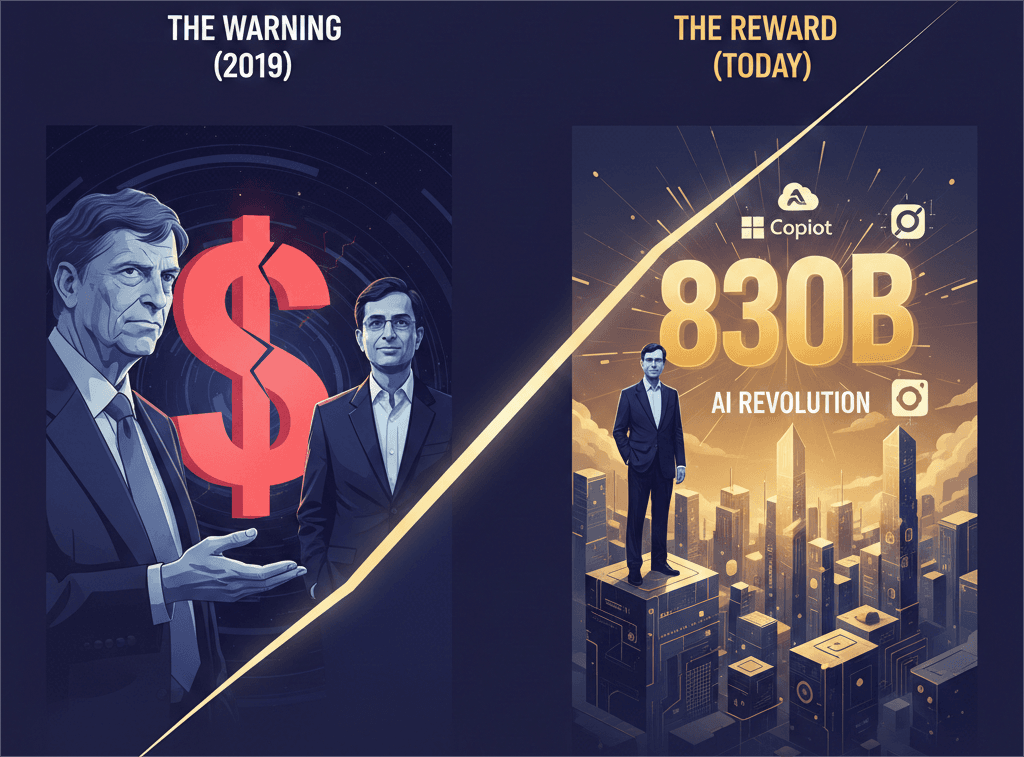
In a striking reminder of how bold decisions shape the future of technology, Satya Nadella, CEO of Microsoft, recently revealed that even Bill Gates was skeptical about the company’s initial $1 billion investment in OpenAI.
At the time, the move was seen as risky, experimental, and far from guaranteed success. Today, however, that decision is widely regarded as one of the most consequential bets in the history of artificial intelligence.
1) The Narrow AI Mindset
Back then, most of the industry focused on Narrow AI — systems built for specific tasks like image recognition or spam filtering. OpenAI’s ambition to build Artificial General Intelligence (AGI) by scaling compute sounded more like science fiction than a practical business strategy.
2) The “Money Pit” Concern
OpenAI was spending heavily on infrastructure without a clear commercial product. Gates, known for building Microsoft on scalable software and strong margins, saw a research-heavy, non-profit-style organization as a high-risk venture with no obvious competitive moat.
3) The Compute Gamble
To support Nadella’s vision, Microsoft had to build a custom supercomputer by linking tens of thousands of GPUs from NVIDIA — an unprecedented capital investment made even before models like GPT-3 were created.
The impact of generative AI reshaped the entire technology landscape, reflected in OpenAI’s rapid valuation growth:
| Year | Estimated Valuation | Key Milestone |
| 2019 | ~$1B | Microsoft partnership |
| 2021 | ~$14B | GPT-3 gains adoption |
| 2023 | $80B+ | Viral growth of ChatGPT |
| 2025 | $150B–$200B+ | Expansion into multimodal and agentic AI |
The broader AI ecosystem is now projected to create hundreds of billions in economic value, driving enterprise transformation across industries.
As AI scales, its economic impact is uneven:
This makes the AI revolution not just an economic shift, but a social equity challenge.
Nadella’s goal wasn’t to add another feature — it was to redefine human-computer interaction.
From Tools to Agents
This vision led to the creation of Microsoft Copilot, transforming Microsoft from a traditional software company into an AI-first platform.
Azure’s Growth Engine
By becoming OpenAI’s exclusive cloud partner, Microsoft Azure became the backbone of large-scale AI. Every OpenAI API call runs on Azure, turning AI demand directly into cloud revenue.
The GitHub Breakthrough
GitHub Copilot demonstrated real-world productivity gains — helping developers code faster and validating the business value of large language models early on.
For Nadella, the investment wasn’t about short-term returns. It was about positioning Microsoft at the center of the next computing platform.
“It was not that hard to convince anyone that this is an important area.”
This aligned with Microsoft’s long-term shift toward becoming a cloud-first, AI-first company.
Today, OpenAI’s technology powers:
The partnership has strengthened Microsoft’s competitive position and accelerated a global AI race, with major tech companies investing heavily in models, infrastructure, and talent.
Transformational innovation rarely looks safe in the beginning. Even a visionary like Bill Gates had reservations — a reminder that the biggest opportunities often appear as the biggest risks.
When Gates warned the $1B OpenAI bet might fail, Nadella moved forward anyway.
Today, that decision helped ignite a multi-hundred-billion-dollar AI revolution — and reshaped the future of computing.
Follow Karostartup for more insights into the intersection of technology, policy, and the future of India.
Quick Share