Another theory of human connection was held by two friends - Vidya Madhavan and Abhinav Anurag . They thought that the laughing manner of the people speaks more about them than any selfie with the choice of filters could ever say. Humor, they claimed, is the fingerprint of personality. And at a time when memes had become the common language of an entire generation, they perceived a vacuum that no one was filling.
That is why they constructed Schmooze .
Vidya and Abhinav knew what it was like to feel hollow swipe-culture. Matches were plentiful. True relationships were hard to come by. Their intuition was quite misleadingly straightforward: what was the internet doing in reality?
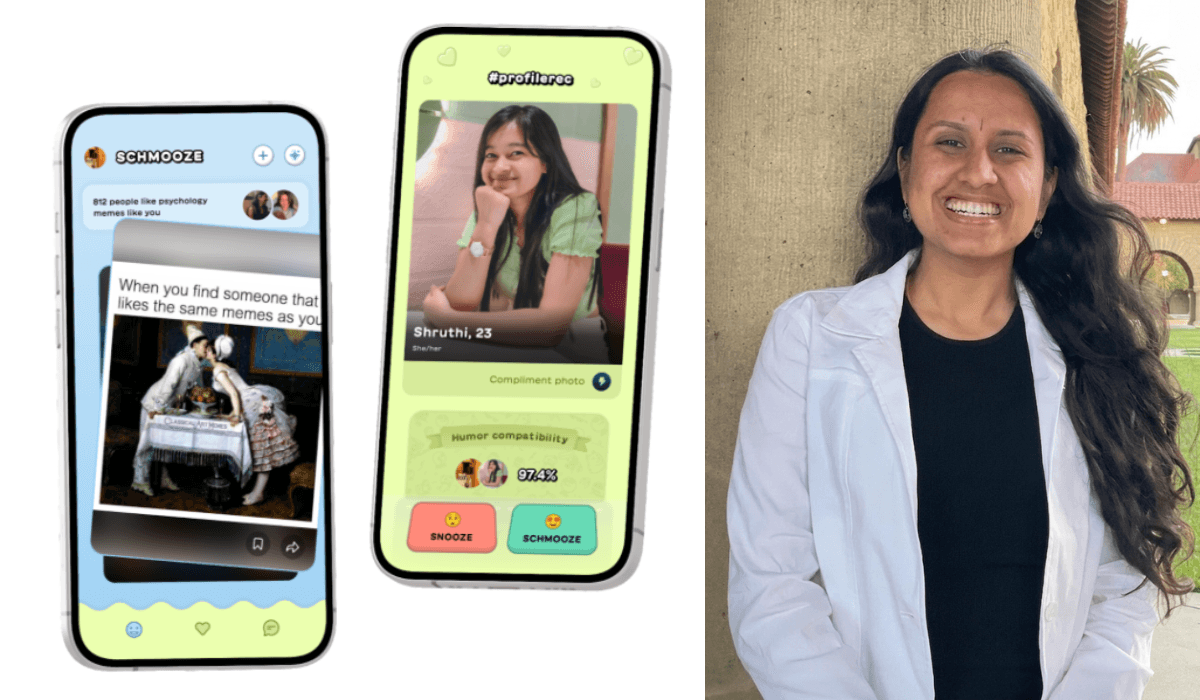
Rather than face first, Schmooze feelings first - the feeling of scrolling through your favorite corner of the internet and snort-laughing at each thing you see as you scroll. Users scroll through a hand-curated feed of memes and respond to each one. Like it. Love it. Cringe at it. Scroll past it. All reactions were information - and that information gave a very realistic image of what someone was like.
The interface of Schmooze had a complex matching engine behind the scenes. The system constructed a dynamic personality map as users responded to memes, either by gravitating towards dark humor, absurdist jokes, wholesome content, or niche internet jokes. The more interacting with it, the more accurately the algorithm comprehended you.
Harmony scores of humor were matched - a scale of the likelihood of two individuals making each other genuinely laugh. This reasoning was based on actual psychology: one of the best predictors of relationship satisfaction in the long term is shared laughter. Schmooze was not merely seeking out those who shared his or her sense of humor. And it was discovering those who shared the world with you.
As of 2021, it was not a subculture any more, it was the culture. Memes were used by younger users to express identity, politics, grief, joy and romance. An ideal meme to a crush was much heavier than a hundred well thought out texts. Schmooze was a native speaker of that language.
The word travels quickly - not via costly advertisements. The matches of Schmooze were posted by the users on Twitter and Tik Tok. Memes profiles are eerily compatible and screenshots of them went viral. The app expanded in a huge rate in college campuses and in urban centers. Compared to the older dating apps which had a stigma, Schmooze was enjoyable, even to those who were not in need of a date.
One of the first funding rounds was led by Lightspeed Venture Partners, which saw what the founders had created: not only a dating app, but a behavioral data engine that is packed into a product that people truly enjoy using. Inventus Capital Partners joined as well, providing strategic advice as well as capital.
As the funding was secured, the team grew. The mission brought on board engineers, data scientists, content curators and brand strategists. The library of memes became more abundant, the algorithm became more intelligent, and the experience became more refined - maintaining the core product as joyful and low-pressure as it is.
Something I had not planned on occurred as Schmooze scaled. Users were not only finding romantic mates, they were finding best friends, creative partners and communities. The shared-humor model proved a universal-purpose human interconnection engine. Two individuals sharing the same obscure absurdist meme as funny were probably going to share dozens of other things: music tastes, outlook on the world, style of communication, even career goals.
Schmooze started researching the friend-matching feature, where they can choose to become platonic friends. In a generation where people had become socially isolated and were digitally reliant, the power to locate your people by laughing at something was truly strong.
With the cynical, densely populated dating app market, the story behind Schmooze emerging was simple: authenticity scales. Performance had worn people down, fed up with creating the ideal profile, selecting the most flattering photo, typing a bio that made them sound cool without appearing desperate. Memes provided them with an environment in which to simply be themselves. There is no way you can pretend which jokes you laugh at.
Schmooze established that personality information is more resilient than appearance information, that the cultural fluency is an actual product moat and that delight is a development tactic. The application was entertaining when not yet matched with anyone and this inherent fun stimulated retention and word-of-mouth better than paid acquisition could have done.
Above all, Vidya and Abhinav were architects of their own. They weren't guessing at what Gen Z wanted. They were Gen Z. And the world appeared.
Right now, two individuals are sending each other the same meme - and they are discovering that they have found the person they are seeking. That's the Schmooze story.
And honestly? It worked pretty well, I tell you.
Quick Share