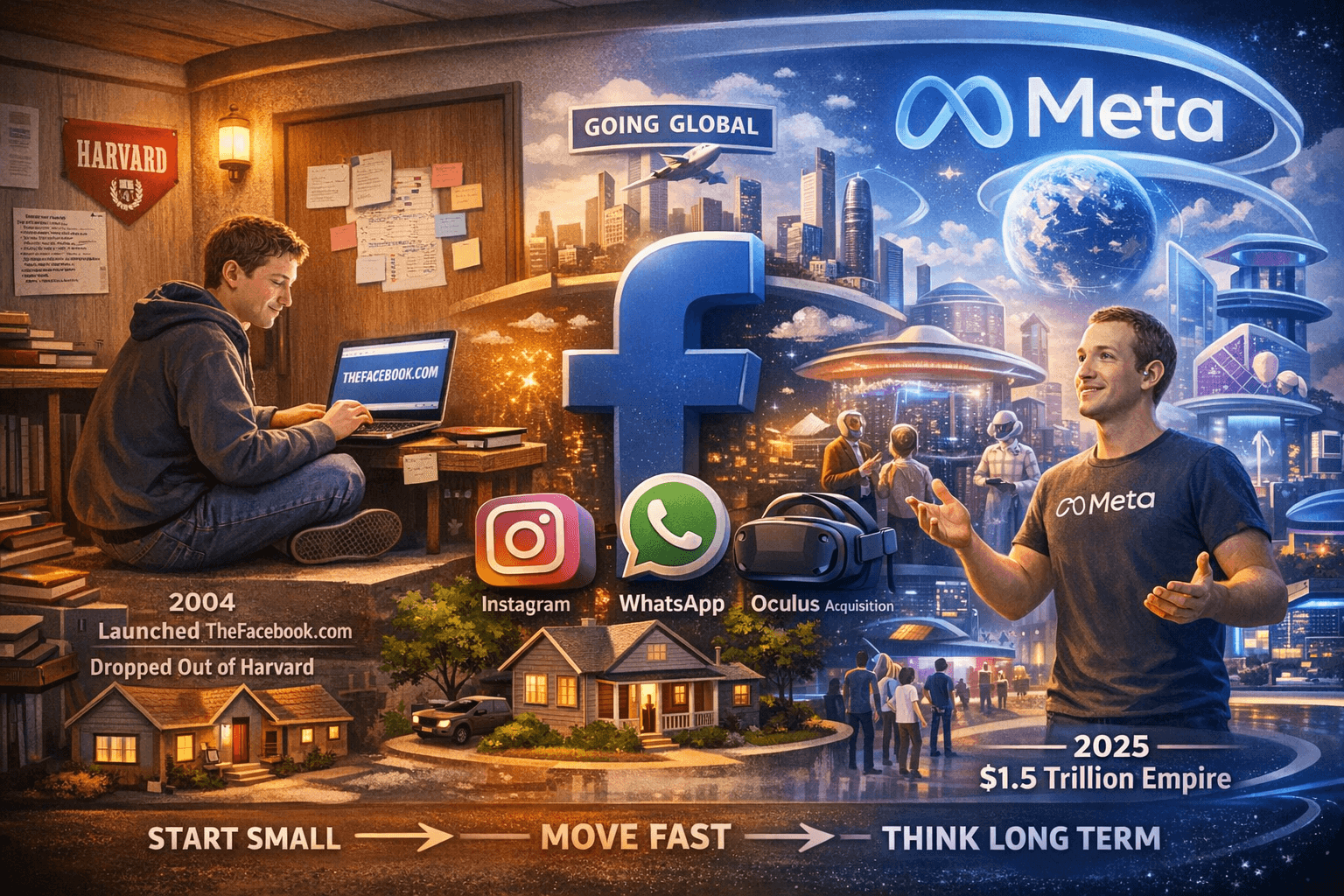
In 2004, a 19-year-old sophomore at Harvard University sat outside his dorm room with a Sony VAIO laptop and a simple but powerful idea. There was no AI boom, no major funding, and no large team supporting him. What he had instead was coding skill, curiosity, and a bold vision to connect people online. That small experiment would soon evolve into one of the most influential technology companies in the world.
Age 19. Harvard sophomore.
At just 19 years old, Zuckerberg was a computer science student experimenting with ways to bring students together online through a digital identity platform.
Built and launched TheFacebook.com in one week.
Working intensively from his dorm room, he coded the entire platform within a week, focusing on simplicity, real identities, and easy interaction between students.
First day: ~22,000 page views.
The response was immediate and overwhelming, as thousands of students visited the site on the very first day, signaling strong product-market fit.
Within 24 hours: Nearly half of Harvard signed up.
The platform spread rapidly across campus, becoming a social necessity for students who wanted to stay connected and visible within their community.
Within months: Expanded to Yale, Columbia, and Stanford.
Seeing the strong demand, Zuckerberg quickly rolled the platform out to other Ivy League institutions, turning a campus tool into a multi-university network.
2004: Dropped out of Harvard.
As the platform’s growth accelerated, Zuckerberg made the high-risk decision to leave Harvard and focus entirely on scaling the company.
Moved to Palo Alto, California.
He relocated to Silicon Valley, placing himself at the center of the global technology ecosystem where talent, investors, and startup culture could support rapid growth.
Set up operations in a rented house.
The early team worked out of a shared house that functioned as Facebook’s first headquarters, reflecting the startup’s scrappy and fast-moving culture.
In 2005, the company officially rebranded from TheFacebook to Facebook , a move that reflected its growing vision beyond college campuses and its ambition to become a universal social platform. The following year marked a major turning point when, in 2006, Facebook opened its doors to the general public, allowing anyone aged 13 and above to join. This decision dramatically expanded its reach and transformed the platform from a student network into a mainstream global community.
Around the same time, Facebook introduced one of its most impactful innovations—the News Feed. Instead of users visiting individual profiles, the platform began delivering real-time updates in a centralized stream, fundamentally changing how people consumed content and interacted online. This feature reshaped user behavior and set a new standard for social media engagement.
As these strategic moves took effect, user growth accelerated rapidly, climbing into the hundreds of millions within a few years. What began as a simple networking tool soon became a daily habit for people worldwide, firmly establishing Facebook as a dominant force in the global social media landscape.
2012: Acquired Instagram for $1 billion.
Recognizing the shift toward mobile and visual content, the acquisition helped Facebook capture the fast-growing photo-sharing and creator market.
2014: Acquired WhatsApp for $19 billion.
This move strengthened Facebook’s global communication presence, especially in international markets where messaging apps were becoming the primary mode of interaction.
2014: Acquired Oculus VR.
The purchase marked the company’s early bet on immersive technologies and future computing platforms beyond smartphones.
2021: Rebranded as Meta Platforms.
The rebranding signaled a strategic shift from being a social media company to becoming a metaverse-focused technology organization.
Focus on VR, AR, AI, and the metaverse.
Meta began investing heavily in immersive digital environments, wearable technology, and artificial intelligence to build the next generation of online interaction.
Long-term vision beyond social media.
Despite skepticism, the company positioned itself for a future where digital presence, virtual workspaces, and immersive experiences could redefine the internet.
Valuation: Around $1.5 trillion.
Meta’s massive scale reflects its dominance across social networking, digital advertising, and communication platforms.
Zuckerberg’s net worth: $220–$264 billion.
His personal wealth places him among the world’s richest individuals, built largely on his long-term ownership and control of the company.
Billions of users across platforms.
With Facebook, Instagram, WhatsApp, and Messenger, Meta’s ecosystem connects a significant portion of the global population every day.
Zuckerberg’s journey shows that transformative companies rarely start with large teams, big funding, or perfect plans. Facebook began as a small dorm-room experiment built in a week. What turned it into a trillion-dollar empire was speed of execution, bold decision-making, long-term thinking, and the willingness to take risks early.
From a single laptop in a college dorm to a global technology giant, the story is a powerful reminder:
Start small. Move fast. Think long term.
Follow Karostartup for more insights into the intersection of technology, policy, and the future of India.
Quick Share