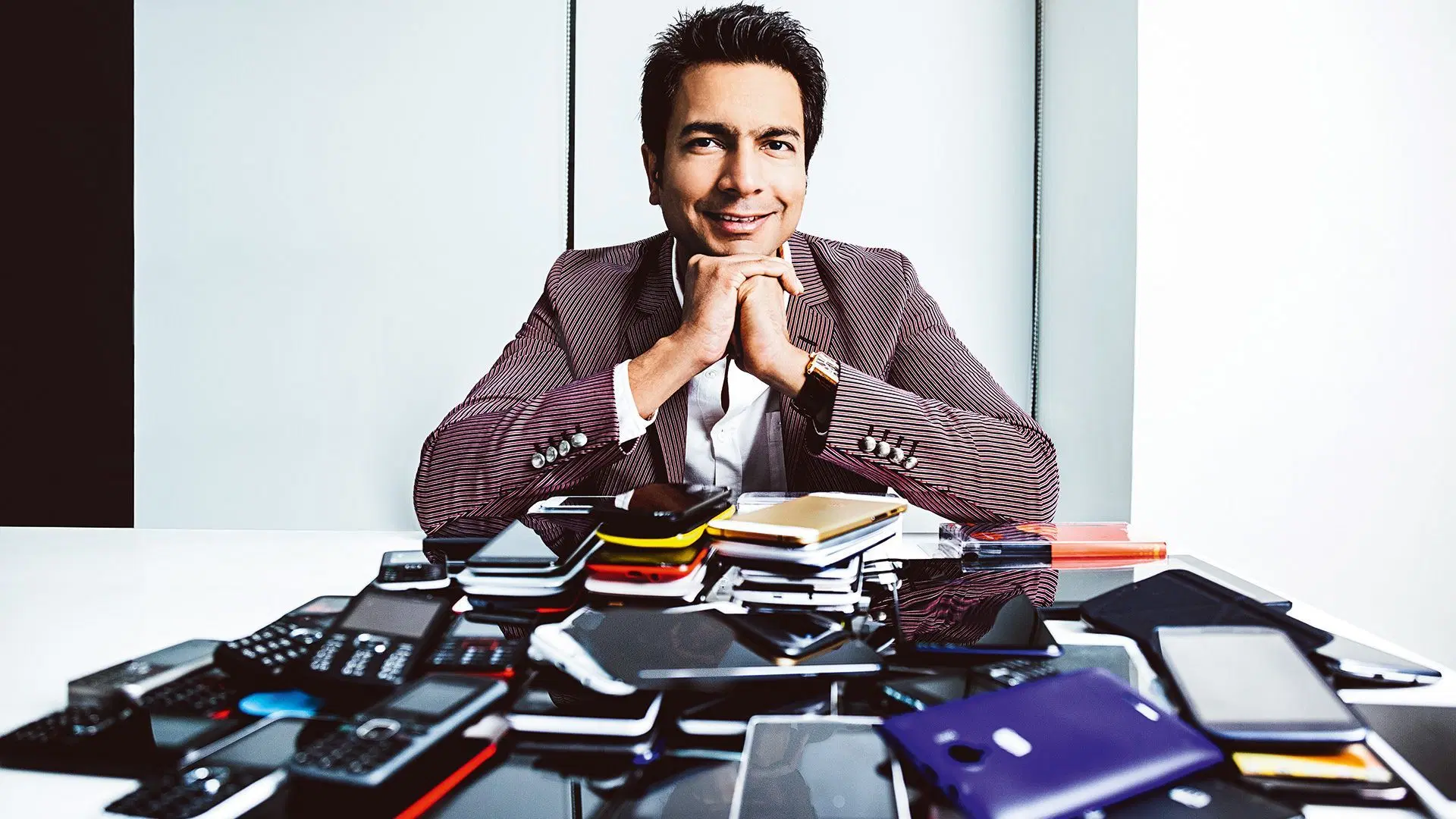
Rahul Sharma was born on 14 th September, 1975 in Delhi, in a family of a school principal and a homemaker mother. His boyhood was plain as there was no silver spoon or relations or shorthand. What he lacked was a father who showed him the importance of integrity and hard work as the key principles. Rahul attributes his father as his real hero and inspiration - it was his father who taught him the feeling of honesty, humility, hard working ethics and honesty that was later to be moulded into the man he would grow up to become. Growing as a middle-income family in Delhi, Rahul had great dreams. He was not willing to just get a job and establish himself/herself, but to create something meaningful. It was a fire within him, which years would not put out, though it never diminished.
Knowledge was the best weapon that Rahul realized at an early age. He studied a degree course in Mechanical Engineering at Rashtrasant Tukadoji Maharaj Nagpur University and subsequently Bachelor of Commerce at the University of Saskatchewan in Canada. He further went to Harvard Business School in Boston, Massachusetts which is a finishing school to serious business persons, the Owner/President Management (OPM) program.
This uncommon blend of engineering, commerce and executive training provided Rahul with a 360 degree perspective of business that most of his business rivals had in fact lacked.
Rahul spent years honing his skills in the corporate world before he was able to found his own empire. He was well versed in brand building and new product introduction and managed to spearhead successful campaigns of global brands such as Microsoft Xbox, Procter and Gamble as well as Shaw communications television service. He joined Shaw Communications Inc. in February 2004 and has been serving as the Vice President of On-Demand Television Services, Corporate Sales and Marketing, and the development of such products as Pay Per View, Video on Demand, and Digital Pay Television. It was not in vain these years passed, it was his classroom. He was studying the functioning of global firms, the ways in which a brand is developed, and how people think. All this would serve as the foundation of what he would construct further.
All this started when his father had given Rahul a computer at the end of 1990s. He was impressed by the technology, and thus, he decided to start in 2000 with his three friends to start Micromax Software. Micromax Informatics was established by Rahul Sharma and his friends Rajesh Aggarwal, Vikas Jain and Sumeet Arora with a limited loan provided by his father. Nobody was preparing cheques to them. No one was queueing to invest. It consisted of only four young guys and borrowed money.
The company has not begun with mobile phones. Rahul was an ambitious person in regards to embedded technology and he opened up a training institute because he believed that embedded systems were the future. His breakthrough was when the M2M (machine-to-machine) division at Nokia wanted finding partners in India. At the same time competitors moved into the distribution of handsets, Sharma moved in the less hype but more profitable direction of fixed wireless terminals (FWTs). He also sold cheap pay phones to Airtel and Vodafone and grew the business to 4 crores to 100 crores each year. This was the genius of Rahul, he was not a follower. He discovered the neglected chance and had it all.
After that occurred the time that changed the story itself.
In 2007, Rahul had the chance of being in a village, Behrampur located in West Bengal with no power. He was aghast that an Airtel PCO is being driven by a truck battery. The PCO owner would drag the battery 12 kilometres to a connected source every night to charge it overnight after which he would drag it the next morning. The extent of innovation with which this man had adjusted to irrevocable circumstances came to him with a shock. This enlightened his mind and he realised that only people who are brave to dream succeed. The use of that single image, a man pulling a truck battery in the darkness, launched a billion-dollar idea. When the citizens of rural India were going to such an extent of charging their phones, what would happen when someone created a phone that just did not have to be charged every day?
Micromax started marketing mobile phones in the year 2008 and it targeted to democratise technology to the masses in its effort to compete with foreign players. Micromax released the first phone, which was named the Xtreme. The charm of these phones was in the fact that when compared to the competitors, Micromax provided features that addressed the real Indian problems at relatively lower costs. It was a straight-forward but strong pitch, assemble to India rather than the world.
Micromax added 30 days stand by time to phones in areas that had little access to electricity. This attribute was a serious gap that was overlooked by the multinational competitors. Nokia and Samsung were modelling phones to suit the consumer markets of Europe and America. Micromax was making the design of the man in Bihar pulling a truck battery at night.
The co-founders then changed their focus to dual-SIM phones. Consequently, Micromax was the first company in India to introduce dual SIM phones with a single baseband - another feature that struck the bullseye of the Indian consumers who had to maintain multiple SIM cards on a low cost.
What they did even in marketing was not conventional. Major brands were spending millions on sponsorships and TV advertisements of IPL. Rahul sought alternatives with limited resources at his disposal. He was inspired by a newspaper advert that had used the words; Entertainment ka baap, and came up with the campaign of Micromax; Mobile ka baap. This is a cheap yet effective print campaign that got noticed in the whole country. A few months later the Micromax phones were sold out and this demonstrated that being creative was more effective than advertising budgets.
The resultant scenario was nothing less than David vs. Goliath except that David emerged victorious this time. Between 2010 and 2015, Micromax was a market leader in the mobile market. Indeed, in 2014, Micromax disrupted the low-end phone market and reduced sales of Samsung in India. Towards the end of the same year, Micromax as an entity had overtaken Samsung to emerge as the mobile phone manufacturing company that ships the highest number of phones during a given quarter in India. Micromax had sold 4.6 million at that time and dominated 22 per cent of the entire Indian market. The firm which began with a loan provided by a salary of a school teacher had outdone Samsung in India. It was the time that Indian startups were able to compete, and succeed, in the global arena.
Micromax announced its entry into the world of a truly global brand on January 24, 2014, when it was the first Indian mobile company to sell in Russia. In 2014, Hugh Jackman was contracted to act as the brand ambassador of Micromax. The Delhi boy was now conducting business with Wolverine.
Rahul was not the one to limit his ambitions to feature phones. He detached another brand in the digital era. The highest benefit that Rahul inherited through Micromax was YU Televentures, a joint venture between Micromax Informatics and Cyanogen Inc. Mobile phones such as YU Yureka and YU Yuphoria dominated the market when launched with a tremendous demand to acquire these phones due to their incredible features. Rahul has a 99 percent ownership in the company.
In every momentous story there is a valley. In the case of Micromax the valley was named Chinese competition. Micromax was under massive threat when Chinese smartphone producers ventured into the Indian market and produced better and cheaper products. New brands such as Xiaomi, Oppo and Vivo came in with huge investment, technological and low prices. Players with virtually endless resources were now taking over the market that Micromax had created. The firm that had turned Samsung into a humble company was no longer able to pace. Revenues fell. Market share shrank. The brand that had previously been the representation of Indian pride was losing its land. And Rahul Sharma had experienced failure in the past. He had been rejected before. And he was aware that one book ends but is merely the start of the next.
As Micromax struggled with its predicament, Rahul had already begun to create his next dream - a dream which would integrate his engineering background and a dream of a cleaner and green India. Rahul Sharma entered the electric vehicle industry in 2017, and his company is called Revolt Intellicorp. Revolt unveiled the first AI based electric motorcycle in India, the RV400, in an attempt to transform the 2-wheeler market. Sharma had a vision of developing a product that was capable of competing with the available petrol bikes with features such as a long battery life and customisable bike tunes.
Rahul informed the media that the company was fully owned by him as he had an objective of making personal mobility viable, affordable, and sustainable. Being a mechanical engineer by his own, he was always interested in mobility and the space of opportunities that it provides. Revolt now assembles its electric bike in a plant in Manesar in Haryana. The production capacity installed on the plant is one lakh per annum. Rahul was again doing what he did best, resolving a real Indian issue through an innovative product to be manufactured to the Indian consumers.
It is the most thrilling part of the story of Rahul Sharma, - a story which is yet to be written.
This rebirth has not been propelled by a fresh Micromax handset, but by BPL, the manufacturing unit of Sharma, Bhagwati products Limited. Its fast growth achieved a real boost after a strategic joint venture with Shanghai-based Huaqin Technology, to acquire a 49-percent stake in Bhagwati Products on August 22, 2024, with the inter-ministerial FDI panel of India clearing the deal. This joint venture endows BPL with a tremendous breadth of design, making it much more than a outsourcing company and much more powerful, which is in line with the position of Huaqin as the No. 1 independent design house in the world. The outcome has been disastrous. Sharma himself had disclosed a 10x growth in a year saying: In 7 months, we managed to increase it this far. I believe we are likely to be among the fastest-developing companies in a year. He observed that BPL was already reporting an output of nearly 1000 crore per month. The fact that BPL is one of the prime beneficiaries of the PLI scheme of the government in manufacture of Large Scale Electronics is a major contributing factor to this growth. They have a special positioning as Sharma explains: "We have a very distinct position where we are a design house plus EMS [Electronics Manufacturing Services]. The man that used to fight the Chinese firms in the smartphone market is now collaborating with the finest of Chinese manufacturing to transform India into an international electronic hub.
In 2012, when Houseful 2 was in the process of shooting, Akshay Kumar, the co-star of actress Asin, introduced her to Sharma. Their friendship flourished and in 2016, the two got married in an intimate ceremony with Akshay Kumar as the best man. The couple is blessed with a daughter. The net worth of Rahul Sharma is estimated to be 1300 crore. He has a number of luxury cars amongst which Bentley Supersport Limited Edition, BMW X6, Mercedes GL450, and Rolls-Royce Ghost Series 2 are not an exception. He has a lavish farmhouse as well in New Delhi. However, in all interviews, the Rolls-Royce driving man refers to his father, the school teacher, as his biggest role model.
Rahul Sharma has received such prestigious awards like GQ Man of the Year or Forbes Person of the Year which proved his status as one of the most influential entrepreneurs of the under-40 age. Rahul Sharma was made the Transformational Business Leader of the Year in 2017.
Taking a glance at the whole path of Rahul Sharma, it is obvious that the philosophy exists:
Started as a borrowed loan and evolved into 1000 crore a month manufacturing powerhouse. It started with being rejected by distributors to beating Samsung in India. There is a small house in Delhi to the Harvard Business School. Rahul Sharma's story is not just about mobile phones or electric bikes or electronics manufacturing. It is about what happens when an ordinary person from an ordinary family refuses — absolutely refuses — to give up.
"Success doesn't come to the strongest — it comes to those who refuse to quit." — Rahul Sharma
And judging by everything he is building right now, Rahul Sharma is far from finished.
Quick Share