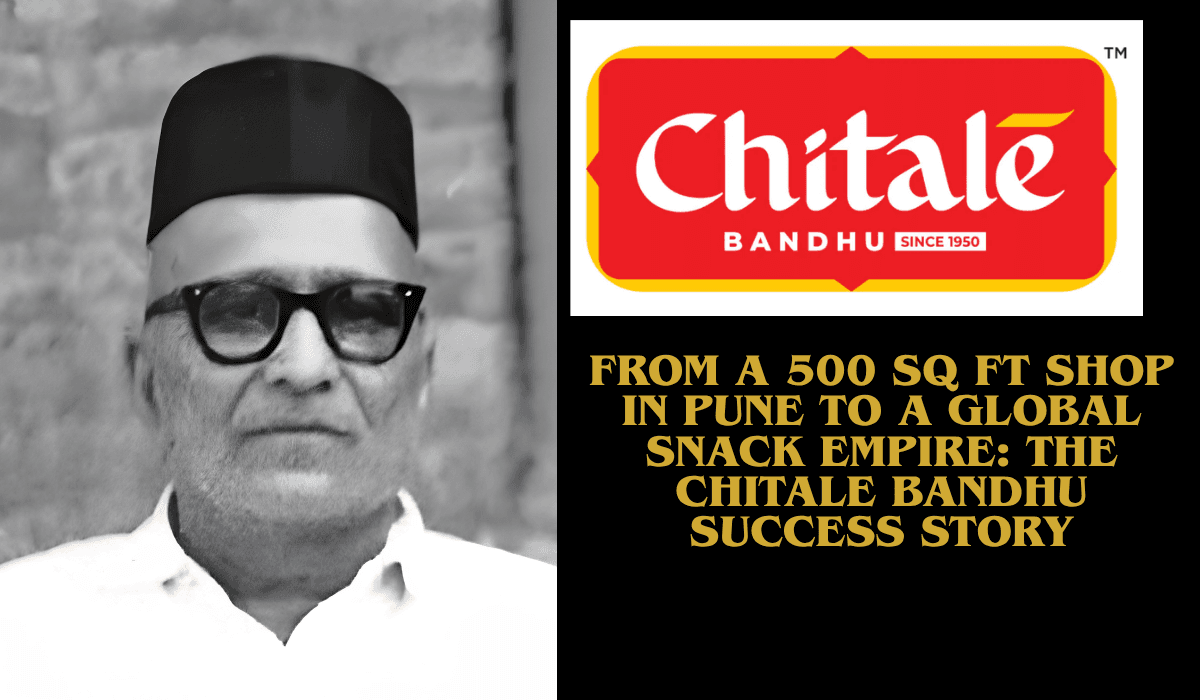
Founded in 1950 by brothers Raghunath and Narsinha Chitale in Pune, Chitale Bandhu Mithaiwale grew from a family dairy business started in 1939
Instead of chasing rapid expansion, the brand focused on one thing consistently: high-quality traditional Indian food people could trust across generations
What began as a 500 sq ft sweet shop on Bajirao Road became a ₹1,200 crore food brand exporting globally, with Sachin Tendulkar as its brand ambassador
For most of India's food history, traditional sweets and snacks existed everywhere but were owned by no one in particular. Every neighbourhood had its mithai shop. Every city had its own version of chivda, chakli, and peda. But almost none of it was consistent. Quality varied from shop to shop, batch to batch, and season to season.
There was no brand that a customer in Mumbai could trust the same way a customer in Pune could. No name that guaranteed the same taste every single time. No food company has treated traditional Indian snacking with the kind of seriousness it deserves.
That gap was exactly what the Chitale family spent decades filling, one product at a time.
The Chitale story does not begin in 1950. It begins much earlier, in the small village of Bhilawadi in the Sangli district of Maharashtra, where Bhaskar Ganesh Chitale, known as B.G. Chitale, was building a modest milk business in the late 1930s.
In 1939, B.G. Chitale founded Chitale Dairy, selling milk, curd, and chakka through railways to retailers in Mumbai. The business grew steadily until a partnership in Mumbai ended in 1946, forcing his son Raghunathrao Chitale to return to Pune. He arrived with limited resources but deep experience in food and dairy.
Together with his brother Narsinha, Raghunathrao began supplying milk to Pune from Bhilawadi. The city took well to them. By 1950, the brothers had saved enough to lease a 500 sq ft shop on Bajirao Road in Pune. That shop became Chitale Bandhu Mithaiwale. The name "Bandhu" means brothers, and it was a word that meant exactly what it said.
The founding philosophy of Chitale Bandhu was not complicated. Make the best possible product. Never compromise on quality, no matter how inconvenient that becomes. And build trust with the customer so slowly and so consistently that it becomes impossible to break.
In a market filled with seasonal sweetmakers and inconsistent local vendors, that consistency was itself a radical act. Punekars began to rely on Chitale not just for festive occasions but for everyday dairy needs. The milk business gave them entry into thousands of homes every single morning. And that daily relationship built a trust that no advertising campaign could have manufactured.
The shop on Bajirao Road became a destination. People did not just buy from Chitale. They visited it.
Chitale Bandhu was built entirely without external funding, across four generations, through reinvestment and discipline alone. That self-reliance came with significant challenges.
Scaling a food business in India meant navigating commodity price volatility, inconsistent raw material supply, and the enormous complexity of maintaining consistent taste at growing volumes. Every expansion decision had to be weighed carefully because there was no investor money to fall back on if something went wrong.
Geography was another challenge. The brand built its deepest loyalty in Pune and Maharashtra, but expanding nationally meant competing against well-funded giants like Haldiram's, Balaji, and Bikaner, all of whom had far greater distribution muscle. "We are competing at a national level against the likes of Balaji, Bikaner, Haldiram," Indraneel Chitale, the fourth-generation managing partner, acknowledged candidly.
There was also the internal challenge of managing growth without losing what made the brand irreplaceable. When the third generation suggested opening a milk bar to sell lassi and chaas, the founders cautioned that moving away from traditional products risked diluting brand value. That instinct to protect the core, even when expansion beckoned, shaped every decade of the brand's growth.
In the 1970s, Narsinha Chitale tasted a snack called Bakarwadi at a neighbour's home. It was a Gujarati snack with its own distinct character. But Narsinha saw something else in it. He took the spiral shape of the Gujarati original, combined it with the spice profile of a local Maharashtra snack called Pudachi Vadi, deep-fried it, and created something entirely new.
The result was Chitale's Bakarwadi. Sweet, spicy, crisp, and completely unlike anything else available in the market. Demand exploded almost immediately. Production soon reached 3,000 kilograms per day. The Bakarwadi became not just a bestselling product but a cultural symbol of Pune itself. Today it is exported to Indian diaspora communities across the US, Europe, and Australia. No trip to Pune is considered complete without carrying a box home.
One of the most important decisions the Chitale family made was to embrace technology without abandoning tradition. In 1994, the brand automated its entire manufacturing process, becoming one of the first traditional Indian food companies to do so at that scale. It was also among the first in the country to sell milk in packaged pouches when every competitor was still using glass bottles.
The fourth generation took this further. Indraneel Chitale built a digital arm that developed an app to track retailer ordering patterns and predict stock replenishment. The brand now produces over 225 products, ranging from pista shrikhand and ukdiche modak to cranberry soan papdi and cornflakes chivda. Innovation was allowed to happen, but always within the boundaries of what the brand stood for.
Chitale Bandhu currently operates over 150 stores across India and internationally, growing at a CAGR of 24% over the last several years. The Chitale Group, which includes the dairy business, has a combined scale of over Rs 1,200 crore. The brand counts cricket legend Sachin Tendulkar as its ambassador and is targeting 10% of India's salty snack market, projected to be worth Rs 1.30 lakh crore by 2035.
The fourth generation of the Chitale family now runs the business, each member managing a different vertical, carrying forward the same discipline the founders brought to a 500 sq ft shop in 1950.
More Than Just Food
Chitale Bandhu is not a brand that was built by a clever marketing team or a well-funded growth strategy. It was built by a family that understood one thing deeply: in food, trust is everything. And trust is built through consistency, not campaigns. Four generations. Eight decades. A Spanish flu, a partnership collapse, a partition, economic liberalisation, the rise of e-commerce, and the arrival of global snack giants. The Chitale family navigated all of it without losing what made them who they are.
And sometimes, the most enduring brands are simply the ones that never stopped caring about the same thing they cared about on the very first day.
Quick Share