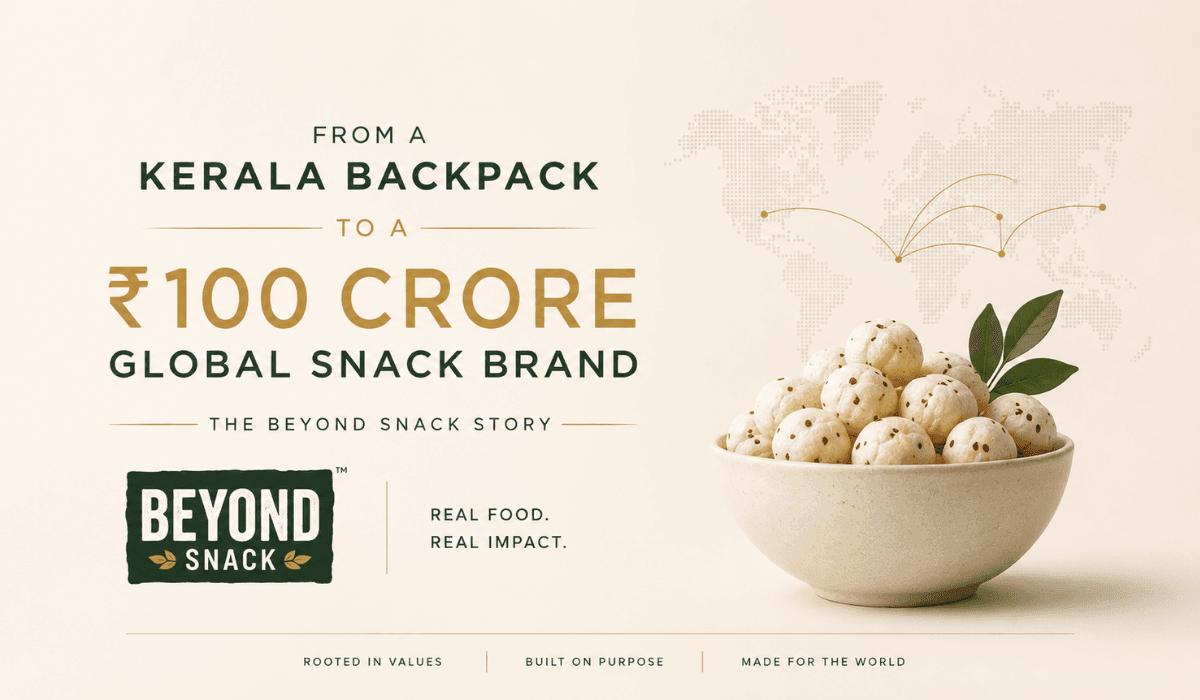
Beyond Snack was founded in 2020 by Manas Madhu , Jyoti Rajguru , and Gautam Raghuraman , born from Manas's personal frustration with the lack of a premium, hygienic, and consistently good Kerala banana chip brand
Instead of chasing snack trends, Beyond Snack focused entirely on reinventing the traditional Nendran banana chip with modern flavours, automation, and strict quality control
What started as a single-product D2C brand from Alappuzha, Kerala, became one of India’s top-selling emerging snack brands across Amazon, Flipkart, and BigBasket, raising Rs 114 Cr and targeting ₹100 crore revenue
Every Keralite knows banana chips. Known locally as kaay upperi, these crispy golden slices of Nendran banana have been a staple across South Indian homes, kitchens, and travel bags for generations. Parents packed them for their children leaving home. Relatives sent them as gifts. Festival spreads were incomplete without them.
But despite being so deeply loved, banana chips had never had a real brand. They came from local shops, small bakeries, and roadside vendors. Quality varied with every batch. Hygiene was an afterthought. And the category sat quietly in the background of India's snack industry, overshadowed by potato chips and namkeens, never treated as a category worthy of serious attention.
Manas Madhu grew up carrying banana chips in his bag every time he left Kerala for college or work. And every time he looked for them outside the state, he found nothing that came close to what he knew from home. That gap stayed with him for years.
Manas Madhu had built a solid corporate career before he turned entrepreneur. He studied BTech in Electronics and Communications Engineering at Kerala University, followed by an MBA from Symbiosis Institute of Business Management in Pune. He worked first at IBS Software Services and then at Capgemini as a Senior Consultant, where he spent years studying value-added industries and watching food businesses grow.
The more he observed the food sector, the more one opportunity kept coming back to him. Banana chips were everywhere in Kerala but nowhere else in a form that was consistent, premium, or trusted. The category was fragmented, unbranded, and completely ripe for a new kind of player.
In 2018, Manas quit his job at Capgemini, moved back to Kerala, and spent nearly two years studying the banana chips industry before launching the brand. He met farmers, visited factories, studied production methods, and obsessed over what it would take to make a chip that was not just good but reliably, repeatably, undeniably the best.
"Banana chips have often been underrated due to a lack of innovation and the right technology," he later said. "We decided to drive that innovation and bring the latest technology to banana chips."
Building a premium food brand around a product that consumers had always bought for a few rupees from a local vendor was not a straightforward task. The first challenge was changing perception. For most buyers outside Kerala, banana chips were an impulse, low-value snack. Convincing them to pay a premium for a branded, flavoured version required both product quality and patient education.
Sourcing was another early obstacle. Beyond Snack chose to use only Grade-1 Nendran bananas, a specific Kerala variety with a distinct flavour and texture. This meant building direct relationships with farmer groups across South India, which took time, logistics, and consistent engagement. The brand eventually built a network of over 220 farmer groups to ensure supply quality and seasonal reliability.
Then there was the production problem. Traditional banana chip manufacturing relied on long frying times, inconsistent hand-cutting, and variable oil quality. Manas wanted chips that were cut to a precise thickness, fried in pure coconut oil, and packaged without human touch to ensure hygiene. Achieving that at scale required significant investment in automation at a time when the brand had very limited resources.
The Tumkur facility, the team eventually built in Karnataka, runs at 95% automation, produces 6.6 metric tonnes per month, and was designed from the ground up to eliminate the inconsistency that had always defined the category.
Beyond Snack launched at an interesting moment. India's D2C food market was maturing rapidly, and a new generation of snack buyers was actively looking for options beyond the usual potato chip aisle. They wanted products with cleaner ingredients, real stories, and honest provenance.
Beyond Snack offered all three. The chips were made from freshly plucked Nendran bananas, fried in refined coconut oil, free from trans fat and cholesterol, and prepared in under two minutes to retain natural nutrients. The brand launched six flavours, including Peri Peri, Salt and Black Pepper, Desi Masala, and Hot and Sweet Chilli, transforming a traditionally single-flavour product into a full snacking experience.
More than 70% of sales came through online channels, including Amazon, Flipkart, BigBasket, Blinkit, Zepto, and Swiggy Instamart, where the brand quickly established itself as the top-selling emerging snack brand. The product's quality spoke before any marketing campaign could.
In December 2021, Beyond Snack appeared on Shark Tank India Season 1. Manas pitched the brand clearly: a premium, authentic Kerala banana chip with a vision to compete nationally against potato chips and namkeens. The Sharks tried the product, liked what they tasted, and saw what the founder saw.
Ashneer Grover and Aman Gupta jointly offered Rs 50 lakhs for 2.5% equity. The deal closed after the show. Within six months of the Shark Tank episode airing, the brand grew threefold. Sales jumped. Website traffic exploded. And Beyond Snack went from a well-loved regional product to a nationally recognised name almost overnight.
"Shark Tank gave us a chance to tell our story to a national audience and showcase the heart behind what we do," Manas said.
Beyond Snack has raised a total of Rs 114 Cr across multiple rounds, including an $8.3 million Series A led by 12 Flags Group in January 2025, with participation from NABVENTURES, FAAD Network, and Enrission India Capital. The brand is now available in 18 Indian cities, across 20,000 brick-and-mortar retail outlets, including DMart and Reliance stores, and in 12 countries internationally. Revenue reached Rs 34 crore in FY24, with the brand targeting Rs 100 crore in the near term.
The team is over 80% women, and Manas has stated a goal of making Beyond Snack 100% women-run by 2026. The brand also sources bananas directly from farmers and has turned a product where 40% of farm produce was being wasted into a viable and growing commercial category.
Beyond Snack did not invent banana chips. It simply refused to accept that one of India's most beloved traditional snacks deserved to stay unbranded, inconsistent, and invisible outside its home state.
Manas Madhu gave up a stable consulting career, moved back to his hometown, spent two years learning an industry before building in it, and then built a production system rigorous enough to take a village-kitchen snack to supermarket shelves across twelve countries.
The product was always there. The category was always ready. It just needed someone stubborn enough to believe it deserved better.
Quick Share