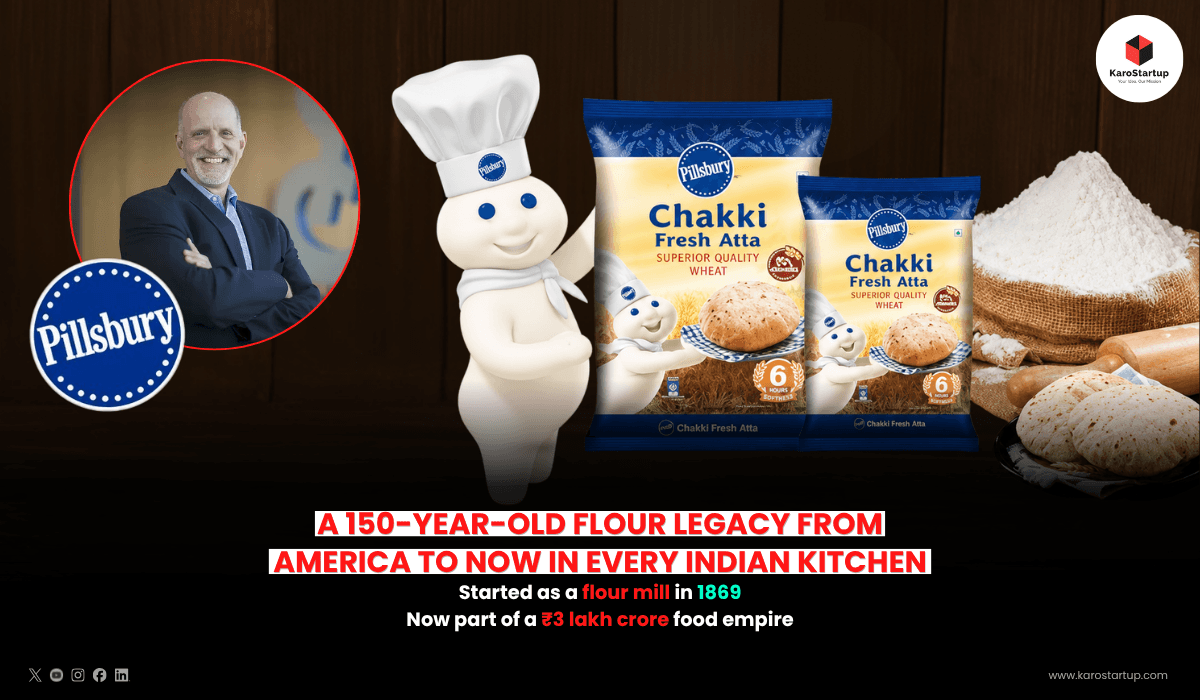
• Pillsbury entered India in 1996 under General Mills, pioneering packaged atta in a market dominated by local chakki mills
• The brand won Indian households with Chakki Fresh Atta, promising soft rotis, quality, and convenience
• Pillsbury later expanded into cake mixes and baking products, becoming a trusted kitchen brand with 150 years of heritage
The Problem Hidden Inside Every Indian Roti
For generations, making roti in India began long before the dough was ever kneaded. Families bought raw wheat in bulk. They cleaned it by hand, dried it, and carried it every week to the neighbourhood chakki, the local flour mill, to be ground fresh. It was a ritual deeply embedded in daily kitchen life across the country.
The process worked. But it was slow, time-consuming, and entirely dependent on the quality and hygiene of the local mill. For working families and urban households increasingly pressed for time, it was also becoming harder to maintain. Yet well into the 1990s, branded packaged atta accounted for less than 5% of total wheat flour consumption in India. Almost no one had seriously tried to change that. Pillsbury walked into that gap in 1996 and changed the category forever.
Pillsbury is not a young brand. In 1869, Charles A. Pillsbury bought a share in a Minneapolis flour mill and a legend was born. What began as a single mill on the banks of the Mississippi River grew into one of America’s most iconic food companies, built on a relentless obsession with flour quality. Before Charles Pillsbury purchased his share in the Minneapolis Flouring Mill, millers marked three X’s on packaging to denote the best flour. Pillsbury broke protocol. He added a fourth X to indicate Pillsbury flour was superior to all others. In 1872, Pillsbury’s Best and the four-X logo were trademarked.
Over the following century, the brand expanded, changed hands, survived two world wars, acquired competitors, and eventually merged with General Mills in 2001. Through all of it, the core promise never changed: the best possible flour, consistently and reliably delivered.
When General Mills brought Pillsbury to India in 1996, they were not simply launching a product. They were introducing a completely new category to one of the world’s most flour-dependent cultures.
The insight driving Pillsbury’s India entry was straightforward but required real conviction to act on. Indian households consumed enormous quantities of wheat flour every single day. Roti was not an occasional meal. It was a staple, eaten morning and evening, across every state and income level. And yet the category was almost entirely unorganised.
Before the late 1990s, wheat flour was mainly home ground or milled through local chakki mills in India. Housewives used to buy raw wheat in bulk, clean it by hand, store it, and mill it using traditional hand-driven chakki or bring some quantity of wheat every week to the local mill to grind for daily needs.
Pillsbury’s proposition was clear: what if a family could get consistently fresh, nutritious, hygienically processed atta without any of that effort? Chakki Fresh Atta was positioned not as a foreign import but as a better version of the familiar. It delivered the same texture and freshness associated with a neighbourhood chakki, but with the added benefits of standardised quality, higher protein and calcium content, and the trust of a global brand behind it.
The Challenges of Changing a Daily Ritual
Entering the Indian atta market meant asking millions of households to abandon a habit they had practised for generations. That is never a small ask. The biggest challenge was not product quality. It was consumer conviction. Indian homemakers had deep relationships with their local chakki and strong opinions about what fresh atta should taste, feel, and smell like. Convincing them that a sealed, shelf-stored packet could deliver something equivalent took significant education, patience, and consistent product performance.
Retail distribution was another challenge. In the mid-1990s, modern retail barely existed in India. General Mills had to build a distribution network that could reach consumers across a massively diverse geography, spanning urban supermarkets, neighbourhood kiranas, and everything in between. Maintaining cold chain integrity and shelf-life standards across that kind of fragmented retail landscape was a genuine operational challenge for a category that was entirely new.
There was also the price sensitivity question. Packaged atta carried a cost premium over local chakki atta. For a country where wheat flour was a daily household necessity, price was never a small consideration. Pillsbury had to demonstrate enough value to justify that premium consistently, and do so at scale.
If Pillsbury’s product earned trust through quality, its mascot earned love through personality. The Pillsbury Doughboy was created in Chicago by the Leo Burnett advertising agency in 1965. The little guy turned 50 in 2015.
When Pillsbury entered India, Indians were quick to connect with the cute mascot who retained his distinct “hoo-hoo” laugh on being poked in the belly even in the Hindi commercials. The universally endearing traits of an innocent face, rotund belly and child-like chuckle made Pillsbury Doughboy the icon he is today.
In a market where brand trust was built through emotional connection as much as product performance, the Doughboy became Pillsbury’s most powerful ambassador. He appeared in every television commercial, stood in every roti-making moment, and made the brand feel warm, familiar, and safe in a way that no amount of nutritional claims could have achieved alone.
Pillsbury Atta was one of the first brands in India to offer a toll-free number, branded Namaste Pillsbury, operational from 9am to 9pm Monday through Saturdays, allowing homemakers to call in with questions about recipes and product use. It was a consumer engagement move that felt ahead of its time for the mid-1990s Indian market.
The product became an instant hit among housewives who loved the convenience of buying readymade atta instead of the long and arduous process of drying and cleaning the grains and grinding them at the chakki.
As urban India expanded and more women entered the workforce, the case for packaged atta grew stronger every year. Time was becoming the scarcest household resource. The weekly chakki trip, once a ritual, became an inconvenience that more and more families were willing to trade away for a reliable packet. Pillsbury had built the category before the demand wave arrived, which meant it was already trusted and familiar when millions of new urban consumers began looking for exactly what it offered.
Since 2002, sales in the branded atta category have grown around eight-fold from under Rs 600 crore to over Rs 4,500 crore, driven by consumers seeking convenience and a guarantee of better quality than unbranded flour. Pillsbury had pioneered a category that its own entry helped create.
Today Pillsbury India operates across atta, cake mixes, baking mixes, custard, and pizza products, sold in over 100 countries globally through General Mills. In India, the brand holds an 8% share of the packaged wheat flour market, competing alongside Aashirvaad, Fortune, and a growing field of regional players in a category it helped bring into existence.
The Doughboy remains one of the most recognisable advertising characters in India, still appearing in campaigns nearly three decades after he first giggled his way into Indian living rooms. The brand continues to localise actively, launching regional variants and expanding its baking range as Indian consumer appetite for home baking has grown steadily.
Pillsbury’s India story is not just about flour. It is about what happens when a brand is willing to build a category that does not yet exist, in a culture where the habit it is asking people to change runs three generations deep.
It required patience, product excellence, smart emotional marketing, and the confidence to keep investing in consumer education long before the market caught up. The brand did not wait for Indian consumers to discover packaged atta on their own. It showed up at their doorstep, with a giggling doughboy and a bag of soft rotis, and earned its place in the kitchen one household at a time.
And sometimes, the most powerful market entries are not the ones that chase existing demand. They are the ones patient enough to create it.
Quick Share