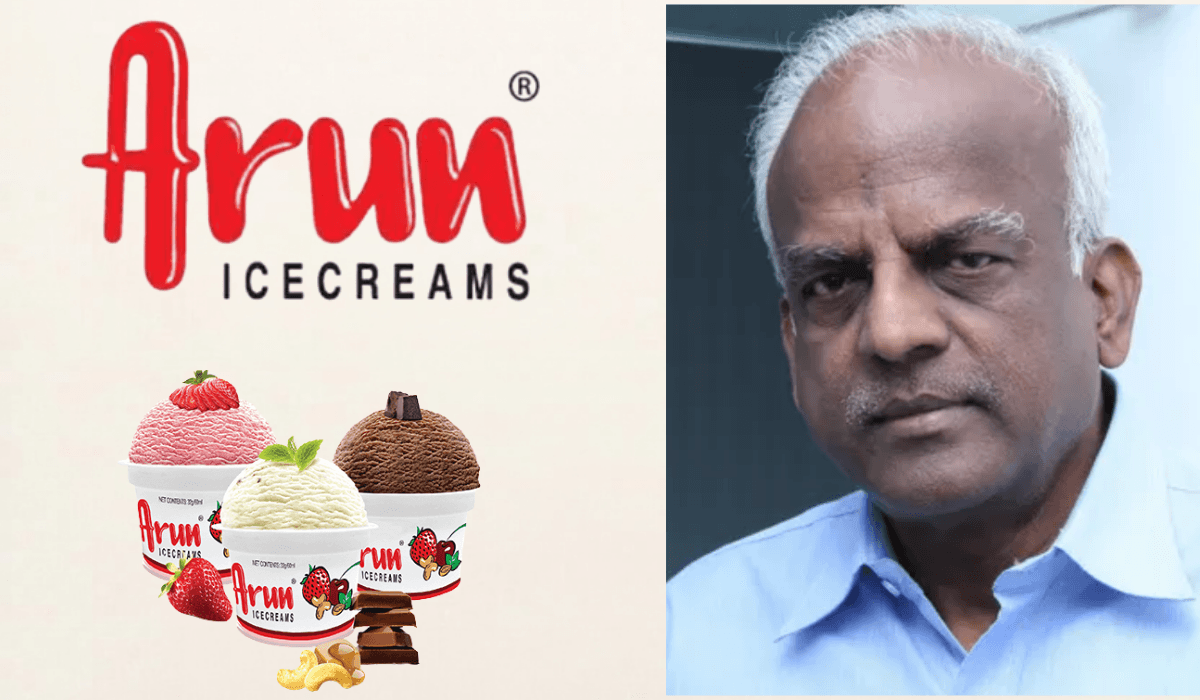
• Arun Ice Cream was founded in 1970 by R.G. Chandramogan, a 21-year-old school dropout who started a small ice candy business in Chennai with Rs 13,000, three employees, and fifteen pushcarts
• Instead of big retail stores, he used pushcarts and local franchises to take ice creams deep into small towns and rural Tamil Nadu before competitors did
• What started as a one-room candy operation slowly became one of the most loved ice cream brands in South India, today sitting inside Hatsun Agro Products with a market valuation crossing Rs 20,000 crore
There was a time when ice cream was not something people bought casually. For most Indian families in the 1960s and 70s, it was reserved for birthdays, festivals, or a rare outing. It felt like a treat, not a regular part of life. In smaller towns and semi-urban areas, availability was limited too. You could not always just walk into a shop and find it waiting for you. So people did not think of it as something for any ordinary afternoon. It was more of a luxury moment than a daily comfort. That gap between craving and accessibility was quietly sitting there, waiting for someone with less money than everyone else to figure out how to close it.
R.G. Chandramogan grew up near Sivakasi, the town famous for firecrackers, where his father ran a small provision store that struggled to stay afloat. Chandramogan had tried studying. He was so afraid of examinations that he would sometimes leave the hall without writing a single word. Formal education had not worked. Waiting around for life to improve on its own was not something he was built for either.
At 21, he sold a piece of family land and walked away with Rs 13,000. He took his uncle's advice, looked practically at what that money could actually start, and decided on ice candies. Not because it was a childhood dream. Because it was something he could begin right then.
In 1970, he rented 250 square feet in Royapuram, north Chennai, for Rs 100 a month. The space was a factory during the day and his bedroom at night. He had three employees, six tricycles, and fifteen pushcarts. He named the brand Arun, after the Tamil word for the first rays of the sun, Arunodyam. A young man sleeping on the factory floor named his company after sunrise. And then he got to work.
The factory produced 10,000 ice candies every day. The pushcarts took them directly to college students, the one customer segment that was always hungry and always looking for something affordable. In the first year, the business did Rs 1.5 lakh in revenue. By 1981, Arun had grown to Rs 4.25 lakh in annual sales. But Chandramogan had noticed something about his own business that bothered him. Ice candies were seasonal. Summer brought customers; every other season was a struggle. If he wanted to build something lasting, he needed milk-based ice creams, products people would buy year-round with better margins.
The foundation of Hatsun Agro was built on this same practical thinking: dairy was already part of every Indian household, so why should ice cream feel rare or difficult to access? Affordable pricing, simple flavours, and easy availability became the core idea. Not a luxury product. Something people could enjoy regularly without thinking twice.
What Chandramogan walked into in the early 1980s was genuinely difficult. South India had over 350 ice cream brands at the time. Dasaprakash, Kwality Walls, and Joy were already well established and well funded. Chandramogan had no advertising budget, no cold storage network, and no way to fight these companies on their own terms. So he did not try.
He packed ice cream with rice and sent it on trains into rural Tamil Nadu. Ice cream travelling with rice for insulation, reaching small-town parlours long before cold chain infrastructure existed to make that kind of distribution logical. It was jugaad born from necessity. Competitors with bigger budgets would never have thought of it because they did not have to. Chandramogan had no other option, and that forced creativity became his biggest advantage.
He also moved location once during the early years, shifting his base to a less accessible area. Customers disappeared almost overnight. Sales dropped sharply. He had to rebuild from scratch in the new location, learning a lesson about visibility and accessibility that shaped every distribution decision he made for the next three decades.
While established brands fought over Chennai and larger cities, Chandramogan quietly went in the opposite direction. In 1978, Arun opened its first parlour. From there, the expansion moved deliberately into small towns and rural areas using a franchise model, something very few consumer brands in India were seriously attempting at that scale at the time.
The strategy was to get into markets where the big competitors had not bothered to go, build loyalty there first, and let the brand grow outward. People kept seeing Arun in their own streets, outside bakeries, in small freezers at corner stores. It did not feel like a distant corporate brand. It felt local and familiar. And when a product becomes part of daily surroundings like that, trust builds without any advertising doing the heavy lifting.
By 1985, Arun had become the largest ice cream brand by sales volume in Tamil Nadu. Not in one city. The entire state. Some franchisees became so emotionally attached to the brand that they named their children Arun. By 1995, expansion into Kerala and Andhra Pradesh had brought the outlet count to over 700, making it the largest ice cream operation in South India.
As lifestyles changed across India, food habits shifted too. People started looking for small daily comforts: something sweet after dinner, something cold on a tiring evening, a quick treat that did not need an occasion. Arun Ice Cream fit naturally into that change. It was affordable, easy to find, and never felt like a planned purchase.
Students picked it up after class. Families brought it home without overthinking. Small daily cravings found a simple answer. Over time, it stopped being just ice cream and became a small, dependable comfort woven into ordinary life. That is a different kind of loyalty from what advertising builds. It is the kind that lasts.
Today, Hatsun Agro Products, the company Chandramogan formally incorporated in 1986, has become India's largest private dairy company with a market valuation crossing Rs 20,000 crore. It procures 3.3 million litres of milk daily from over 4 lakh farmers across South India. Its portfolio spans Arokya Milk, Hatsun Curd, Hatsun Paneer, and the premium Ibaco parlour brand launched in 2012. Annual turnover exceeds Rs 7,200 crore. Chandramogan's personal net worth crossed 2 billion dollars in 2023.
But what makes this journey worth understanding is that the foundation never changed. At Rs 20,000 crore, the idea is still the same one that a 21-year-old with Rs 13,000 had in a 250 sq ft room in Royapuram. Make dairy products accessible, affordable, and part of everyday life.
Arun Ice Cream did not become what it is by trying to be premium or complicated. It became what it is by staying simple and showing up consistently in places other brands ignored. It understood something very basic about Indian consumers: people do not always want fancy food. Most of the time they want something familiar, affordable, and already there when they feel like it. And sometimes the biggest success stories are not built on complicated strategies. They are built on doing simple things well, for a very long time, for the people everyone else overlooked.
Quick Share