STARTUP STORIES
How Missing One Bus Built a ₹120 Crore Company
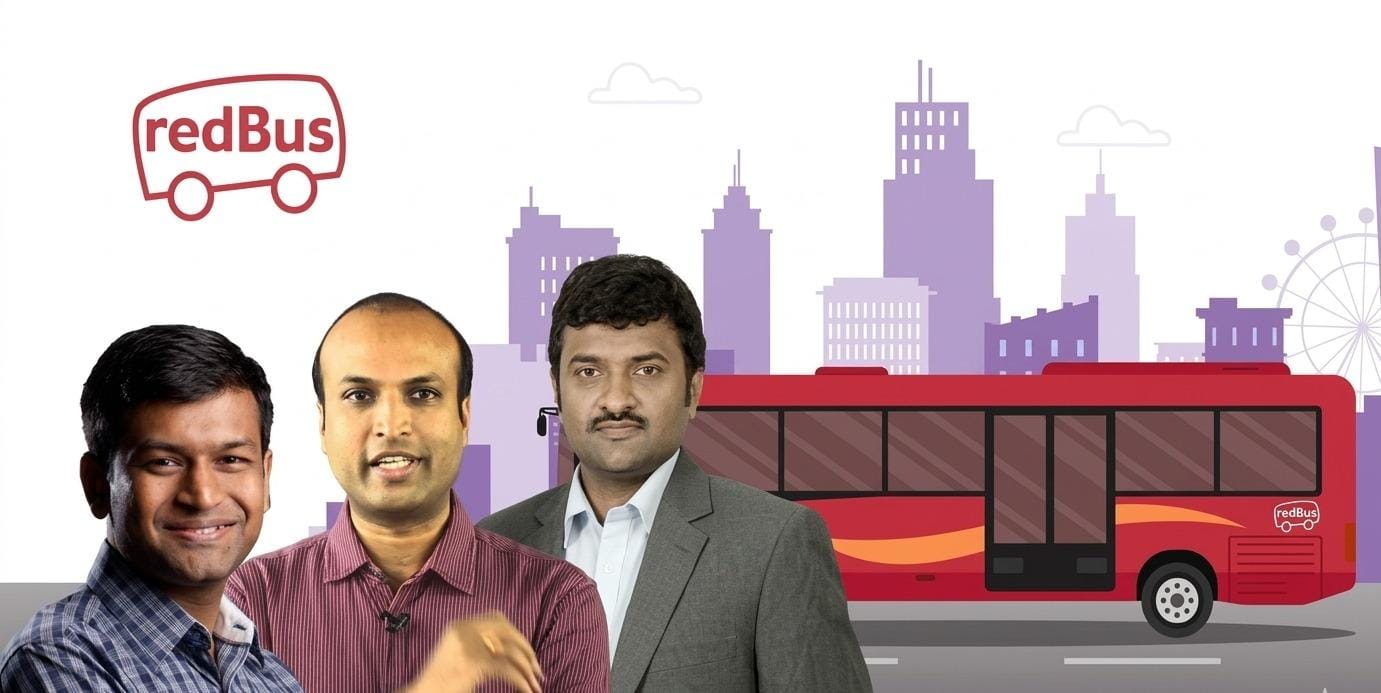
There has never been a lack of bus routes in India. However, a platform that can book all the seats on all the buses, all the operators, into a single, smooth digital platform? This was not the case, until a computer programmer missed his Diwali home train. Phanindra Sama transformed that personal anger into RedBus, the first and the largest online bus ticketing company in India a startup that reinvented the rules of intercity transport of hundreds of millions of Indians.
RedBus is not only a booking platform. It is the tale of one, very much relatable issue, which was the mess of purchasing a bus ticket in India, that was resolved through graceful technology and perseverance.
RedBus — Company Highlights
|
STARTUP NAME |
REDBUS |
|
Headquarters |
Bangalore, Karnataka, India |
|
Sector |
Travel Tech, Online Bus Ticketing |
|
Founders |
Phanindra Sama, Sudhakar Pasupunuri, Charan Padmaraju |
|
Founded |
2006 |
|
Acquired By |
ibibo Group (2013) → MakeMyTrip (2017) |
|
Website |
About RedBus
RedBus is an Indian online bus ticketing company, which was established in 2006 in Bangalore, Karnataka. It works on a market place system whereby the travellers are matched with hundreds of bus operators operating in India and the passengers are able to search or compare buses, book seats and do all booking online within a few minutes. At the time of its highest performance as a stand-alone business, RedBus had collaborated with a total of approximately 2000 bus operators, provided access to more than 100,000 routes, and sold millions of tickets each month.
The platform will run on its own site (redbus.in), a highly rated mobile application and third-party travel aggregators. RedBus had also gone abroad, starting up in Malaysia, Singapore, Indonesia, Colombia and Peru, where the Indian bus-tech model is exported to other developing markets facing similar ticketing issues.Sitting at the intersection of three powerful trends — India's digital payments revolution, the explosion of smartphone adoption, and the chronic inefficiency of intercity bus travel — RedBus found its product-market fit early, and never let go. Its GoBus platform additionally enables bus operators to manage their inventory, pricing, and schedules digitally, making RedBus as valuable to the supply side as it is to the demand side.
Facts about the Founders
Three alumni of IIT Bombay, Phanindra Sama (Phani), Sudhakar Pasupunuri and Charan Padmaraju started RedBus. The three were comfortable software workers in Bangalore when the idea came to them but they decided to bet on themselves.
Phanindra Sama -The RedBus Face
The RedBus narrative is portrayed by Phani. He was born in Andhra Pradesh, and educated in IIT Bombay, and in 2005, when working at Texas Instruments in Bangalore, he attempted - and failed - to purchase a bus ticket home to attend Diwali. All the travel agents he had been to were sold out. The idea of helpless frustrations at the moment became the RedBus foundation. The fact that it is not only the idea that makes the story of Phani so compelling is the discipline. Instead of resigning, he took months to prove the idea. He went around bus operators himself, most of whom had a very cynical attitude towards technology and a young engineer attempting to digitalise their business. He had continued, operator after operator, city after city, gaining their confidence, as of olden time: by honesty, by industry, by achievement.
Phani subsequently worked as CEO until ibibo acquisition in 2013. He has gone on to be one of the most authoritative voices of startups in India, a champion of Tier-2 India entrepreneurship, as well as an active angel investor in the ecosystem he contributed to its creation.
Sudhakar Pasupunuri & Charan Padmaraju — The Builders Behind the Brand
Sudhakar and Charan built the technology backbone of RedBus. While Phani handled operator relationships and business development, Sudhakar and Charan engineered the real-time seat inventory system — a genuinely difficult technical challenge, given that bus operators worked on paper ledgers and had no digital infrastructure at all. Their ability to build lightweight, reliable software that could plug into the operator's world was essential to RedBus's early success.
"People thought we were crazy. Why would anyone book a bus ticket online? In 2006, even booking a flight online was unusual. But we knew the problem was real because we had lived it." — Phanindra Sama, Co-Founder, RedBus
RedBus — The Startup Story
Similar to most good ideas, RedBus starts with frustration. It was the Diwali of 2005. Phanindra Sama, a young software engineer with Texas Instruments in Bangalore was making an attempt to reach home to his family in Andhra Pradesh. He went to the travel agents one after another, and discovered every seat occupied. He missed the festival. He was sitting at home in Bangalore frustrated and alone, and began to ask a question, which would alter his life: why is it so difficult to buy a bus ticket in India? The problem was structural. The intercity bus industry in India was in the occlusiveness. Thousands of routes were operated by hundreds of different operators and there was no centralised inventory, no way to view all the available routes, and no way to book without physically going to an agent who may only sell tickets on a few operators. The data were fragmented, the agents could not be trusted and everything was based on anarchy.
Phani realized an opening on the surface. He persuaded two of his friends in IIT Bombay, Sudhakar and Charan, to accompany him. The three left their cozy technology jobs in August 2006 and made RedBus with their own funds. The initial years were literally tough. The bus operators, the majority of whom had their inventory on papers, were heavily suspicious of three young engineers who had assured them that they were going to sell their positions online. Phani would spend hours in dirty bus depots, selling the idea, bus operator by bus operator, over chai. The initial break was made when Seedfund, the first Indian seed venture fund operated by Bharati Jacob and Mahesh Murthy, invested about 500,000 dollars in the year 2007. The institutional investor approval got the team into more operator alliances and enabled the team to take its technology seriously.
The second challenge was consumer adoption. In the 20062007, online transactions in India were at an infancy level. The majority of Indians lacked debit cards, internet banking services were almost non-existent and the Internet was almost non-trustful in online transactions. RedBus has addressed this by providing the cash-like bookings with the agents at the same time selling its online platform. RedBus was already in the right place due to the increased internet penetration and better payment infrastructure.
By 2010, the tide had turned. The adoption of smartphones was increasing, the internet banking industry was expanding faster and RedBus had established the most extensive network of bus operator alliances in India. The site possessed what could not be easily copied by its competitors: authentic relationships, authentic inventory and authentic consumer trust. Growth became explosive.
RedBus — Mission and Vision
Mission: To make bus travel in India and across the world effortless, reliable, and accessible for every traveller — by connecting passengers and bus operators through a seamless, trustworthy technology platform.
Vision: To become the world's most trusted bus travel marketplace — a platform that empowers millions of travellers to move freely, and thousands of bus operators to run efficient, technology-driven businesses.
RedBus — Products and Services
RedBus built an end-to-end travel ecosystem that served both consumers and bus operators. Its key product categories are:
Consumer-Facing Products
- Online Bus Ticketing: Search, compare, and book seats across thousands of bus operators on a single platform — with real-time seat maps, filters, and pricing.
- RedBus Mobile App: One of India's earliest and most downloaded travel apps, allowing users to book, cancel, and track buses from their phones.
- Seat Selection: An industry-first feature allowing travellers to choose their exact seat — a critical differentiator in a market where seat quality varies dramatically.
- Live Bus Tracking: Real-time GPS tracking of booked buses, giving passengers confidence and reducing anxiety around travel times.
- rPool (Carpooling): A carpooling service allowing travellers to share rides between cities, reducing costs and carbon footprint.
- Holiday Packages & Hotel Bookings: Later-stage product extensions leveraging the travel intent of the existing user base.
Operator-Facing Products (B2B)
- BOSS (Bus Operator Software System): A proprietary seat inventory and fleet management software given free to bus operators — the strategic tool that locked in supply-side relationships.
- GoBus: A white-label solution for bus operators to sell tickets on their own branded portals, powered by RedBus's technology.
- Ticketing Hardware: Point-of-sale terminals and ticketing machines provided to operators to bring them into the digital ecosystem.
RedBus — Revenue Model
RedBus generates revenue through several complementary streams:
- Convenience Fee / Commission: A booking fee charged to the consumer per ticket, plus a commission from bus operators on every ticket sold — the primary revenue driver.
- Advertisement & Promotions: Bus operators pay for premium placement and promotional campaigns, particularly around peak travel seasons.
- B2B Software Licensing: Revenue from enterprise versions of BOSS and GoBus, sold to larger operators and state transport corporations.
- Cancellation & Rebooking Fees: Service charges on ticket modifications, a meaningful contributor to overall revenue.
- International Operations: Commission revenue from bus bookings in Southeast Asia and Latin America, diversifying the revenue base geographically.
RedBus — Challenges Faced
Convincing Operators to Go Digital
The bus industry in India in 2006 was entirely paper-based. Convincing operators to trust their business to software built by three unknown engineers was the first and most daunting challenge. Phani addressed this through sheer persistence — building personal relationships, demonstrating results slowly, and creating BOSS as a free tool that made operators' lives easier rather than just extracting value from them.
Consumer Trust in Online Payments
In 2006, paying for anything online in India was an act of faith that most consumers were not willing to take. RedBus responded by building hybrid booking flows that accommodated cash payments through agents while educating users on the safety of online transactions. As digital payments matured — with net banking, then mobile wallets, then UPI — RedBus was positioned to benefit enormously.
Fragmented, Unorganised Supply
India's bus industry is extraordinarily fragmented — thousands of small, privately owned operators, each running a handful of routes, with no standard pricing or ticketing system. Aggregating this supply at scale required enormous on-the-ground effort across hundreds of cities and towns.
Combating Clones and Fast Followers
Once RedBus proved the model worked, well-funded competitors and clones appeared quickly. RedBus's answer was always to deepen its operator relationships and improve its technology — investing in product features that created genuine switching costs on both sides of the marketplace.
RedBus — Funding and Investors
|
Year |
Round |
Amount |
Key Investors |
|
2006 |
Bootstrapped |
Personal Savings |
Founders |
|
2007 |
Angel Round |
~$500K |
Seedfund (Bharati Jacob & Mahesh Murthy) |
|
2009 |
Series A |
~$5 Million |
Inventus Capital, Seedfund |
|
2011 |
Series B |
~$15 Million |
Inventus Capital, Helion Venture Partners |
|
2013 |
Acquisition |
~$120 Million |
ibibo Group |
|
2017 |
Re-acquisition |
Undisclosed |
MakeMyTrip–Goibibo Merger |
RedBus — Growth Metrics
|
FY2010 |
FY2011 |
FY2012 |
FY2013 (Pre-Acq.) |
|
|
GMV (Est.) |
₹50 Cr |
₹150 Cr |
₹400 Cr |
₹700+ Cr |
|
Tickets Sold |
~5 Lakh |
~15 Lakh |
~40 Lakh |
~70 Lakh |
|
Bus Operators |
~100 |
~500 |
~1,500 |
~2,000+ |
|
Cities Covered |
~20 |
~100 |
~500 |
~800+ |
RedBus — Competitors
|
Competitor |
Key Strength |
Weakness vs RedBus |
|
Abhibus |
Regional presence in South India |
Smaller inventory, limited reach |
|
MakeMyTrip (Buses) |
Multi-modal travel platform |
Buses were a secondary product |
|
Goibibo |
Strong tech backend |
Late entrant to bus segment |
|
Paytm Bus |
Payment ecosystem leverage |
Fewer operator relationships |
|
State RTCs Online |
Government backing |
Poor UX, limited online penetration |
What differentiated RedBus from all of the above was first-mover advantage, network depth, and the BOSS software lock-in. No competitor had invested as early or as deeply in operator relationships, and no competitor had built a supply-side software system that created genuine switching costs. By the time well-capitalised players took the bus segment seriously, RedBus had already built a moat that proved virtually impossible to breach.
What are the Top Products of RedBus?
- RedBus Online Ticketing Platform (Web & App)
- BOSS — Bus Operator Software System
- Real-Time Seat Selection & Live Bus Tracking
- GoBus — White-Label Operator Booking Portal
- rPool — Intercity Carpooling Service
- RedBus for Business — Corporate Travel Management
RedBus is not just where you book a ticket — it is where India's bus industry found its future.
Visit KaroStartup for more insights into India's most inspiring startup journeys.
Visit Karostartup for more insights into the intersection of technology, policy, and the future of India.