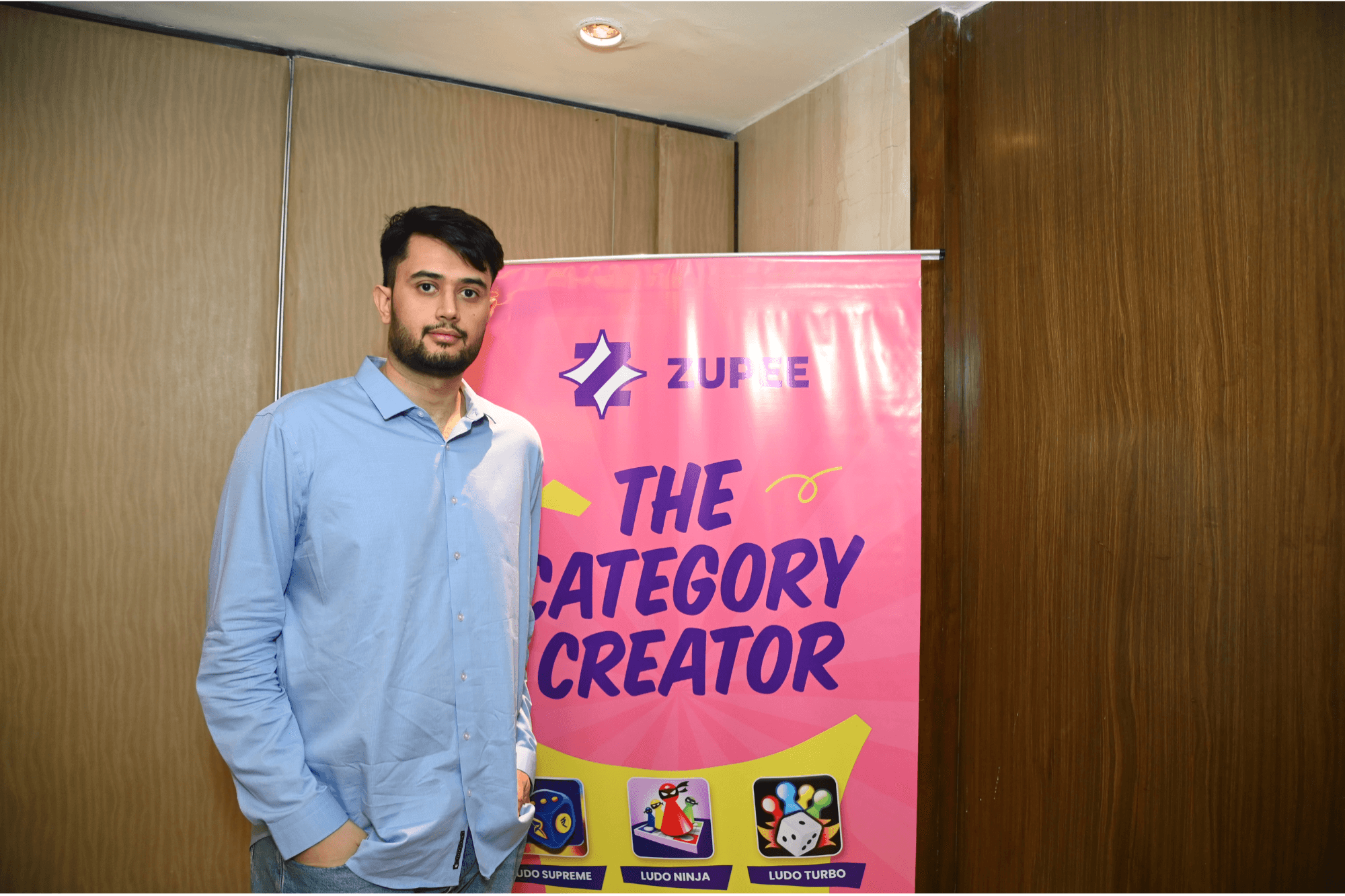
“We made traditional ludo to skill based ludo”
-Dilsher Malhi
In almost every Indian home, there was once a Ludo board folded carefully inside a cupboard brought out during summer vacations, family gatherings, or power cuts. It was simple, colorful, and innocent. No one imagined that this same board game could one day power a 5000 crore company just by making some changes to the traditional ludo.
Today Zupee reached a valuation of nearly ₹5,000 crore, becoming one of India’s largest skill-gaming startups.
But beyond the valuation, beyond the revenue, beyond the headlines what makes Zupee special is this:iyproved that you don’t always need a complex idea to build something big. Sometimes, all it takes is reimagining something familiar… and daring to see opportunity where others only see nostalgia.
Dilsher always viewed life differently and wanted to bring something that will bring something that will bring excitement to our minds from daily boring routine life
He belonged from a middles class family his dad was a police man his surroundings was like where you study and get a stable job for a stable life
But dilsher since his childhood was different he wanted to learn about life and live life to the fullest. He also had an interest in physiology and philosophy of life and wanted to bring a change in this world.
Then he went to study engineering at IIT Kanpur, he was more curious about why people play, compete and seek challenging questions rooted in philosophy and psychology.
He believed that the world of products could be divided into two categories: painkillers that solve basic problem statements and vitamins that enhance life’s quality.
“Imagine a world where fiction and entertainment don’t exist.It would be very dark and depressing.”
This idea that entertainment isn’t trivial but essential to human life laid the philosophical foundation for what would become Zupee.
Zupee went on to become India’s first skill-based Ludo gaming platform, transforming a slow, dice-dependent board game into fast-paced, time-bound formats like Ludo Supreme and Ludo Turbo. The platform introduced move-based scoring, reduced randomness, and made performance matter more than pure chance.
Dilsher Malhi and Siddhant Saurabh first connected through India’s growing startup and technology ecosystem, where ideas moved fast, and conversations often stretched late into the night. What began as simple exchanges about product innovation and India’s digital economy slowly evolved into something deeper.
The gaming industry was exploding, fantasy sports platforms like Dream11 were dominating headlines, and real-money casino-style apps were scaling rapidly. But the more they observed the market, the more they felt something was missing. Growth was visible, but sustainability and skill were questionable. They both believed India didn’t just need another platform built on luck; it needed something rooted in ability, fairness, and long-term value.
During countless brainstorming sessions, coffee-fueled debates, and intense whiteboard discussions, one thought kept resurfacing: why not reimagine a game every Indian already understands? In 2018, while the industry focused on fantasy leagues and betting-style mechanics, they asked a bold and different question: what if Ludo could be transformed into a competitive, skill-based game for the digital era? What if winning wasn’t determined by random dice rolls alone, but by strategy, speed, sharp decision-making, and mental alertness?
That single shift in perspective changed everything. With that clarity, Dilsher and Siddhant launched Zupee with a clear mission to reinterpret familiar games into structured skill-based experiences. They were determined not to build a gambling platform or replicate casino-style models. Instead, they wanted to design games in which outcomes depended primarily on player performance rather than chance. Zupee was born from that conviction, a belief that entertainment could be engaging, competitive, and responsible all at once.
Now, the problem was that Ludo is both, so they redefined the rules and policies to make it a proper skill in the game.
Zupee’s big breakthrough wasn’t inventing a new kind of game; it was reinventing a familiar one.
They knew what they wanted to bring to the world, but there is a very thin, confusing line between a game of skill and a game of chance (gambling).
They did not want to create something that could be considered gambling, so they studied research papers, legal judgments, and expert analysis to ensure their games qualified as games of skill. (In India, jurisdictions have consistently emphasised that when skill predominates over chance, the activity cannot be classified as gambling)
Ludo is a game millions of Indians grew up with, simple, intuitive, and social. But classic Ludo is slow and heavily dependent on the luck of dice rolls. Zupee took this simplicity and added structure.
They introduced formats like Ludo Supreme and Ludo Turbo, redefining the rules to:
Offer short sessions (typically under 10 minutes),
Reward strategic moves and decision-making,
Introduce move-based scoring instead of just finishing first,
Rank players by performance across rounds.
This shift reduced the impact of dice luck and increased the role of player skill. It transformed Ludo from a casual pastime into a competitive experience that could be monetised fairly.
Once upon a time in the lively world of mobile games, Zupee came along with a simple promise: play your way. You could jump into a game, have fun, and never spend a single rupee if you didn’t want to. Registration was free, and the games were packed with excitement. For those who wanted a thrill and a shot at winning real money, Zupee offered special contests with small entry fees. The company earned through tiny platform charges while players enjoyed the adrenaline of real-money challenges. Most people were happy playing for free, while a small, adventurous group tried their hand at cash contests. This balance kept the whole ecosystem healthy and fair.
To keep the fun safe, Zupee added time limits, daily caps, and alerts to make sure players stayed in control. It wasn’t just gaming; it was responsible gaming.
Zupee’s rise felt like a rollercoaster. Back in 2019, it started with a modest seed round of around ₹7–8 crore to test its ideas. By 2020, after a ₹60 crore Series A, its valuation jumped to nearly ₹250 crore. The momentum didn’t stop by 2021, valuations touched ₹750 crore, and by 2022, Zupee had raised over ₹800 crore, soaring close to ₹5,000 crore.
By mid-2025, the numbers told the tale: 150 million registered players and 12.5 billion gameplays. Zupee had become a household name in India’s mobile gaming universe.
Then came 2025, and with it, the Online Gaming Bill. Real-money gaming was banned. Overnight, giants like Dream11, MPL, and Zupee had to change course. Zupee took a bold step: no more real-money games. The company shifted to free games like Ludo Supreme, Ludo Turbo, Snakes & Ladders, and Trump Card Mania. The focus turned toward cultural content and fun-first experiences.
This change wasn’t easy. By early 2026, nearly 200 employees, 40% of the team, had to leave as the company reshaped itself for the new era. Revenue now came from ads, brand tie-ups, subscriptions, and in-app features, rather than entry fees.
In 2026, Zupee is playing a new game. Free games, social interactions, and culturally rich content are at its core. It now competes with everything from short videos to interactive mini-dramas, staying true to its style — simple yet deep games that keep your brain alive and your heart happy.
The journey from childhood board games to a ₹5,000 crore company is a story of understanding why people play. Even in a world without cash prizes, games that reward skill and human choice will always find players. And that’s the heartbeat of Zupee’s story.
For millions, Zupee became more than a casual timepass. It was a place to challenge your mind, laugh with friends, and escape the day-to-day grind. Creator Dilsher always said entertainment is like a vitamin – it makes life brighter, builds connections, and sparks joy. Zupee’s focus on skill over luck and its commitment to fair play reflected that philosophy.
Follow Karostartup for more startup success stories.
Quick Share