By the time you finish reading this article, the AI landscape will have shifted slightly. That's not an exaggeration — it's just where we are.
It started quietly. OpenAI made ChatGPT publicly available in November 2022, more or less as a demo, a proof of concept. In 5 days, it had one million users. It had a hundred million within two months. No technology related to consumers in history had expanded that rapidly - not Instagram, not Tik Tok, not the iPhone. The Silicon Valley giants were witnessing it with their own eyes and they panicked. Google, a corporation, the whole identity of which was created on sorting out the information of the world turned out to be confronted with an existential question: What if people no longer search, but ask? Microsoft, the perceived slow, business-oriented dinosaur of the technology industry, had actually wagered a billion dollars on OpenAI way back in 2019. That bet suddenly appeared to be the west bet in the history of the company.
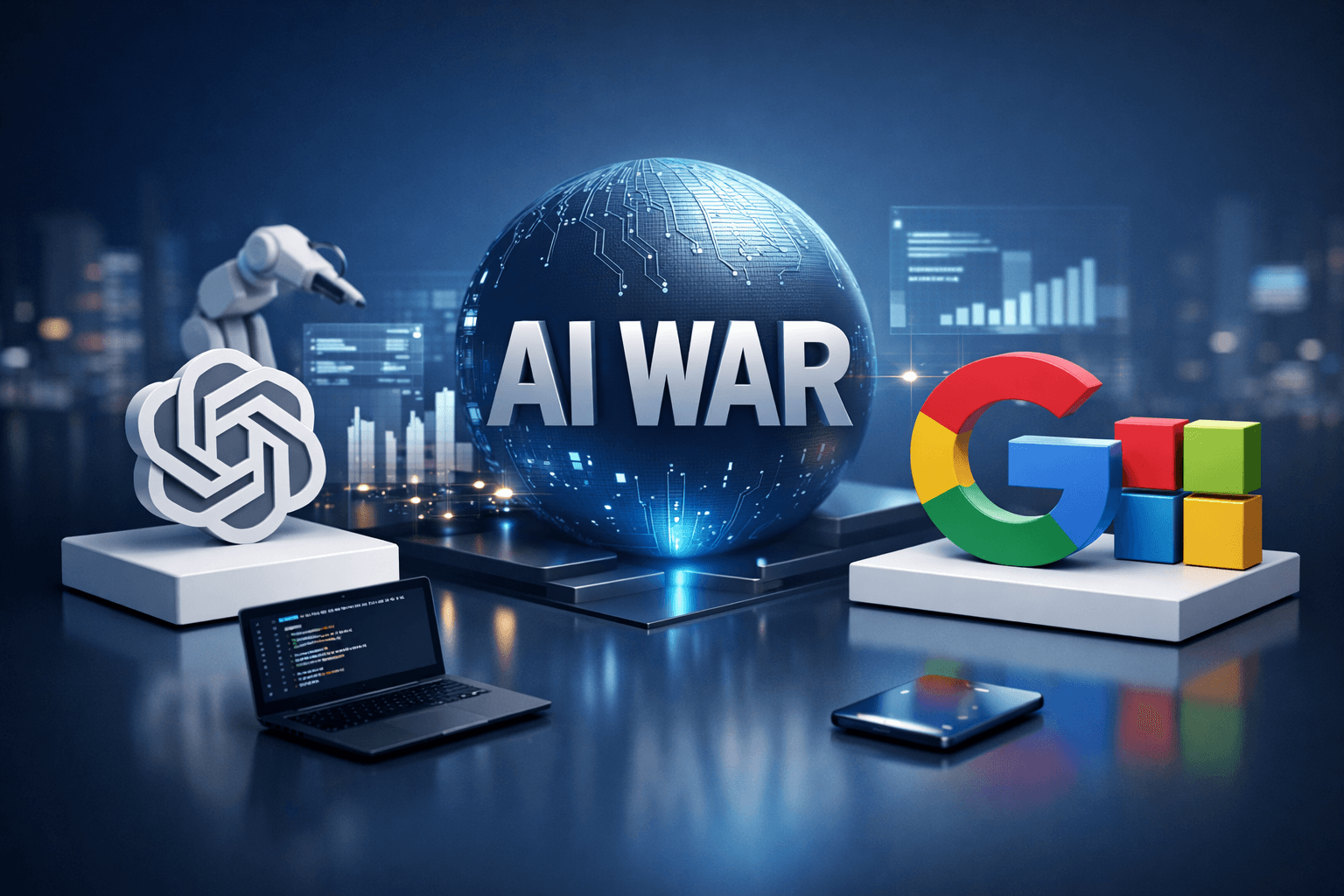
The AI war had begun. And unlike the majority of tech wars: Android vs. iOS, Facebook vs. Twitter , it is not only about market share. It is more than that: it is who owns the front line between human beings and knowledge.
OpenAI How to be the Disruptor Wearing a Lab Coat.
The OpenAI is the most unusual company in the world. It was established as a non-profit making entity with the aim of making artificial general intelligence of service to all mankind. It after became a capped-profit organization. It then took in billions of dollars of Microsoft. It is both a research laboratory, a start-up, a philosophical movement, and a product company, at the same time, and it is drawing all four of those directions simultaneously.
However, the users do not need to be bothered by all that complexity, as ChatGPT is truly good. It writes, it codes, it reason, it argues when it is wrong, it apologizes and it tries again. The multimodal capability introduced in GPT-4o and its successors voice, image and text intertwined made the product less software-like and more like a partner.
The strength of the OpenAI lies within its cultural momentum. It does not only have users but converts. Developers build on its API. Writers swear by it. Students use it. Teachers argue about it. It is quoted by the executives during board meetings. ChatGPT is now a verb (as Google was previously) and that brand name is not for sale by the scorecard.
Its weakness? Dependence. OpenAI could not be scaled without Microsoft and its cloud equipment as well as capital. And as the company shifts out of a research laboratory into a product juggernaut, the tensions within the company on the question of mission versus monetary have burst out into the open again and again.
In case OpenAI is the disruptor Google is the disrupted empire.
The Google search engine handles an average of 8.5 billion queries in a day. The search advertising contributes to the massive majority of the Alphabet revenue. During the past two decades, human beings would feel the need to know something and they would type it in a Google search box. Now it is being threatened, not by a rival that can provide a superior search, but by a paradigm shift, not search, but the conversation, not links, or synthesis. The reaction of Google has been vigorous. Their flagship AI model family is called Gemini and is technically mighty. The Google DeepMind, a convergence between Google Brain and the fabled DeepMind lab, is arguably the most focussed AI research talent on the planet. Google has TPUs (its own AI chips), YouTube (the largest video data in the world), Gmail, Android, Chrome, Maps, and 20 years of search history. On balance sheet, Google ought to be leading this war by a large margin.
However, there is a tension at the heart of the strategy of Google: all the successful answers to AI are the search that they did not display an advertisement. The old Google is constructing the product that would be the killer of the old Google. That is almost an insurmountable organizational burden, and that is why the initial rollout of AI at Google did not seem to flow naturally, why Bard was introduced in a crude manner, why the rebrand of Google under the name Gemini was rushed. Google is not losing. However it is not only fighting OpenAI but it is also fighting itself.
Whereas OpenAI got the press attention and Google avoided crisis PR, Microsoft did something low-key and shatteringly successful: putting AI in the environment where people already work. Copilot is integrated into Word and Excel, PowerPoint, Outlook, Teams, GitHub, and even windows. It is not going to make you alter your workflow - it comes directly within the tools that you have been using your entire life. With the enterprises that use Microsoft 365, Copilot is not a new application to be installed; it became one of the items in the toolbar one day. That is the way that Microsoft wins. Not through flashy, but through infrastructure. The models used by OpenAI have Azure as the cloud substrate. GitHub Copilot is now considered to be a standard tool among software developers. The number of Microsoft Teams monthly active users is 300 million. These are not distribution channels, but moats. The assumption that Microsoft makes is that the adoption into the enterprise is more adhesive, lucrative, and defensible than the consumer popularity. To date, the statistics substantiate such a thesis.
It is worth going back to see what exactly these companies are building as the battle is not with the chatbot, but with the foundation model. Large language models (LLMs) are conditioned on massive amounts of text. They get to know statistical patterns within language so effectively that they can acquire emergent capabilities, that is, capabilities not written in code by their creators. Writing poetry, writing code, think through legal debates, writing plain English quantum physics, all that was not in form of a rule. They emerged from scale. The second frontier is multimodality: The models that can see, hear, speak, and reason all these and on the same time. All of this is being pushed in this direction by GPT-4o, Gemini Ultra, and the successors. Following this, there is agentic AI- models, which not only react to a prompt, but take some action on their own: browsing the web, writing and executing code, handling files, booking appointments, running software on behalf of you. It is at this point that the competition is really high-stakes. A robot that has access to your email, calendar, documents and browser is not just an efficient tool, but the main interface of the way you conduct business with your digital life. Whoever assembles that interface, and whoever you will trust with it, is a very powerful person.
This is where the AI war is really interesting, and indeed complex.
In the case of startups, the emergence of the strong AI infrastructure can be considered the most important economic phenomenon since the boom of cloud computing in the 2010s. Software economics have been radically changed. The former GPT-4 or Claude can use a group of five engineers to create what would have taken a group of fifty to construct. AI fills in the boilerplate, proposes the architecture, finds the bugs, develops the documentation, and responds to the customer support e-mail. The leverage is phenomenal. It is spawning a new category of what venture capitalists are dubbing micro-SaaS or AI-native startups lean and fast-paced companies that are developing highly specialized tools based on foundation model APIs. They are not attempting to construct the AI, but rather the application layer over the AI. An artificial intelligence start-up that analyses contracts by using GPT-4. An organization employing AI to overview patient notes in the healthcare industry. An advertising engine that creates one-to-one copy.
The Feature Problem is killing the startups that had overbuilt. When you are selling your whole product with the name AI-powered writing assistant, it is a problem when ChatGPT has a write for me button. Your new start up is called AI code reviewer, then now you are competing against GitHub Copilot, supported by Microsoft and built-in to every IDE of a developer. Big Tech has a sadistic practice of monitoring the thriving of third-party apps, and making the feature. The Cost Problem is also silently crippling those startups that have scaled on AI APIs with unsustainable margins. Large models incur high costs to run inference. The OpenAI or Google bill can take up the bulk of your revenue when you are handling millions of API calls a month. Numerous AI companies are finding out that they have a product everyone enjoys and a business model that drains money. Yet the founders that survive, not by focusing too narrowly, but by creating some proprietary data benefit or discovering a distribution channel that the giants cannot easily copy is expanding at a rate that is arguably more rapid than any other generation of startup ever existed. Since it is not merely they are building with AI; they are building companies based on AI as the operating system, which puts them structurally advantaged in terms of cost to all competitors they are disrupting, who are still running their basic legacy operating systems.
This is the bad tidings behind all this:
These artificial intelligence systems are insanely powerful. They are also fully reliant on training data. And those companies enjoying the most, highest-quality, proprietary data do not necessarily find themselves at the end of the current product wars.
Google owns search history, Gmail, Youtube. Meta possesses social networks, discussions, photos on Instagram and Facebook. Apple contains health information, iMessages, Siri communications. This is information which nobody can match, neither a startup nor a competitor. With increasingly competent and specialized models, having the appropriate data to tailor it to particular fields, medicine, law, finance, engineering, etc. will be more important than the largest base model.
The next stage of the AI war will not be a competition of the best model. It will be regarding who holds the data to make his or her model the best to your particular use case.
They are inclined to speak about the AI war in the terms of a pure competition market share, valuations, benchmark scores, API pricing. It is much more than the balance sheet of any particular company. Work is being restructured. The initial set of tasks to be automated is not the factory jobs economists dreaded - it's knowledge work. Writing, coding, analysis, customer care, paralegal research, financial modeling. White-collar employees are finding that their experience and years of education are now estimated in terms of fractions of a cent per query. There is a shift in the way we access information. A search engine, ten blue links and synthesizing them yourself was the cognitive effort required to find what one was looking into over a generation. More and more, it consists of talking to a conversational AI and getting a synthesized response. This alters not only the economy of publishing and media, but also the epistemology of how we make our beliefs, and those whom we believe to mediate our cognitions of reality.
Power is concentrating. The AI models that train the frontier are calculable in hundreds of millions of dollars. There are very few organizations in the world that can afford to play on that level. The revolution in AI, as a source of democratization, is also enabling a technological power to concentrate that has perhaps few historical precedents.
No one has won the AI war. That much is certain.
OpenAI leads in cultural mindshare and developer adoption. Google leads in raw research capability and data assets. Microsoft leads in enterprise deployment and distribution. Meta, Amazon, Apple, and dozens of others are all competing in different dimensions of the same space.
What's remarkable about this moment is that the war is being fought on multiple fronts simultaneously: model capability, product experience, enterprise sales, developer ecosystems, pricing, regulation, and public trust. No single company dominates all of them.
The most likely outcome isn't a single winner — it's a stratified market where different AI systems dominate different contexts. The AI you use for work might be embedded in Microsoft Copilot. The AI that powers your search might be Google Gemini. The AI a startup uses to build its product might be Claude or GPT-4 via API. The AI running on your phone might be Apple's on-device model.
The prize isn't monopoly. The prize is presence — becoming so woven into how people think, work, create, and decide that removing you becomes unthinkable.
The AI war isn't a spectator sport.
If you're a developer, you're choosing which models to build on — and that choice shapes your product's future. If you're a startup founder, you're navigating a landscape where your biggest threat might be a feature update from a trillion-dollar company. If you're a knowledge worker, you're figuring out whether AI is your most powerful tool or your most dangerous competitor. If you're a student, you're entering a workforce being restructured in real time. The battle between OpenAI, Google, and Microsoft will determine which platforms we live and work inside. But the larger war — the one about what AI means for human creativity, employment, autonomy, and understanding — that's a war we're all fighting, whether we've chosen sides or not.
The only losing move is to assume it doesn't concern you.
The AI revolution is not coming. It's already here — and it's still accelerating.
Visit Karostartup for more insights into the intersection of technology, policy, and the future of India.
Quick Share