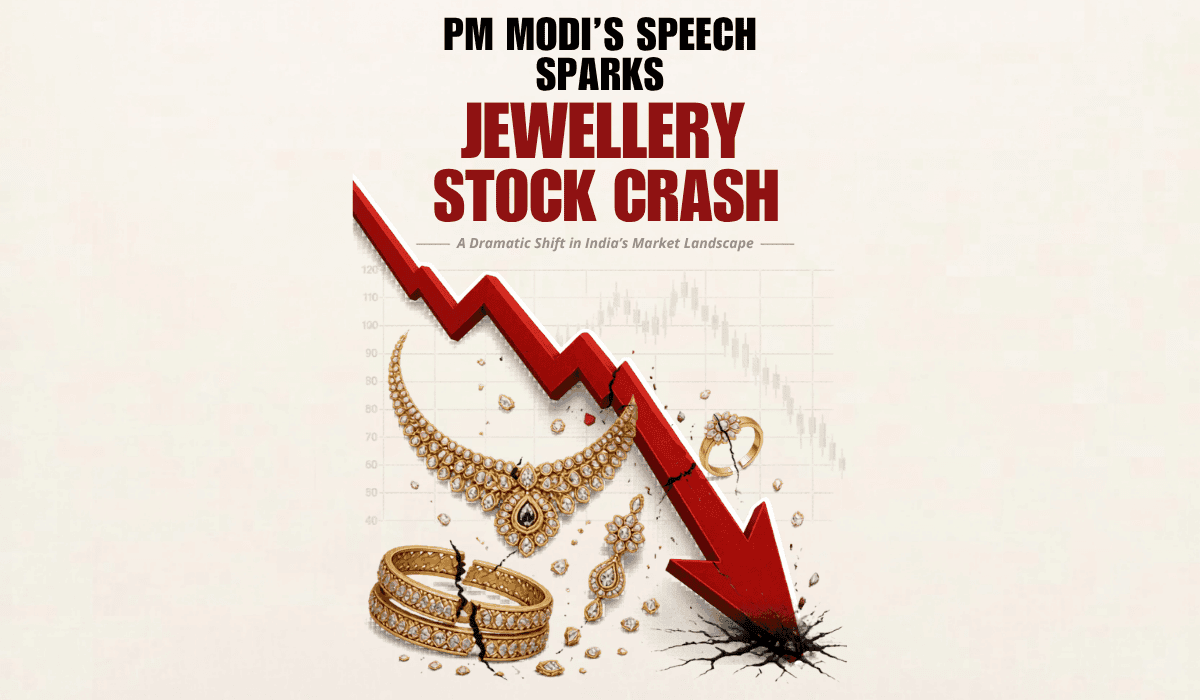
On the morning of 11 May 2026, investors who held shares in India's biggest jewellery companies woke up to an uncomfortable sight. Senco Gold was down nearly 9 percent. Titan had fallen more than 5 percent. Kalyan Jewellers dropped over 7 percent. Sky Gold was the biggest casualty, sliding more than 12 percent intraday. And this was not because of a global market crash, a corporate scandal, or a bad quarterly result. It was because the Prime Minister had given a speech the evening before. One appeal. One rally. And an entire sector went into freefall.
On 10 May 2026, speaking at a BJP rally in Hyderabad, Prime Minister Narendra Modi asked something that nobody in that position had quite said before in those terms. He urged ordinary Indians, especially middle-class families, to voluntarily stop buying gold for at least one year. Specifically, he asked people to skip gold purchases for weddings. He also asked citizens to cut back on foreign holidays, choose domestic destinations for weddings instead of abroad, reduce non-essential spending, and revisit habits like working from home and virtual meetings where possible. The message behind all of it was the same: India needs to conserve foreign exchange. And gold, he said directly, is a significant part of the problem.
India's gold import bill for the financial year 2025-26 hit a record high of nearly 72 billion dollars. That is not a small number to move around. Gold and crude oil together are the two biggest contributors to India's current account deficit, meaning they are two of the largest reasons money flows out of the country rather than staying in. With crude oil already trading above 104 dollars per barrel due to ongoing tensions in West Asia, and the Indian rupee under pressure, foreign exchange reserves have been taking a hit from multiple directions at once. The government needed to slow that outflow somewhere. Gold, being a discretionary purchase in many cases, especially for weddings and gifting, was seen as one place where public behaviour could realistically be shifted if the appeal landed right. That was the logic behind the speech.
The immediate reaction in jewellery stocks was driven by one simple fear: if people actually listen to this, demand drops. India's gold jewellery industry runs on a deeply cultural engine. Weddings alone account for a massive portion of annual gold sales. Festivals, gifting seasons, family occasions, and gold purchases in India are not purely financial decisions. They are emotional and traditional ones. When the country's Prime Minister publicly asks people to press pause on that tradition for a year, it creates genuine uncertainty about what the near-term demand picture looks like.
Beyond the appeal itself, markets also started pricing in a second risk: the possibility that import duties on gold could be raised as a follow-up policy measure. If the voluntary appeal did not work fast enough, a duty hike would be the next logical step. That fear of policy action following the speech added another layer of selling pressure on top of the direct demand concern.
Senco Gold fell to Rs 332.60. Titan dropped to Rs 3,245.90. Kalyan Jewellers traded at Rs 551.40. PC Jeweller slipped to Rs 17.90. The selling was broad, and it moved fast.
There is a slightly uncomfortable irony sitting inside this story. Titan, one of the biggest losers on 11 May, had just reported a 35 percent year-on-year rise in net profit for the March quarter, with revenue jumping nearly 78 percent and its jewellery business growing 50 percent on the year. These were strong numbers. The company's board had also recommended a dividend of Rs 15 per share for the full year.
In other words, the business was doing well. The fundamentals had not changed overnight. What changed was a single speech creating enough uncertainty about the future that investors chose to sell first and ask questions later.
That is how sentiment works in equity markets. A company's actual performance and its stock price can point in completely different directions when something disrupts the market's picture of what comes next.
The honest answer is that nobody knows yet how much of this sticks. India's relationship with gold runs deep in ways that political appeals have historically struggled to redirect. Gold is savings, it is inheritance, it is the visible expression of a family's prosperity at a wedding. Asking people to skip it for a year is asking them to change behaviour that is woven into how families mark the most important moments of their lives. Whether that appeal translates into actual behavioural change at any meaningful scale remains to be seen.
What is more concrete is the policy risk. MeitY's own trajectory and the government's stated need to protect forex reserves mean the conversation about gold import duties is not going away. That is the variable the jewellery sector will be watching most closely in the weeks ahead.
For now, the stocks took the hit. The wedding season keeps moving. And somewhere in India, a family planning a ceremony in the next few months is probably still going to buy the gold anyway.
Because some things a speech cannot change. At least not overnight.
Quick Share