In October 2021, Facebook CEO Mark Zuckerberg dramatized the change by announcing that the company would change its name to Meta, marking the beginning of a complete shift in the corporate strategy of building the metaverse. Zuckerberg had de fined the metaverse as the future of computing, and then he estimated that it would have a billion users in a decade. The company invested in Reality Labs, the team that was responsible to create that vision, and released Horizon Worlds at the end of the same year. At the time, Zuckerberg wrote that he hoped the metaverse would be used by one billion people in ten years, with hundreds of billions of dollars of online transactions and millions of creators and developers employed. It was broad and bold vision, and investors, employees, and the general population were all eyes on it.
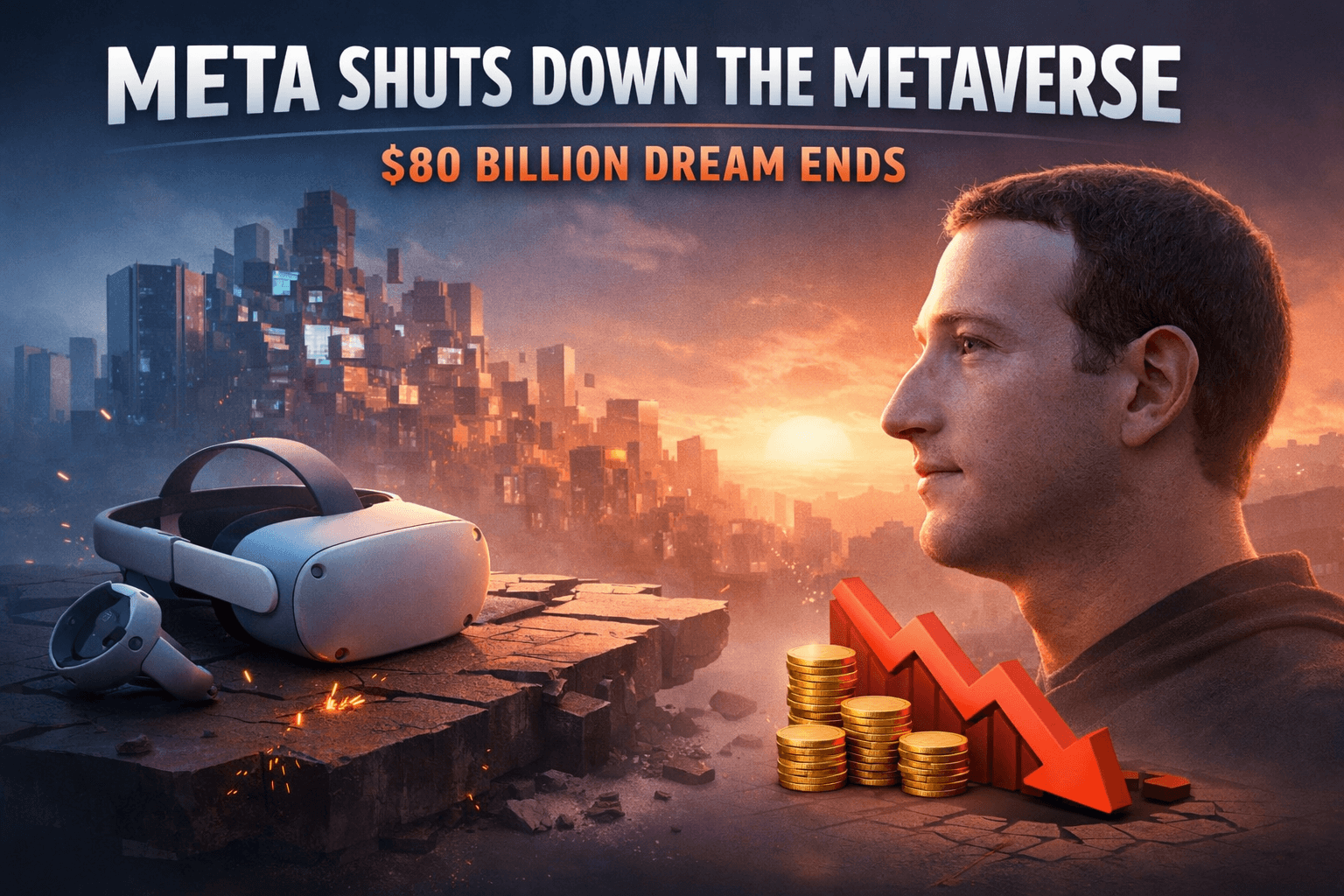
Meta has made the decision to close its Horizon Worlds online multiplayer VR game and spent tens of billions of dollars in pursuing the metaverse. The platform initially launched on Meta Quest in December 2021 and a mobile version will launch in September 2023. Meta confirms that it will only target the mobile version, which is to delist the Meta Quest version on March 31, 2026, and entirely sunset it on June 15. Beginning June 15, 2026, users will not be able to create , publish, or edit VR worlds, or to view Meta Horizon Worlds with VR headsets. Rather, the spaces will be reserved to the Meta Horizon mobile app - i.e. in case they were optimized towards mobile. The subscription will cut benefits that were offered to subscribers of Meta Horizon Plus, such as Meta Credits, Digital Clothing, Avatars, and In-World Purchases, on March 31, 2026.
The figures narrate a tale of near unbelievable financial destruction. Reality Labs incurred billions of dollars of operating losses per quarter. During the fourth quarter of 2025 alone, the unit alone incurred a loss of 6.02 billion. Combined over the years since the pivot to metaverse, the cumulative investment of Meta is approximated to have been more than 80 billion dollars - making it one of the most expensive product bets that a company has ever made in its history. It was not the first time that industry watchers were surprised by the losses. Report after report the earnings of Meta in the quarter revealed that the Reality Labs was a money-bleeding department that had little to point to in terms of revenue or number of users. It was posed to Zuckerberg by the shareholders several times as to the strategy, and over the years he was quite defiant in saying the metaverse was a long-term play.
The platform has failed to deliver on its expectations. It has never attracted a number higher than several hundred thousand monthly active users, a small number considering the investment required. Nevertheless, according to critics, it was the combination of factors, namely the prohibitive price of VR hardware , the issue of motion sickness, the idea that the avatars were far too clunky, and, perhaps, most importantly, the lack of reasons to encourage average users to put on a headset and go online. It was reported with vacant virtual spaces and poor retention. There were only in the low hundreds of thousands of monthly users, and nothing like the mass adoption that Meta had anticipated. The mobile edition, which was released in 2023 to reach customers without VR headsets, did not alter the trend. Mainstream and Head of Reality Labs Andrew "Boz" Bosworth recently founded out that VR has not been expanding as much or as rapidly as Meta had expected. That confession, unusual in its openness on senior executive level, was an early indicator that the inside reckoning had already occurred many years before this week announcement.
The shutdown had not been without human cost. Ouro Interactive, an in-house studio that had been working on first-party content in Horizon Worlds since 2023, laid off over 1,000 workers during the January 2026 round of cuts at Reality Labs. The change of Horizon Worlds occurred weeks following a reduction in the Reality Labs (more than 1,000 workers) by Meta. Studios working on VR titles were also hit by the January cuts. To most of such workers, the warning signs were a months-long shift in strategic message, as Meta was slowly moving the focus of its messaging off the metaverse and into artificial intelligence.
The metaverse aspirations of Meta have been discarded successfully to adopt AI. Having transferred its investments into Reality Labs in the direction opposite of the metaverse, Meta is currently committed to the AI wearables and towards its own development of AI models. With a recent earnings call, Zuckerberg marked the new direction. He said it was difficult to envision the world in a few years, where the vast majority of glasses worn by people would not be AI glasses. The company now focuses not on VR headsets and virtual worlds but on AI-based smart glasses and the development of large language models, in which consumer demand and competitive pressure are much greater.
Reality Labs VP of Content Samantha Ryan said: “The reason we are well-positioned to launch synchronous social games on a massive scale is because we have the unique capability to bridge the games with billions of users on the largest social networks in the world. She also mentioned that Meta continues to have a very strong hardware roadmap in the VR, but the metaverse is no longer the priority.
Meta has been keen to ensure that it has not been seen as an outright capitulation, but it has been a strategic refocus. The company stated: “We are splitting up the two platforms to allow them to grow with more focus and the Horizon Worlds platform will become a mobile only experience. The mobile aspect of Horizon Worlds will remain, just like Roblox, which is nowhere close to the grand, all-encompassing digital civilization that Zuckerberg had initially imagined. Meta does not give up on virtual reality hardware. Quest line is not retired yet, and the company is still working with the developers of the VR experiences. The difference is focus. The metaverse is no longer front page.
The metaverse of Meta today will undergo an upswing and downswing that will be the subject of study in business schools in decades to come. It serves as a warning against the risks of gambling an entire corporate identity on one, untested technology trend - and the challenge of trying to make people act in a way that is dictated by a boardroom and not the market. In case of Meta, this point does not seem like a failure and rather a detour - albeit a costly one. The company had wasted years and tens of billions in pursuit of a vision that was inevitable at the time. It happens that timing is everything and as much as ambition. Rivals and critics are now keeping their eyes on whether the AI pivot by Meta will be an even more successful transformation or the history will repeat itself.
The vision of the metaverse as envisioned by Meta is dead. What started with a flashy rebrand, an investment of billions and a promise to change human connection has seen a quiet ending which is an email to users and a closeup date of June 15. It is a mute conclusion of a loud pledge.
It is still unclear whether Meta can reinvent itself with AI, and whether that transition would be worth the colossal losses incurred in the meantime, but that was the question of the next chapter of the company.
Quick Share