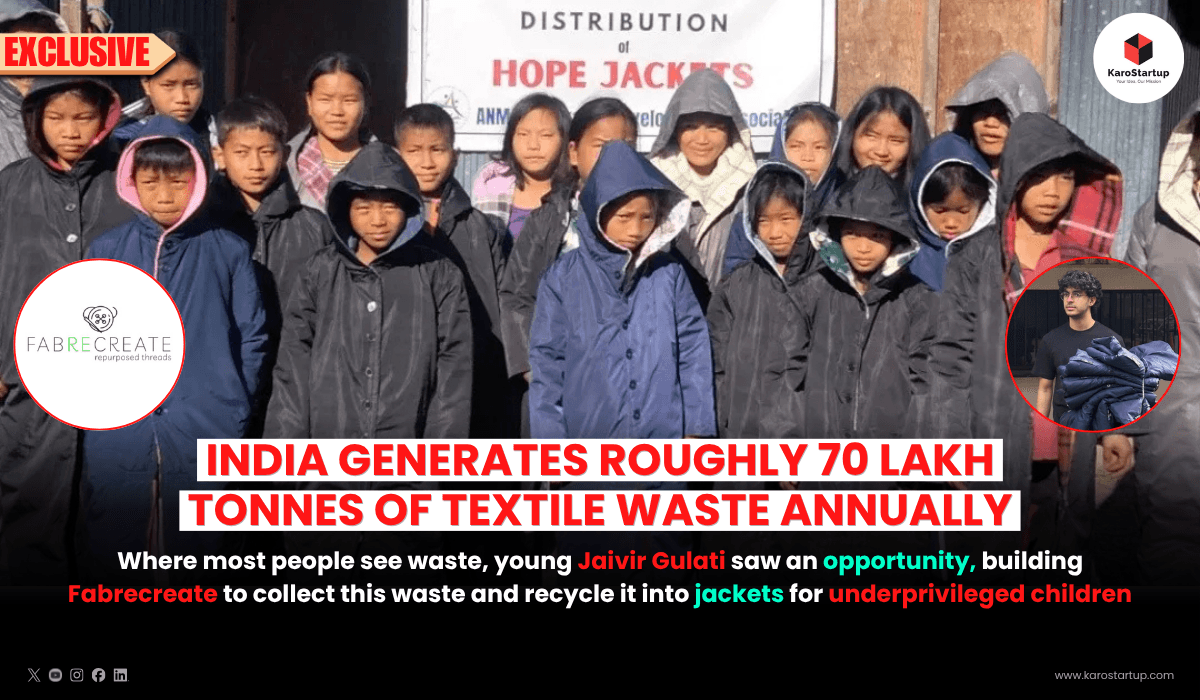
It's 2023, and a young Jaivir Gulati witnesses haunting visuals of the Russia-Ukraine war, children stand in freezing temperatures without proper winter clothing, while dining in his school’s mess on a chilly evening. Those haunting images stayed with him for days. While our sympathy often gets drowned in intellectual debates about disparity, social inequality and the horrors of war, Gulati decided to act on his instincts by founding Fabrecreate, built on the principle that something as basic as warmth shouldn’t be a privilege.
Interestingly, during the same time, young Jaivir was learning more about the fashion industry and the textile waste it generates. The contrast shocked him – on one hand, children couldn’t afford suitable winter attire, whereas tonnes of textile waste were being generated, the majority of which found its way into landfills. Jaivir Gulati aims to tackle two hard-pressed issues with the same organisation.
Currently valued at $225 billion , the textile industry in India is projected to grow to $350 billion by 2030. The flip side of this is that India generates an estimated 7.25 million tons of textile waste annually, largely formed by unsold inventory, discarded clothing and factory scraps. Nearly 45% of post-consumer textile waste doesn’t enter any formal recovery path, instead being diverted to landfills and incinerators. Gaps in collection, weak sorting infrastructure, and limited recycling facilities prevent us from realising its true value and progressing towards a circular economy.
Over the years, the clothing industry has provided succinct ethical dilemmas. It is the second-biggest consumer of water and is responsible for 2 – 8% of carbon emissions worldwide. The development of synthetic textiles post-World War 2 revolutionised the fashion industry. That said, the development of these plastic-based textiles significantly damages the environment owing to the emission of greenhouse gases through their life cycle. The fast fashion trend only exacerbates the issue. You have cheaper, less durable garments with limited cycles, whose worth quickly wears off, triggering a vicious cycle of buying and discarding at a rapid pace.
One would assume that sourcing textile waste would be the easiest part, but Gulati observes that such assumptions aren’t true. Many companies are hesitant to trust young founders or are unwilling to support the operational burden of donating surplus material.
Jaivir recalls all the emails that never got replies, the people who questioned his ability to pull things off on account of his age, the partnerships that didn’t move forward, the manufacturers who showed interest and then disappeared, the stressful days of customs issues and shipment delays for international consignments. Despite all these hurdles, Fabrecreate continues to transform lives and fulfil its mission.
He recalls the importance of perseverance, stating,
“Initially, rejection used to feel personal. Now I’ve learned that it’s just part of building anything meaningful. It taught me patience and also made me more persistent. Sometimes one “yes” makes up for twenty rejections.”
Circular economy isn’t simply about eliminating carbon footprints, reducing textile waste, but also providing dignity of labour to the workers who form the invisible backbone of this industry. Fabrecreate works with over 30 women artisans through self-help groups who stitch these jackets.
One of his biggest lessons along the journey – execution matters more than ideas. Many people have great ideas, but actual implementation can involve handling unglamorous everyday tasks such as logistics, follow-ups, payments, operations, timelines and quality checks. So far, they’ve supported 10,000 + children across India and countries like Ukraine, Greece and Myanmar.
While ‘young founder’ and ‘social entrepreneurship’ feel like cool buzzwords, once the shine wears off, the daily grind can be messy and uncertain. Jaivir Gulati is a student juggling sports, academics and Fabrecreate. Most of the problem-solving happens between classes, emails and late-night calls.
Author and Inspirational speaker, Simon Sinek, suggested that people are more driven towards the ‘Why’, a mission that isn’t created out of thin air but discovered through your journey. Few people are lucky enough to find their purpose early in life. Even fewer dare to pursue it. Jaivir Gulati is a shining example of purpose meeting courage to solve a problem he truly believes in.
Quick Share