Even its name was not accidental. Farmley represents the connection between the Farm and the Family, a connection between the people, who produce the food and the people who consume it. It was beyond branding. It was a mission statement.
They have used technology and supply-chain know-how to develop an entire farm-to-fork system that offers high-quality, adulteration-free nuts and seeds and enables farmers directly. Farmley originally was a bootstrapped B2B platform, but the initial processing units were founded on the personal savings of the founders and strong connections with suppliers, where Bihar provided Makhana and California provided almonds in order to control quality at each stage. The first concept was to break the supply chain and operate in that manner. They had direct control over networks with farmers and importers. Later they began to concentrate on value addition to the supply chain.
The sourcing plan was very careful and well-established based on the geography of India. As per their business plan, they carry out all the tasks involved in makhanas in Bihar, all types of cashews in Mangaluru and raisins in Sangli. This was not just a business decision of sourcing regionally. It was a promise of authenticity and traceability. They have been built strong back-end connections with 5,000+ producers and farmers. By removing the middlemen, Farmley guaranteed that greater value to the farmers was achieved and the end consumers obtained cleaner products at lower prices.
Similar to most companies, Farmley suffered the interference caused by COVID-19. But they made it a launchpad, as most did not. In 2020, when Farmley switched to a D2C brand (after being a B2B supplier) a demand surge due to the pandemic-related immunity-boosting food led to a rapid scale-up. With lockdowns driving people online and fear of health reaching an all-time high, Farmley was in the right place: a familiar, traceable, health-focused brand with millions of new health-conscious Indians to serve.
Originally, Farmley was an e-commerce first brand available in online shops like Flipkart and Amazon. It has grown exponentially by utilizing performance marketing with the use of keywords, but above all its flagship date-based products. Relevance also contributed to the early success of the brand as the products such as date bites were shown to the consumers when they typed in related words such as almonds or dry fruits.
The results were stunning. The revenue increased more than 400 percent in 2020-2022 and the number of professionals increased to over 200 people, with five special processing centers in India.
Farmley knew this is what most health brands fail to grasp: people will not sacrifice taste in favor of health. Firstly, healthy food must be tasty. A common myth about healthy snacks that they are tasteless was discussed by Farmley co-founder Akash Sharma.
On the aspect of snacking, it is all about the taste of the product, which they feel is best served by sampling the product and then the packaging or branding will just enforce the concept of healthy eating.
Maida-free, palm oil-free and clean-label are the most popular products of Farmley. Agarwal, the co-founder, found three key consumer trends that define demand.
Consumers are reading food labels. Words such as Ethrel are being asked. People need easy to understand, clear-cut ingredients.
He observed an increased dislike towards sugar, maida and palm oil too.
Whether it is Makhana-based munchies, decadent Date Bites, or delicious trail mixes, roasted nuts, Farmley is helping to unlock happiness, fuelling a sense of adventure with the power of taste and creating healthier habits one delicious bite at a time..
Farmley was operating behind the scenes to create one of the most stringent quality operations in the food industry in India.
They approximately produce 15 tons a day as of 2024, which was as low as 5 tons the year before. Some of the products such as raisins are of high moisture hence they should be stored separately in cold conditions. They do around 30–35 inwards in a day, and almost 10% of their material goes for sampling and checking. They even carry out a chemical test of all the seasonings. This compulsive quality control became the greatest competitive moat of Farmley: a guarantee of uniformity and purity in a market that had long been the victim of adulteration.
The financials and investor journey of Farmley is a story of a company that had won the confidence of every rupee.
In August 2022, the brand raised $6 million in a Series A round that was co-led by DSG and Alkemi Partners. It had previously raised $2 million in a seed round, led by Omnivore and Insitor.
During a Pre-Series B round, Farmley raised $6.7 million, led by BC Jindal Group, and including its previous investors, such as DSG Consumer Partners, Omnivore, and Alkemi Partners.
Then followed the historic moment. In May 2025, Farmley raised a $42 million Series C round, led by L Catterton, the leading global consumer-oriented investment company, and including current investors like DSG Consumer Partners.
The Partner and India head of L Catterton explained the investment in a straightforward manner.
Farmley has had the benefit of capitalizing on long term consumer trends, with its better-for-you positioning and high quality products, that attract customers. The company has been able to grow through its strong sourcing of dried fruits and nuts, its active new product development engine and its status as a strategic partner in key selling channels.
The financial performance of Farmley has been improving over the past four years. During the FY22, the company registered a revenue of approximately Rs 204 crore but incurred very huge losses as a result of excessive expenditures. During FY23, revenue declined to Rs 170 crore, and losses were significantly reduced, as costs were contained. FY24 was a recovery, as revenue increased to Rs 230 crore, and losses decreased to Rs 26.5 crore. FY25 has emerged to be the best year to date as revenue increased to Rs 394 crore and the losses continued to decrease to Rs 22.5 crore.
The increase in revenue has been about 55 percent per year in the last two years and is expected to end up at around 41 million in FY25. Notably, the company has created such a momentum and at the same time become profitable, a testimony to its financial discipline.
In FY26, Farmley is projecting revenue of 600 to 700 crore, and it will grow due to offline shops, quick delivery, and increased cost control.
The initial domination of Farmley was online, but the founders were aware that to reach actual national size, it was essential to be on the ground.
According to Sharma, over 20 percent of our revenue is currently through offline channels, not an online D2C brand anymore.
At present, the contribution of digital channels to the total revenue is approximately 70 percent. Nevertheless, the company is in the process of actively undertaking a rebalancing strategy where it is keen to achieve a ratio of 55:45 between online and offline revenue in the next few years.
Farmley has been relying on sampling, first using digital platforms and more recently incorporating offline ones, like contemporary trade chains like Spencer, Metro, and Reliance.
The brand is now offered on prominent domestic airlines, such as Air India and IndiGo, highlighting the growing demand for healthier snacks during travel. The company is, as a matter of fact, experiencing a rapid growth in travel consumption.
Customers are more price-sensitive than grammage-sensitive: when they have Rs 20, they will buy a healthy snack at Rs 20. That is why we have smaller SKUs which fit various budgets: Rs 50, Rs 100.
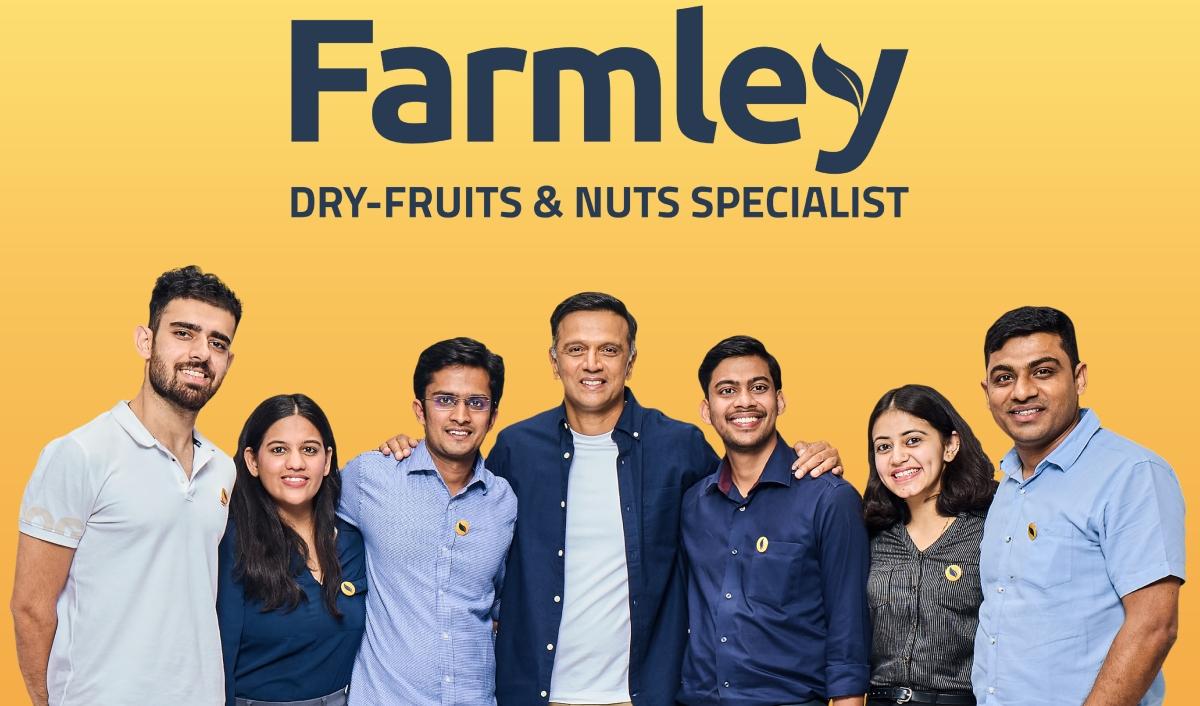
Farmley took a risky brand ambassador decision so as to convey credibility and trustworthiness to the mainstream India.
Former Indian cricket captain Rahul Dravid, who has a nationwide reputation of integrity, discipline and consistency, endorses Farmley. It would not be any more suitable that the face of a brand that was constructed on the very same values.
The Road between Snack Brand and Food Empire.
Farmley now has much greater ambitions than nuts and dried fruits. Farmley is about to take its next major step: to become not only a popular snacking brand but a full-scale food brand. Abhishek Agarwal identifies three key trends affecting consumer demand over the next 3-5 years: the increasing label awareness, the escalating movement away sugar, maida and palm oil, and the emergence of protein awareness.
One of the strategies is a new factory in Noida which is estimated to cost Rs 4050 crore and should be operational by FY27.
Co-founder Abhishek Agarwal says that expansion offline is among the top priorities and targeted to expand to 20,000 stores to 1.5 lakh stores in the next 18 months.
As nut market in India is projected to reach about 10 billion dollars by the end of decade, Farmley hopes to shift its product line to a holistic nutrition company.
The narrative of Farmley is not all about line charts and capital rounds. It is a story of two engineers who took a look at a faulty system and chose to repair it to farmers, consumers and the future of food in India.
Farmley didn't just sell snacks. They addressed a trust problem with the food supply chain. Indian consumers were sick and tired of poor quality and high priced dry fruits. Farmley was providing farm-to-fork freshness.
Farmley was a successful person and not because of hype. It was based on the knowledge of what the Indian consumers desired and provided it consistently.
Since its creation in 2017 based on personal savings and bootstrapping, to a Rs 394 crore revenue brand with support of international investors and endorsed by millions of households, the story of Farmley is an indication that the world pays attention to you when you are trying to solve a real issue and do so with sincerity.
The farm never did not know. Better was something the family needed. Farmley just got it to happen.
Quick Share