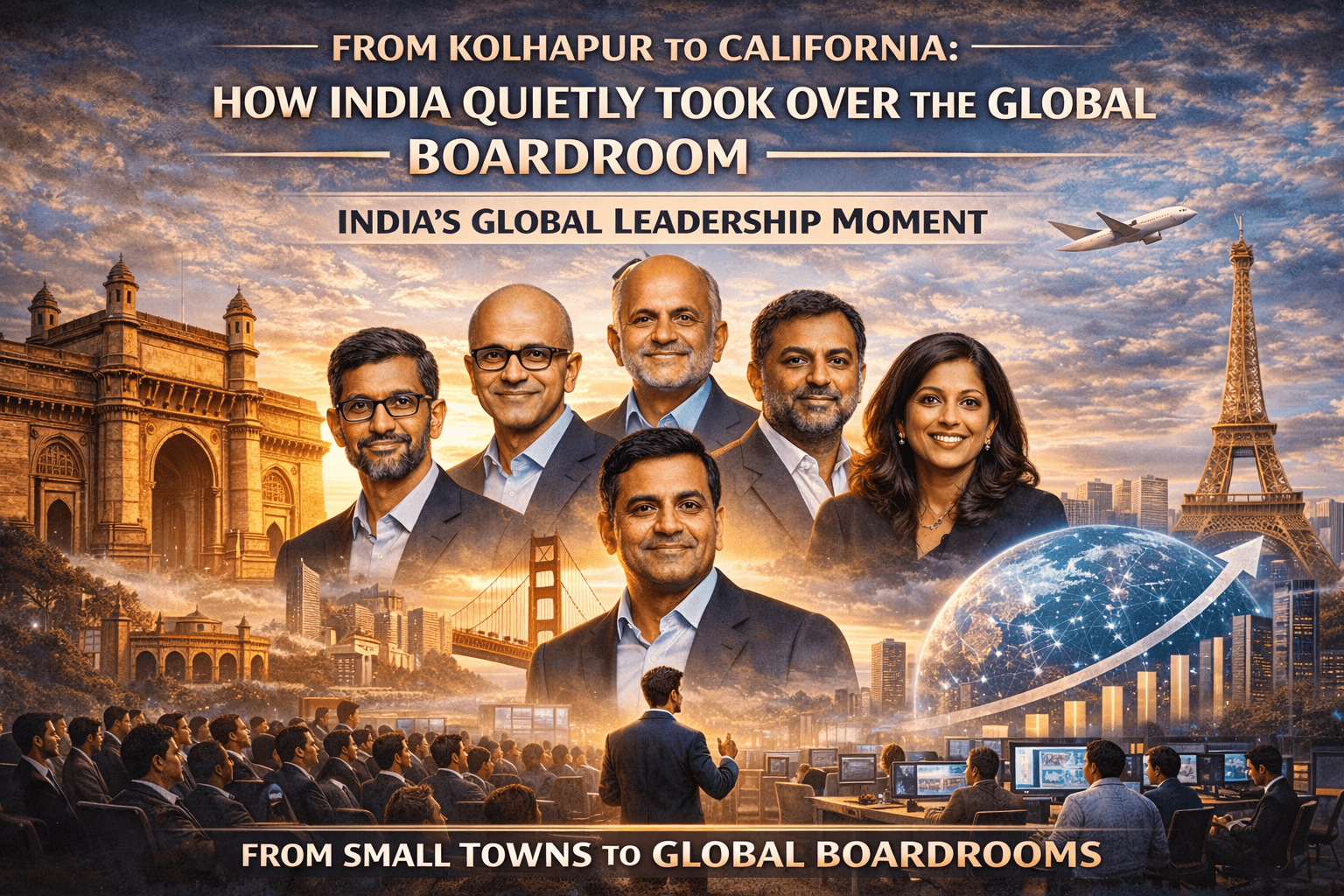
MUMBAI — The room was packed, the air thick with the quiet hum of high-stakes diplomacy. Addressing a cohort of global dignitaries, French President Emmanuel Macron delivered a remark that was less a compliment and more a declaration of a new world order:
“India does not just participate in global innovation. India leads the way.”
This wasn’t mere diplomatic floral arrangement. It was a recognition of a seismic shift in the global hierarchy. For decades, India was viewed as the world’s reliable engine room; today, it has moved to the bridge, steering the ship of global industry.
The sheer scale of Indian-origin leadership in 2026 is staggering. We are no longer talking about isolated success stories, but a systemic takeover of the world’s most critical sectors.
| Leader | Company | Sector |
| AI & Information | ||
| Cloud & Enterprise | ||
| Quantum & Hybrid Cloud | ||
| Digital Creativity | ||
| Cybersecurity | ||
| Global Luxury |
Combined, the market capitalization of companies led by Indian-origin CEOs exceeds $5 trillion. To put that in perspective, if these companies were a nation, they would constitute the third-largest economy in the world. From the silicon wafers of California to the couture ateliers of Paris, the "Indian Mindset" is now the standard for global governance.
Two decades ago, the focus was on outsourcing. Indian engineers were the world’s digital mechanics . They fixed Y2K bugs, maintained legacy systems, and wrote the code that drove Western innovation. They excelled at execution, but they rarely influenced strategy. Today, that narrative has changed. Indian leaders are no longer just writing code. They are shaping the ethics of Artificial Intelligence, the structure of Cloud Computing, and the future of Global Security. This shift from "Service Provider" to "Strategic Architect" shows India’s growth on the world stage.
The most inspiring element of this ascent is its pedigree. Most of these leaders did not start in gilded halls. They emerged from:
Modest Beginnings: Small-town roots and middle-class households where education was the only true currency.
The IIT-Lehigh-Stanford Pipeline : A rigorous foundational education in India followed by specialized global exposure.
The Resilience Factor: Growing up in a hyper-competitive environment fostered a unique "jugaad" (frugal innovation) tempered by world-class corporate discipline.
The "Brain Drain" concern of the 90s has changed into a "Global Brain Circulation." The achievements of these CEOs have created a mental guide for founders in Bengaluru, Gurgaon, and Pune. If an Indian professional can oversee a trillion-dollar legacy company, why can’t an Indian founder create one from scratch in their own country? We are already seeing the outcomes. India’s startup ecosystem is no longer just copying Western models. It is innovating in FinTech, SpaceTech, and AgriTech for the "next billion" users.
President Macron’s words reflect a reality that the markets have already recognized and adjusted for: innovation currently flows from India. For years, India was viewed as a source of talent, a place where global companies could find engineers and developers. Today, that view has changed completely. Indian talent is not only powering multinational corporations but is also guiding their strategic direction, driving the development of groundbreaking technologies, and influencing the global business landscape. This chapter features Indian-origin leaders managing some of the world’s most influential companies, from tech giants to luxury brands .
They make decisions that affect billions of users around the globe. But the story doesn’t stop there. The next chapter, already unfolding, promises something even greater: Indian companies stepping onto the global stage as multinationals, setting standards, creating products, and defining markets that others will strive to lead. This change is not temporary; it is here to stay. The momentum is clear, fueled by education, entrepreneurial spirit, and global experience. The world is finally noticing, acknowledging that India is no longer just involved in innovation—it is leading it.
As Indian companies and leaders continue to shape the future, the global business landscape will increasingly reflect the vision, strategy, and ambition that comes from India.
Follow Karostartup for more.
Quick Share