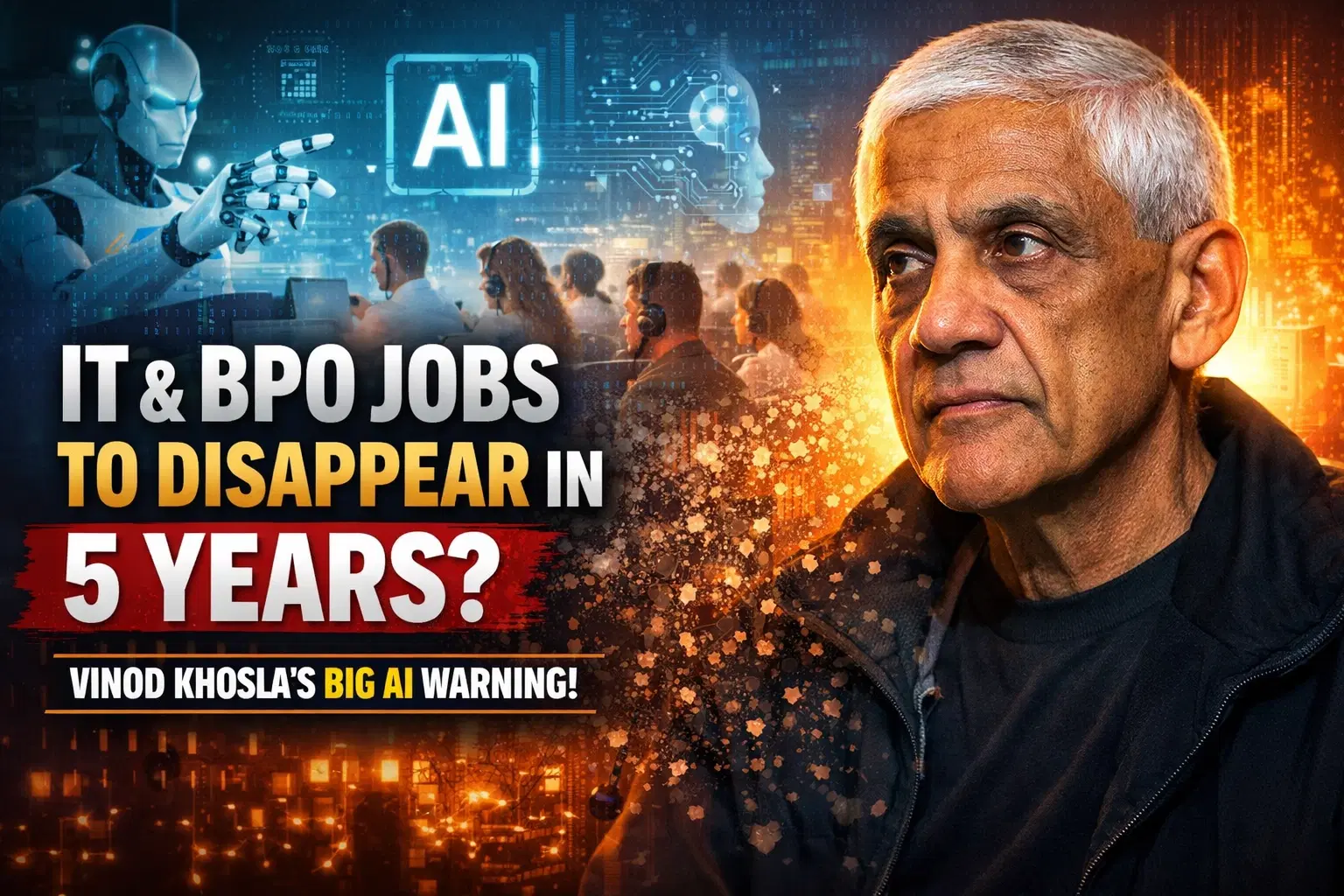
In a bold prediction that has sparked debate across the global technology ecosystem, Silicon Valley billionaire Vinod Khosla has warned that traditional IT and BPO services could largely disappear within the next five years due to rapid advancements in artificial intelligence.
Khosla, co-founder of Sun Microsystems and founder of Khosla Ventures, is known for backing disruptive technologies early. As one of the prominent early investors in OpenAI, his views on AI’s future impact carry significant weight in the startup and tech community.
According to the NASSCOM Strategic Review 2025, India’s technology industry workforce reached approximately 58 lakh employees in FY25, highlighting the massive scale of the country’s IT and digital services ecosystem. The report underscores how the sector continues to be one of India’s largest private employers, spanning IT services, BPO, engineering R&D, and emerging digital technologies. With millions of livelihoods dependent on the industry, any large-scale AI-led disruption — as predicted by tech investor Vinod Khosla — could have significant economic and employment implications.
The prediction is especially significant for India, whose economy has long been powered by its IT and outsourcing sectors. Industry giants such as Tata Consultancy Services, Infosys, and Wipro collectively employ millions and serve global enterprises.
If AI dramatically reduces the need for large-scale manpower in service-based models, the implications for employment and economic structure could be profound. The outsourcing industry, which once thrived on cost arbitrage and skilled labor, may need to reinvent itself around AI integration and high-value services.
However, Khosla’s prediction is not necessarily about job extinction but job transformation. While routine and repetitive roles may decline, new categories of work are emerging in the AI ecosystem.
Roles such as AI system supervisors, automation architects, AI ethics specialists, and prompt engineers are already gaining traction. Instead of eliminating work entirely, AI could shift demand toward creativity, strategic thinking, and technical oversight.
Historically, every technological revolution — from the internet boom to cloud computing — has disrupted traditional roles while simultaneously creating new industries. The AI revolution may follow a similar pattern, albeit at a much faster pace.
For startups and founders, the message is clear: adapt quickly or risk becoming obsolete.
AI-first business models, automation-led operations, and lean, technology-driven teams could define the next wave of successful companies. Startups that integrate AI deeply into their workflows may gain significant competitive advantages in cost efficiency and scalability.
As the debate continues, one thing is certain — artificial intelligence is no longer a future possibility. It is a present reality reshaping industries at unprecedented speed.
Vinod Khosla’s warning may sound dramatic, but it underscores a broader truth: the global workforce is entering one of the most transformative phases in modern economic history.
Follow Karostartup for more.
Quick Share